Topic Summary
AED 10,000 Penalty Per Incorrect Invoice
The Federal Tax Authority can fine UAE businesses AED 10,000 for each tax invoice with an incorrect or missing sequential number. Since VAT launched in 2018, documentation errors have driven a significant share of the over AED 50 million in total administrative fines issued.
Know Your VAT Registration Thresholds
Mandatory VAT registration kicks in at AED 375,000 in annual taxable turnover, with a 30-day window to register after crossing it. Voluntary registration is available from AED 187,500, and both carry identical invoicing obligations once registered.
Sequential Numbering Is Non-Negotiable
Every invoice number must be one integer higher than the last, with no gaps, jumps, or resets permitted across your entire VAT registration. The FTA will expect a documented explanation for any break in the number series during an audit, and a software reset is not an accepted defence.
Numbers Must Be Unique Across All Branches
If multiple branches or trading names share the same Tax Registration Number, the invoice numbering system must remain unified and non-duplicated across all of them. A consultancy issuing 200 invoices a month, for example, cannot allow any branch to reuse or overlap numbers.
Alphanumeric Series Are Allowed With Conditions
Non-sequential alphanumeric formats such as INV-2026-A-001 are permitted, but only if the series is predefined, consistently applied, and fully documented. Any deviation from the documented format can still trigger compliance issues during an FTA audit.
Retain Every Invoice for Five Years
UAE VAT law requires all tax invoices to be stored and retrievable for a minimum of five years from the date of issue. A missing invoice number is treated as a standalone administrative violation, separate from any underlying tax liability.
Build a Compliant System Before Your First Invoice
Setting up a documented, sequential numbering system from day one prevents costly retroactive corrections and audit exposure. A properly structured business foundation, including the right license type, helps ensure your invoicing obligations are met from the moment you register for VAT.
Since VAT launched on 1 January 2018, the Federal Tax Authority has issued penalties totalling over AED 50 million in administrative fines, with a significant share tied to documentation errors rather than unpaid tax. The AED 10,000 per-invoice penalty for incorrect tax invoice numbering in the UAE is one of the most frequently triggered. The mandatory registration threshold sits at AED 375,000 in annual taxable turnover, with a 30-day window to register after crossing it (Federal Tax Authority, 2024). Late registration alone carries a flat AED 10,000 penalty. This article covers exactly what UAE VAT law requires for tax invoice numbering, how to build a compliant system before your first invoice, and how a free zone license sets the right foundation from day one.
What Is Tax Invoice Numbering in the UAE and Why It Matters
Tax invoice numbering in the UAE is the mandatory system requiring every VAT-registered business to assign a unique, sequential number to each tax invoice it issues. Under UAE VAT law, this number must be traceable, non-duplicated, and retained for five years. Missing or incorrect numbers can trigger an AED 10,000 penalty per violation. For more detail, see our guide on UAE tax invoice rules and required details.
The Legal Basis Under UAE VAT Law
UAE Federal Decree-Law No. 8 of 2017 on VAT is the governing legislation. It mandates sequential numbering on every tax invoice issued by a VAT registrant from 1 January 2018 onward. The Federal Tax Authority (FTA) administers the law, audits compliance, and issues penalties under the schedule set by Cabinet Decision No. 40 of 2017.
The numbering requirement exists so the FTA can reconstruct your complete invoice trail during an audit. Every number must be unique to your VAT registration. A consultancy in Dubai issuing 200 invoices a month must ensure no number is skipped, reused, or duplicated across any branch or trading name sharing the same Tax Registration Number (TRN).
Who Must Comply: The VAT Registration Threshold
The obligation applies to every VAT-registered business, regardless of size. Here's where the thresholds sit:
Mandatory registration: AED 375,000 in annual taxable turnover
Voluntary registration: AED 187,500 in annual taxable turnover
Registration deadline: 30 days after the end of the month in which the threshold is crossed
Late registration penalty: AED 10,000 (one-time flat penalty)
A trading startup that crosses AED 375,000 in its first year must register within 30 days of the month end in which the threshold was exceeded. Businesses that register voluntarily carry identical invoicing obligations to mandatory registrants, the threshold only determines when you must register, not whether the rules apply.
The Sequential Numbering Rule: What the UAE Tax Invoice Requirements Actually Require
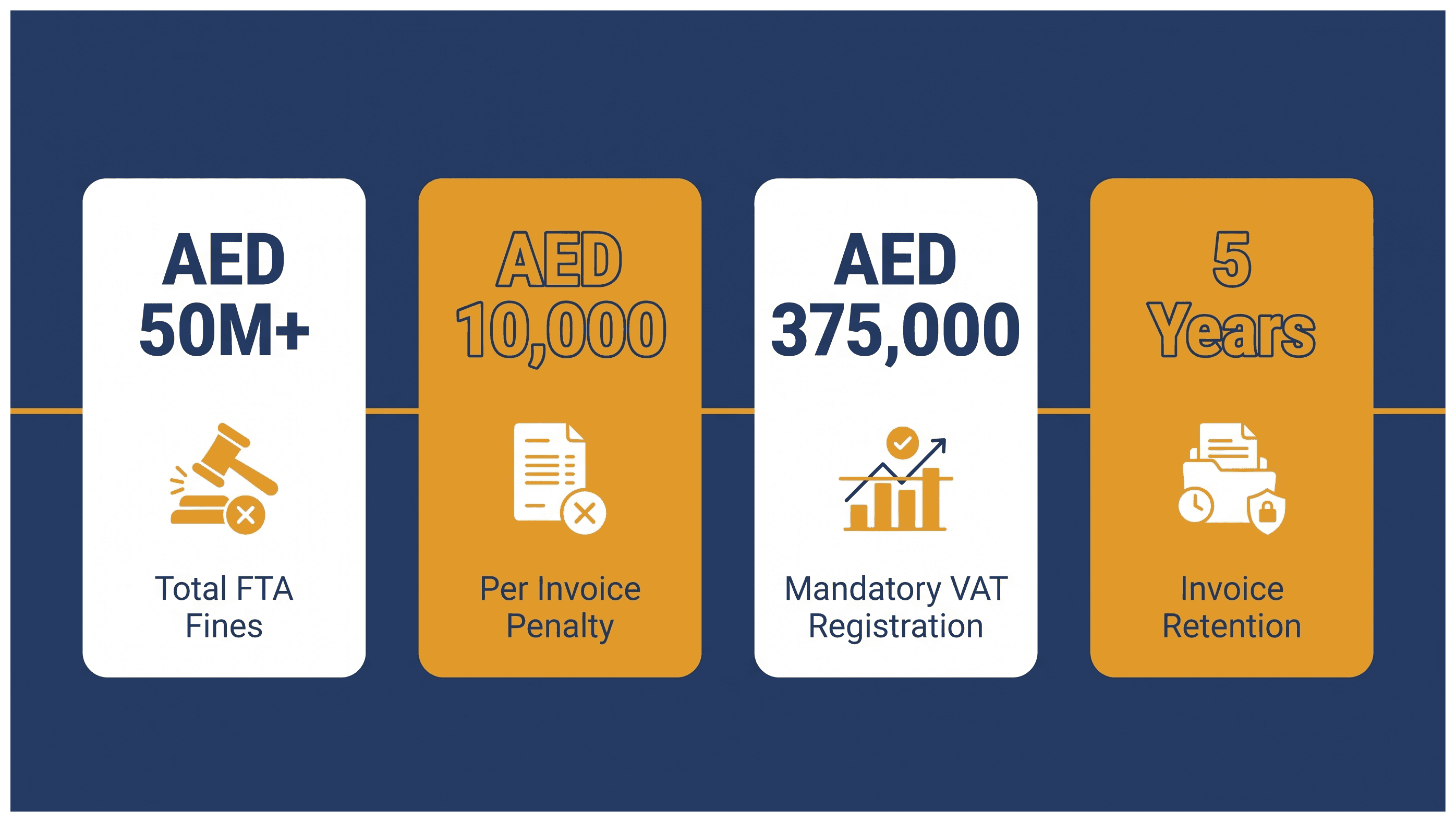
UAE tax invoice numbering must be sequential and unique across a registrant's full VAT account. Numbers cannot be reused, duplicated, or issued out of order. The FTA requires invoices to be retained for five years. A missing or duplicated invoice number is a standalone administrative violation carrying an AED 10,000 penalty.
Sequential vs. Non-Sequential Numbering: The Core Distinction
Sequential means each invoice number is one integer higher than the last. Gaps, jumps, or resets trigger audit flags. The FTA expects you to explain any gap in a number series during an audit, "the software reset" is not a defence.
Non-sequential alphanumeric codes (such as INV-2026-A-001) are permitted, but only if the series is predefined, documented, and consistently applied. An e-commerce business in Dubai using a system that auto-resets invoice numbers to 001 at the start of each month is non-compliant. The series must be continuous unless separate, fully documented series are maintained per branch with clear rationale on file.
Mandatory Fields Every Tax Invoice Must Carry
Tax invoice numbering in the UAE is one element of a broader set of mandatory fields. A full tax invoice must include:
The words "Tax Invoice" in Arabic or English
Supplier name, address, and TRN
Customer name, address, and TRN (for registered business customers)
A sequential invoice number unique to the supplier's VAT account
Date of issue and date of supply (if different)
A line-by-line description of goods or services with VAT calculated per line
A Dubai-based IT services company billing a corporate client must include both TRNs, the sequential number, and a full VAT breakdown. Omitting the customer's TRN on a B2B supply above AED 10,000 is a separate violation from a numbering error, each carries its own AED 10,000 exposure. For supplies under AED 10,000 to non-business customers, a simplified tax invoice is permitted.
Is a simplified tax invoice the same as a full tax invoice?
No. A simplified tax invoice is permitted only for supplies under AED 10,000 to non-business customers. It requires fewer fields and does not need the customer's TRN. All B2B supplies, regardless of value, require a full tax invoice with both TRNs and a sequential number.
6 Steps to Set Up a Compliant Tax Invoice Numbering System in the UAE
To set up a compliant tax invoice numbering system in the UAE: register for VAT before crossing AED 375,000 in turnover, assign a unique sequential series before issuing your first invoice, document your numbering logic, configure your accounting software, test for gaps, and store all invoices for five years.
Step 1: Register for VAT and Obtain Your TRN
Apply through the FTA's EmaraTax portal at tax.gov.ae before or immediately after crossing AED 375,000 in taxable turnover. You have 30 days from the end of the month in which you exceeded the threshold. A professional services firm that hits AED 380,000 in June must submit its VAT registration application by 31 July at the latest. Your TRN must appear on every tax invoice from the registration date forward.
Step 2: Define and Document Your Invoice Series
Choose a single continuous series (e.g., INV-00001 onward) or separate documented series per branch or entity
Write the numbering logic into your accounting policy before issuing invoice number one
Disable manual overrides in your accounting software and configure the starting number
A trading company with a free zone branch and a mainland branch can run FZ-00001 and ML-00001 as separate series, provided both are documented and each series stays unique and sequential
The five-year retention obligation applies to the numbering logic documentation itself, not just the invoices
UAE Tax Invoice Compliance Calendar: Key Deadlines and Penalties
Compliance Event | Deadline / Requirement | Penalty for Missing |
|---|---|---|
VAT registration after crossing AED 375,000 threshold | 30 days after end of threshold month | AED 10,000 late registration penalty (one-time flat) |
Monthly VAT return filing and payment | 28th of the following month | Late filing and late payment penalties apply |
Quarterly VAT return filing and payment | 28th of the month after quarter end | Late filing and late payment penalties apply |
Tax invoice issuance with sequential number | At point of supply | AED 10,000 per incorrect or non-compliant invoice |
Tax invoice and record retention | Minimum 5 years from date of supply | AED 10,000 for failure to retain |
Response to FTA correspondence | Within period stated in FTA notice (typically 20 business days) | Penalties for non-response vary by notice type |
Steps 3 to 6: Configure, Test, Retain, and Audit Regularly
Configure your accounting software. Disable auto-reset features and set up alerts for duplicate numbers. Cloud-based platforms such as Zoho Books or QuickBooks, configured for UAE VAT, auto-generate sequential numbers and flag duplicates before an invoice is issued.
Issue a test invoice. Verify the number sequence, TRN display, and VAT calculation before going live. Fix errors at this stage, not after the FTA does.
Store all tax invoices for five years. Paper or electronic copies both qualify, but you need a backup. Loss of records is treated as non-retention by the FTA, carrying its own AED 10,000 penalty.
Run a quarterly internal audit. Compare your invoice register against your VAT return output tax figure before each submission. Catching gaps yourself is always less costly than an FTA-initiated audit.
Penalties for Non-Compliant Tax Invoice Numbering in the UAE
The FTA charges AED 10,000 for each tax invoice that is incorrect, missing a mandatory field, or carries a duplicated or non-sequential number. There is no grace period for first-time violations once a business is VAT-registered. Repeated violations can trigger a full VAT audit and compound penalties across every non-compliant invoice.
The AED 10,000 Per-Invoice Penalty Explained
Cabinet Decision No. 40 of 2017 sets the administrative penalties schedule. Issuing an invoice without a sequential number, with a missing TRN, or with a duplicate number each constitute separate violations, not a single combined penalty. A business issuing 50 non-compliant invoices in one VAT period faces a theoretical exposure of AED 500,000. The FTA does not cap total penalties per audit cycle; each invoice is assessed individually.
Consider a startup audited after 18 months of trading that had been resetting invoice numbers monthly. Every invoice issued in those reset months carries a potential AED 10,000 penalty. That's the kind of exposure that makes proper tax invoice numbering in the UAE worth prioritising from invoice number one.
What happens if you voluntarily disclose a numbering error before an audit?
Voluntary disclosure through the FTA's EmaraTax portal reduces penalty exposure compared to a post-audit correction. The FTA treats proactive disclosure as a mitigating factor. It does not eliminate the penalty entirely, but it is consistently less costly than waiting for the FTA to find the error first.
How Tax Invoice Numbering Applies When You Set Up in a Free Zone
Free zone companies registered for VAT in the UAE carry identical tax invoice numbering obligations to mainland businesses. The free zone license determines your legal entity and registered address, but VAT compliance, including sequential invoice numbering, TRN display, and five-year retention, is governed solely by the FTA, not the free zone authority.
Free Zone VAT Status and Invoice Obligations
A free zone company making taxable supplies to UAE mainland customers must register for VAT once turnover crosses AED 375,000. Supplies between UAE Cabinet-designated zones may be zero-rated under specific conditions, but the invoice must still carry a sequential number and a zero-rate notation.
Dubai South Business Hub Free Zone (DSBH) is not a designated zone, so standard VAT rules apply to all supplies made by DSBH-licensed companies. A DSBH-licensed technology consultancy billing AED 50,000 per month to a Dubai mainland client is making a standard-rated taxable supply and must issue a fully compliant, sequentially numbered tax invoice at 5% VAT. Every DSBH-licensed company that crosses the AED 375,000 threshold must register with the FTA independently and maintain its own sequential invoice series.
Getting Your License and VAT Setup Right From Day One
Your trade license is the legal prerequisite for FTA registration, you cannot obtain a TRN without one. At DSBH, the license is issued in one business day, so your VAT registration application can follow almost immediately. A founder who receives their DSBH license on a Monday can submit the VAT registration on Tuesday and have a TRN in place before issuing invoice number one.
If you anticipate crossing AED 187,500 in turnover within 30 days of launch, voluntary registration at the outset avoids a last-minute compliance scramble. DSBH packages start from:
0 Visa Package: AED 12,500, includes license, Articles of Association, share register, flexi-desk space
1 Visa Package: AED 16,350, adds one investor visa allocation and establishment card
2 Visa Package: AED 18,200, adds two investor visa allocations and establishment card
Visa processing (entry permit, status change, medical, Emirates ID) is quoted separately. You can review the business setup cost in Dubai using the DSBH cost calculator before committing.
Common Tax Invoice Numbering Mistakes UAE Businesses Make
The most common tax invoice numbering mistakes in the UAE include resetting number series at year-end, issuing duplicate numbers across software systems, omitting the TRN on B2B invoices above AED 10,000, using handwritten invoice books without a documented series, and failing to retain voided invoice records within the five-year window.
System Errors That Create Compliance Risk
Accounting software that auto-resets at financial year end creates a duplicate series mirroring the prior year, a common trigger for FTA queries. A services business that switched accounting software mid-year and restarted its invoice series at 001 in the new system ended up with two sets of INV-00001 through INV-00150 in the same VAT period. That's a clear compliance failure with penalty exposure on every duplicate.
Voided or cancelled invoices must be retained with a "void" notation. Deleting them creates an unexplained gap in the series. Both your old and new systems must either share a single continuous series or maintain separately documented series with a clear rationale on file.
Procedural Errors That Auditors Spot Quickly
Issuing receipts or delivery notes as substitutes for tax invoices without mandatory fields
Using the same invoice number for a credit note and
References
Frequently Asked Questions