
Topic Summary
Understand the Five-Year VAT Retention Rule
UAE VAT law requires businesses to keep tax invoices for a minimum of five years from the end of the tax period in which the transaction occurred, not simply from the invoice date. This means quarterly filers must maintain staggered archiving schedules rather than a single annual cull.
Corporate Tax Adds a Seven-Year Obligation
Federal Decree-Law No. 47 of 2022 on Corporate Tax introduced a parallel seven-year record retention requirement that sits on top of the VAT five-year rule. Finance teams must satisfy both timelines simultaneously, keeping the longer obligation in mind for any document that falls under both laws.
Real Estate Records Require 15-Year Retention
Businesses involved in real estate activities face a significantly extended deadline of 15 years for tax invoice retention. This fixed deadline applies regardless of company size or filing frequency and cannot be shortened at the business's discretion.
Know the Penalty Tiers for Non-Compliance
A first record-keeping violation carries a penalty of AED 10,000, while a repeat violation within 24 months escalates to AED 50,000. Critically, these penalties apply even when no additional VAT is owed, making missing invoices a standalone legal risk.
Retain a Broader Range of Documents Than Expected
The retention rules cover far more than just sales invoices, including received invoices, credit and debit notes, customs declarations, bills of lading, contracts, and general ledgers. Tagging each document type at the point of receipt makes retrieval significantly faster if an audit notice arrives.
Prepare for Tight FTA Audit Response Windows
When the Federal Tax Authority issues an audit notice, businesses typically have only 5 to 20 business days to produce all requested records. Dubai free zone companies are equally exposed, so having an organized, readily accessible archive is essential to meeting these deadlines.
Retain Records Longer When Disputes Are Active
The FTA can extend its audit window beyond the standard five years in cases of suspected fraud or ongoing disputes. Businesses should consider retaining records past the minimum period whenever a transaction or period remains unresolved.
In 2026, the Federal Tax Authority can issue a VAT audit notice covering any return filed in the past five years, and if your tax invoices are missing, the default penalty starts at AED 10,000 per violation (Federal Tax Authority, 2026). For Dubai free zone companies, that exposure is real and entirely avoidable. The UAE introduced VAT in January 2018 under Federal Decree-Law No. 8 of 2017, and the record-keeping rules have carried legal teeth since day one. Corporate tax, introduced under Federal Decree-Law No. 47 of 2022, added a parallel seven-year retention obligation on top. A first record-keeping violation costs AED 10,000; a repeat within 24 months costs AED 50,000. Real estate records must be kept for 15 years. This guide covers what tax invoice retention UAE rules require, the exact deadlines that apply, how VAT and corporate tax obligations interact, and the practical steps finance managers can take to stay audit-ready.
What Is Tax Invoice Retention in the UAE and Why It Matters
Tax invoice retention in the UAE is the legal obligation for VAT-registered businesses to keep tax invoices, credit notes, and related records for a minimum of five years from the end of the relevant tax period. The Federal Tax Authority uses these documents as primary evidence during audits and assessments (Federal Tax Authority, 2026).
The Legal Basis for Retention Obligations
Three separate laws create the retention framework. UAE Federal Decree-Law No. 8 of 2017 on VAT and its Executive Regulation set the five-year minimum. Federal Decree-Law No. 47 of 2022 on Corporate Tax adds a parallel seven-year obligation. The Tax Procedures Law, Federal Decree-Law No. 7 of 2017, gives the FTA authority to request any retained document during an audit.
Critically, both laws treat failure to retain records as a standalone violation, independent of whether a tax shortfall exists. You can owe zero additional VAT and still face an AED 10,000 penalty for missing invoices.
Consider this scenario: a trading company in a Dubai free zone receives a VAT audit notice in March 2026 covering January 2021 to December 2025. Every invoice from that entire window must be available within the timeframe the FTA specifies in its notice, typically 5 to 20 business days.
Which Documents Fall Under the Retention Rules
The scope is broader than most finance teams expect. Both issued and received invoices are in scope, and customs documentation counts as a supporting record. Documents you must retain include:
Tax invoices (standard and simplified) issued and received
Tax credit notes and debit notes
Import and export records, customs declarations, and bills of lading
Accounting records, trial balances, and general ledgers
Contracts, agreements, and correspondence supporting the transaction value
For banking and taxation workflows, tagging each document type at the point of receipt saves significant time when an audit notice arrives.
The 5-Year Retention Rule: Tax Invoice UAE Deadlines and Thresholds
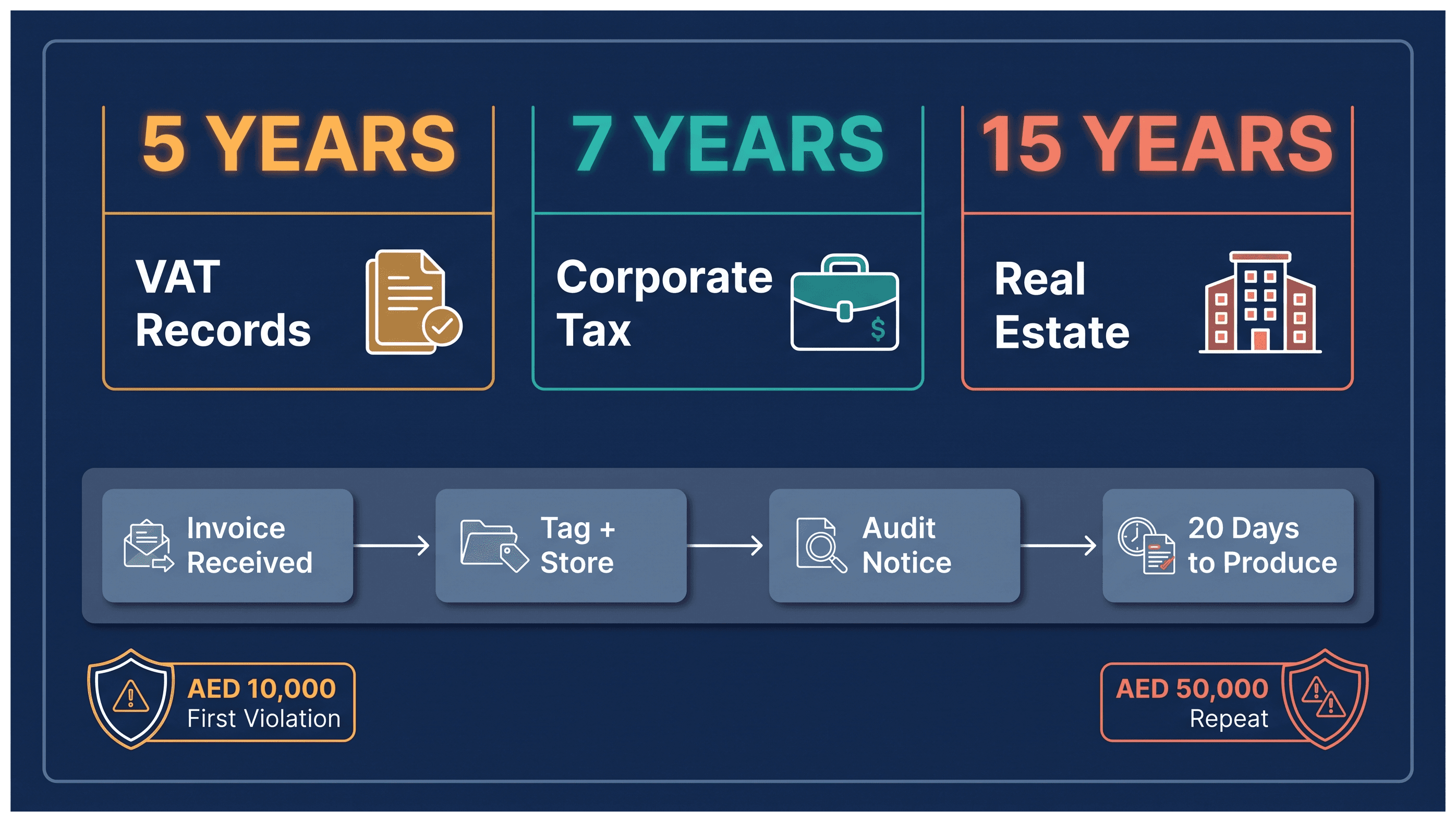
UAE VAT law sets a five-year minimum retention period for tax invoices, measured from the end of the tax period in which the transaction occurred. For real estate activities, the tax invoice UAE deadline extends to 15 years. These deadlines are fixed; there is no discretion to shorten them (UAE Cabinet, 2017).
How the Five-Year Clock Is Calculated
The clock starts from the end of the tax period, monthly or quarterly, in which the invoice relates, not the invoice date itself. A services company filing quarterly retains invoices from Q1 2021 (January to March 2021) until the end of Q1 2026 at the earliest, not from the date each invoice was issued.
For monthly filers, each month's invoices have their own end-date. That means staggered archiving schedules are necessary rather than a single annual cull. The FTA can also extend the audit window in cases of suspected fraud, so retaining records beyond the standard period is advisable wherever disputes are ongoing.
Real Estate and Capital Assets: The 15-Year Exception
Article 79(2) of the UAE VAT Executive Regulation extends the retention period to 15 years for real estate-related records. This covers purchase invoicess, and records used to calculate input tax adjustments under the Capital Assets Scheme.
Companies with mixed portfolios, both real estate and non-real estate activities, must apply the correct period to each document category separately. Misfiling real estate records under the five-year rule is one of the most common compliance gaps identified in FTA audits. If your real estate license covers brokerage or property management, the 15-year rule applies to every relevant invoice from the date of your first transaction.
Corporate Tax Records and How Retention Obligations Overlap
The UAE Corporate Tax Law requires taxable persons to retain financial statements, supporting schedules, and underlying records for seven years from the end of the relevant financial year. Where a single document satisfies both VAT and corporate tax requirements, the longer seven-year window applies to that document (Ministry of Finance, 2022).
The Seven-Year Corporate Tax Retention Period
Federal Decree-Law No. 47 of 2022 sets a seven-year minimum for records supporting corporate tax returns. The period runs from the end of the tax period to which the records relate. Records in scope include financial statements, transfer pricing documentation, related-party transaction schedules, and depreciation schedules.
Worth flagging: exempt persons and those below the AED 375,000 taxable income threshold (which attracts the 0% rate) are still subject to record-keeping obligations even if no tax is owed. The obligation follows registration, not liability.
Where VAT and Corporate Tax Records Converge
A standard tax invoice is simultaneously a VAT document and a supporting record for corporate tax revenue recognition. The rule is simple: apply the longer of the two periods. Seven years overrides five years for any document that serves both purposes.
Here's a concrete example. A technology company licensed in Dubai South Business Hub issues a tax invoice in February 2024. Under VAT rules, it must be kept until at least the end of Q1 2029. Under corporate tax rules, it must be kept until the end of financial year 2031. The seven-year window governs, full stop.
Finance managers should tag records by applicable law at the point of filing to avoid premature disposal. Free zone companies qualifying for the 0% Qualifying Free Zone Person rate must simultaneously satisfy four conditions, Qualifying Income, adequate substance, the de minimis non-qualifying revenue threshold, and no election to apply the standard rate, and all four require supporting documentation retained for seven years.
Step-by-Step Compliance Guide for Tax Invoice Retention in the UAE
To comply with UAE tax invoice retention rules, classify each document by applicable law, apply the correct retention period (five, seven, or 15 years), store records in a retrievable format, and audit your archive annually. A written retention policy signed off by management is the baseline the FTA expects to see. This tax invoice UAE guide gives you the framework to build that system from scratch.
Steps to Build a Compliant Retention System
Classify every record type in your chart of accounts as VAT-only (5 years), corporate tax-only (7 years), dual-purpose (7 years), or real estate (15 years).
Assign a destruction date to each document category at the point of filing. Do not leave this to a future decision, the date is calculable the moment the tax period closes.
Choose a storage medium, cloud, on-premise server, or physical archive, that meets the FTA's accessibility and integrity standards.
Implement access controls so records cannot be altered after filing. Use version-controlled or read-only formats for electronic files.
Schedule an annual internal audit of the archive to confirm completeness and flag any gaps before they become FTA findings.
Electronic Storage: What the FTA Accepts
Electronic records are fully accepted. They must be complete, unaltered, and readable within the FTA's specified timeframe.
Scanned copies of paper invoices are acceptable if legible and original metadata is preserved.
Cloud storage hosted outside the UAE is permitted. You must retrieve and present records from a UAE location on request.
Encryption is acceptable. Supply the decryption key or a readable export during any audit.
There is no physical storage requirement. The FTA's standard is readable format on request, nothing more, nothing less. For business support with document management workflows, specialist advisers can help you map your record types to the correct retention periods before your first FTA filing.
Penalties for Non-Compliance: Figures Every Finance Manager Should Know
The Federal Tax Authority imposes AED 10,000 for a first failure to maintain required tax records and AED 50,000 for a repeat violation within two years. These penalties apply per violation, not per missing invoice, and are separate from any tax shortfall or late-payment surcharge. Tax invoice retention UAE compliance failures are treated as standalone offences (UAE Cabinet Decision No. 40 of 2017, as amended).
The Penalty Scale and How It Compounds
The penalty structure under Cabinet Decision No. 40 of 2017 works on a per-violation basis. A first violation for failure to keep required records costs AED 10,000. A repeat violation of the same kind within 24 months costs AED 50,000. Penalties stack: a company missing records across three separate tax periods can face three independent first-violation penalties.
The FTA can also disallow input tax credit claims where the supporting invoice cannot be produced. That creates a secondary financial exposure beyond the fixed penalty, potentially significant for companies with large monthly input tax positions.
Here's a real-world scenario: a finance manager discovers that purchase invoices from Q2 and Q3 2022 were deleted during a server migration. Two separate violations result. The first costs AED 10,000. If the FTA treats the second as a repeat violation, it costs AED 50,000. Total fixed exposure: AED 60,000, before any disallowed input tax is calculated.
UAE Tax Record Retention Compliance Calendar
Obligation | Trigger Event | Retention Period and Earliest Destruction |
|---|---|---|
Standard VAT invoices | End of the VAT tax period (monthly or quarterly) | 5 years from period end, e.g. Q4 2020 invoices: retain until 31 December 2025 |
Real estate invoices | End of the VAT tax period in which the transaction occurred | 15 years from period end, per Article 79(2) of the VAT Executive Regulation |
Corporate tax records | End of the financial year to which the records relate | 7 years from financial year end, per Federal Decree-Law No. 47 of 2022 |
Dual-purpose invoices (VAT + Corporate Tax) | End of the later applicable period under either law | 7 years from the later period end, the longer window always governs |
Post-deregistration VAT records | Date of VAT deregistration with the FTA | 5 years from deregistration date, obligation survives the cancellation of registration |
Annual archive review | Q1 each year | Confirm no premature disposal; flag records entering the FTA's five-year audit window |
VAT and Corporate Tax Late Registration: Separate Penalties
Late VAT registration carries a flat AED 10,000 penalty. Late corporate tax registration carries a separate AED 10,000 flat, one-time penalty. These are entirely distinct from record-keeping penalties and do not offset each other, a company that registers late for both faces AED 20,000 in registration penalties before any record-keeping violation is counted.
If your company needs support with FTA registration or wants to review its current compliance position, business support services at Dubai South Business Hub can connect you with qualified tax advisers.
Tax Invoice Retention UAE: Compliance Calendar
A compliance calendar for UAE tax invoice retention maps each obligation to its trigger date, retention end date, and responsible owner. Finance managers should maintain a rolling schedule that updates automatically when new tax periods close, flagging records approaching their destruction date and those entering an audit risk window. The table in the previous section gives you the framework; this section explains how to operate it.
Annual Compliance Calendar for Record Retention
The table above covers the core obligations. In practice, a working compliance calendar should also include: a Q1 review of all records approaching their destruction date; a mid-year check confirming that new document types added to the business are classified correctly; and a year-end reconciliation confirming that every tax period's archive is complete before the next period opens.
If you're planning to start a business in Dubai, build your retention infrastructure before your first VAT return, not after your first audit notice.
How Free Zone Companies in Dubai Handle Retention Requirements
Dubai free zone companies registered for UAE VAT face identical tax invoice retention obligations to mainland entities: five years for standard records, seven years where corporate tax applies, and 15 years for real estate. Free zone status does not create any exemption from Federal Tax Authority record-keeping rules (UAE Government Portal, 2026).
VAT Registration Thresholds That Trigger Retention Duties
The mandatory VAT registration threshold is AED 375,000 in taxable supplies over any 12-month period. The voluntary threshold is AED 187,500, companies below mandatory but above voluntary can register and must then retain records from their registration date. Once registered, retention obligations apply from the first tax period, regardless of whether any VAT was actually collected.
De-registered companies must retain records for five years from the date of deregistration. The obligation doesn't end when the registration does.
Practical Considerations for DSBH-Licensed Companies
Dubai South Business Hub issues a trade license in one day. VAT registration with the FTA is a separate process that the company must complete independently once it meets the relevant threshold. These are two distinct steps with two distinct timelines.
Free zone companies operating across both UAE mainland and free zone supply chains must retain records for
References
Frequently Asked Questions