Topic Summary
What Is UAE VAT for E-Commerce Business and Why It Matters
UAE VAT for an e-commerce business is a 5% consumption tax on taxable online sales of goods and services. Registration with the Federal Tax Authority (FTA) is mandatory above AED 375,000. Correct classification of each sale directly affects your margins and compliance.
How Marketplace Sales and Cross-Border Supply Are Taxed
How Marketplace Sales and Cross-Border Supply Are Taxed
Step-by-Step VAT Registration for an E-Commerce Business
To complete VAT registration for an e-commerce business, create an EmaraTax account, gather your license and sales records, apply, then receive your Tax Registration Number (TRN). Most applications are decided within about 20 business days [1].
Zero Rated VAT UAE for Cross-Border E-Commerce Supply
Zero rated VAT UAE treatment means 0% VAT on qualifying supplies, such as exported goods, while you still reclaim input VAT. Exempt supplies allow no recovery. You need proof of export to support the zero rate.
How a Free Zone License Fits Into Your VAT Setup
A free zone license from Dubai South Business Hub doesn't exempt you from UAE VAT for e-commerce business. Registration depends on turnover, though Designated Zone goods movements can get special treatment. Corporate tax and VAT are separate, and your business isn't tax free.
What UAE VAT for E-Commerce Business Costs and How Long It Takes
The FTA charges no application fee. Your costs are accounting software, filing support and penalties. Registration takes about 20 business days. Late registration costs AED 10,000 and a first late filing AED 1,000 (FTA, 2026).
Common Mistakes and What to Do Next
The most common UAE e-commerce VAT mistakes are late registration, mixing zero-rated and exempt supplies, missing export evidence and non-compliant invoices. Track turnover monthly, keep shipping records and use correct tax codes.
UAE VAT for e-commerce business is charged at a 5% standard rate, and registration becomes mandatory once taxable supplies and imports pass AED 375,000 over 12 months [1]. Voluntary registration starts at AED 187,500 [1]. Exports of goods and qualifying services can be zero-rated.
More than 350,000 businesses are VAT-registered in the UAE [2], and online sellers often misjudge the trigger date. A late registration penalty of AED 10,000 applies (FTA, 2026) [1]. This guide helps finance and operations staff register, invoice, file and classify sales correctly.
What Is UAE VAT for E-Commerce Business and Why It Matters
UAE VAT for an e-commerce business is a 5% consumption tax on taxable online sales of goods and services. Registration with the Federal Tax Authority (FTA) is mandatory above AED 375,000. Correct classification of each sale directly affects your margins and compliance.
How the 5% Standard Rate Applies to Online Sales
The 5% standard rate covers domestic B2C and B2B sales of goods and most services. Prices shown to UAE consumers should be VAT-inclusive. Take a AED 200 item: AED 190.48 net plus AED 9.52 VAT.
Charge 5% on domestic sales.
Show VAT-inclusive prices.
Recover input VAT on stock, ads, logistics and platform fees.
The AED 375,000 Mandatory Registration Threshold
The test looks at taxable supplies and imports over the previous 12 months, or what you expect in the next 30 days. Say your Shopify and marketplace sales reach AED 410,000. You must apply within 30 days of crossing the line. Voluntary registration from AED 187,500 lets you recover input VAT earlier. See our UAE VAT registration guide for more.
How Marketplace Sales and Cross-Border Supply Are Taxed
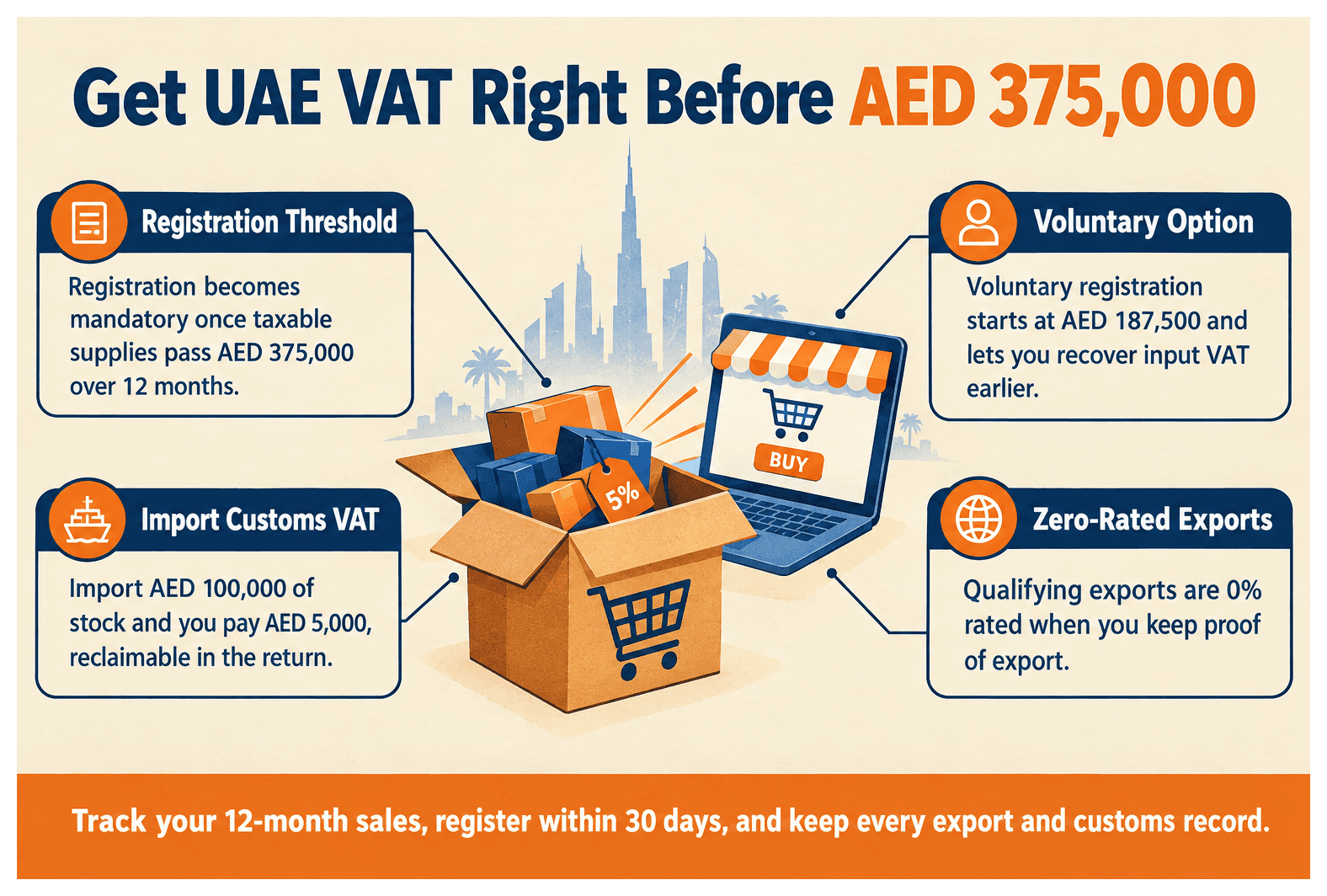
Marketplace sales to UAE buyers carry 5% VAT, and the seller generally accounts for it unless the platform is the supplier of record. For UAE VAT for e-commerce business, place of supply decides cross-border cases. Exports with evidence can be zero-rated, while imports are taxed at the border.
Who Charges VAT on Marketplace Orders
Check whether the platform acts as seller of record or as your agent. Commission and fulfilment fees carry 5% input VAT. A seller on a regional marketplace should match AED commission invoices to payout statements, then reclaim that tax in the return.
Imports, Courier Shipments and Customs VAT
Customs collects 5% on imported goods. Import AED 100,000 of stock and you pay AED 5,000, which a registered seller reclaims in the return. Keep every customs declaration as evidence.
Selling to Customers in Other GCC Countries
Qualifying exports are 0% rated with proof of export. Destination VAT and customs rules may still apply, so check the implementing-state treatment before shipping. A UAE seller sending to Saudi Arabia should keep the shipping documents.
Step-by-Step VAT Registration for an E-Commerce Business
To complete VAT registration for an e-commerce business, create an EmaraTax account, gather your license and sales records, apply, then receive your Tax Registration Number (TRN). Most applications are decided within about 20 business days [1].
Step 1: Confirm Your Taxable Turnover
Add domestic, zero-rated and imported supplies across Amazon, Noon and your own site over a rolling 12 months. Compare the total with AED 375,000 and AED 187,500, then decide mandatory or voluntary.
Step 2: Prepare Documents and Apply on EmaraTax
You'll need the trade license, Emirates ID and passport of the owner, bank details and turnover evidence. A Dubai South Business Hub licensee uploads the free zone license and bank letter through the FTA portal.
Step 3: Receive Your TRN and Set Up Invoicing
Show the TRN on every tax invoice. Configure 5% and 0% codes in your store and accounting software. Our guide on how to issue a correct tax invoice lists the required fields.
Step 4: File Returns and Keep Records
Returns are due within 28 days of period end. Keep records for 5 years and reconcile marketplace payouts monthly. Our VAT return filing for Dubai companies article covers the rules.
Zero Rated VAT UAE for Cross-Border E-Commerce Supply
Zero rated VAT UAE treatment means 0% VAT on qualifying supplies, such as exported goods, while you still reclaim input VAT. Exempt supplies allow no recovery. You need proof of export to support the zero rate.
Zero-Rated Versus Exempt Supplies
Registered sellers still report zero-rated sales. An exporter might reclaim AED 8,000 of input VAT on stock tied to zero-rated shipments. Exempt sales give you no such recovery.
Evidence Needed to Support the Zero Rate
Commercial invoice.
Airway bill or shipping document.
Customs export declaration.
Payment records matching the customer.
Store these for 5 years, for example per shipment to a UK buyer.
Services Exported Outside the UAE
Services can be zero-rated when the customer is outside the UAE and doesn't use the service there. A Dubai agency billing a US client for ad management should review the conditions in our guide to UAE VAT on services exported outside the UAE.
How a Free Zone License Fits Into Your VAT Setup
A free zone license from Dubai South Business Hub doesn't exempt you from UAE VAT for e-commerce business. Registration depends on turnover, though Designated Zone goods movements can get special treatment. Corporate tax and VAT are separate, and your business isn't tax free.
Free Zone Status Does Not Remove VAT Duties
Free zone companies face the same AED 375,000 threshold. A Dubai South licensee selling online to UAE consumers charges 5% once registered. Designated Zone rules cover only specific goods and conditions.
UAE E-Commerce VAT Treatment, Rates and Penalties in AED
Feature | Item | Rate or Amount (AED, with date) |
|---|---|---|
Standard VAT rate (5%) | Applies to domestic online sales | 5%, AED 9.52 on a AED 200 VAT-inclusive item (2026) |
Mandatory registration threshold (AED 375,000) | Taxable supplies and imports over 12 months | AED 375,000 (2026) |
Voluntary registration threshold (AED 187,500) | Early input VAT recovery | AED 187,500 (2026) |
Late registration penalty (AED 10,000) | Applies after the 30-day window | AED 10,000 (FTA, 2026) |
First late filing penalty (AED 1,000) | First missed return deadline | AED 1,000 (FTA, 2026) |
Choosing a Structure Before You Register
Free zone and mainland sellers share the same VAT rate and threshold. The differences lie in licensing and selling access, as our free zone vs mainland for an e-commerce business comparison explains. Use the cost calculator to estimate license and visa package costs before you apply.
What UAE VAT for E-Commerce Business Costs and How Long It Takes
The FTA charges no application fee. Your costs are accounting software, filing support and penalties. Registration takes about 20 business days. Late registration costs AED 10,000 and a first late filing AED 1,000 (FTA, 2026).
Registration, Filing and Penalty Costs in AED
Register 60 days late and you face AED 10,000, against a minimal compliance cost for registering on time. Verify fee amounts on the FTA site before you act.
Timeline From Application to First Return
Apply in January and expect a decision in about 20 business days. Your first return is due 28 days after the first tax period ends. Set up your accounting before that first filing.
Common Mistakes and What to Do Next
The most common UAE e-commerce VAT mistakes are late registration, mixing zero-rated and exempt supplies, missing export evidence and non-compliant invoices. Track turnover monthly, keep shipping records and use correct tax codes.
Mistakes That Trigger FTA Penalties
Leaving marketplace or website sales out of the threshold count.
Charging 5% on qualifying exports, or 0% on domestic sales.
Omitting the TRN from invoices.
One seller forgot website sales and registered 45 days late, which cost AED 10,000.
Your Next Steps Before You Launch
Run your trade name through the name check.
Estimate costs with the cost calculator.
Schedule VAT registration for your license issue month.
Speak to Dubai South Business Hub about forming your free zone company today.
UAE VAT for e-commerce business comes down to the 5% rate, the AED 375,000 threshold, correct marketplace and cross-border treatment, and solid zero rated VAT UAE evidence. A free zone license doesn't remove VAT duties.
References
Federal Tax Authority, 2026
Ministry of Finance, 2026
Statista, 2025
Frequently Asked Questions