
Topic Summary
Know the AED 375,000 Registration Threshold
Mandatory VAT registration kicks in once your taxable supplies or imports exceed AED 375,000 in any 12-month period. Missing the registration deadline triggers an automatic AED 10,000 flat penalty with no warning letter issued beforehand.
File and Pay Within 28 Days of Period End
VAT returns must be submitted through the FTA's EmaraTax portal within 28 days of each tax period end, with any net VAT due paid by the same deadline. Most Dubai companies are assigned a quarterly cycle ending on 31 January, 30 April, 31 July, and 31 October.
Understand Output Tax Minus Input Tax
Your net VAT liability is simply the 5% output tax collected from customers minus the 5% input tax paid on qualifying business purchases. A negative result means you have a refund credit you can claim back from the Federal Tax Authority.
Avoid Costly Late Filing and Payment Penalties
A late return triggers an automatic AED 1,000 fine for a first offence, rising to AED 2,000 for a repeat within 24 months. Late payment also attracts a 2% surcharge from day one, making timely filing and payment essential to protecting your cash flow.
Retain All VAT Records for Five Years
Dubai companies are legally required to keep all supporting VAT records, including invoices and import declarations, for a minimum of five years. Failing to maintain adequate documentation can expose your business to additional penalties during an FTA audit.
Voluntary Registration Starts at AED 187,500
Businesses can register for VAT voluntarily once taxable supplies reach AED 187,500, allowing input tax reclaims before hitting the mandatory threshold. This can be a smart cash flow strategy for growing companies with significant supplier VAT costs.
Free Zone Companies Face the Same VAT Rules
Companies operating in Dubai free zones, including those at Dubai South Business Hub, are subject to the same registration thresholds and filing obligations as mainland businesses. Your assigned filing cycle and VAT registration details will appear on your certificate inside EmaraTax.
Since the UAE introduced VAT in January 2018, the Federal Tax Authority has processed millions of returns, and first-time founders remain the group most likely to miss a deadline or miscalculate their liability (Federal Tax Authority, 2026). The standard rate is 5% [1]. The mandatory registration threshold is AED 375,000 [2]. A late return triggers an automatic AED 1,000 fine [3]. Late payment attracts a 2% surcharge on day one [4]. Record retention is required for five years [5]. This vat return filing dubai guide covers every one of those figures, plus the registration steps, a compliance calendar, and the most common errors so you can meet every deadline from day one.
What Is VAT Return Filing for Dubai Companies and Why It Matters
VAT return filing for Dubai companies is the process of reporting output tax collected from customers and input tax paid on purchases to the Federal Tax Authority via EmaraTax, then remitting or reclaiming the net difference. Returns are due within 28 days of each tax period end, and the standard VAT rate is 5%.
The Mechanics of Output Tax and Input Tax
Output tax is the 5% VAT you charge on taxable supplies to your customers. Input tax is the 5% VAT you paid on qualifying business purchases and imports. The net VAT payable is simply output tax minus input tax. A negative result produces a refund credit you can claim back from the Federal Tax Authority.
Output tax: 5% on every standard-rated invoice you issue.
Input tax: 5% on qualifying supplier invoices and import declarations.
Net liability: output tax minus input tax; a credit balance is refundable.
Here's a concrete example. A Dubai-based general trading company invoices AED 200,000 in a quarter, collecting AED 10,000 in output tax, while paying AED 6,000 input tax on stock purchases. The net VAT liability for that period is AED 4,000, payable to the Federal Tax Authority within 28 days of the quarter end. You can explore the business activities that attract standard-rated VAT before you set your pricing.
Who Must File: The AED 375,000 Threshold
Mandatory VAT registration applies when taxable supplies or imports exceed AED 375,000 in any 12-month period (Federal Tax Authority, 2026).
Voluntary registration is available from AED 187,500, which lets you reclaim input tax before hitting the mandatory threshold.
Free zone companies, including those at Dubai South Business Hub, face the same thresholds as mainland businesses.
Missing the mandatory registration deadline costs AED 10,000, a one-time flat penalty assessed automatically.
A consultancy that crosses AED 375,000 in November must apply immediately. Waiting until the next quarter triggers that AED 10,000 penalty with no warning letter.
Key VAT Return Rules Every Dubai Company Must Know
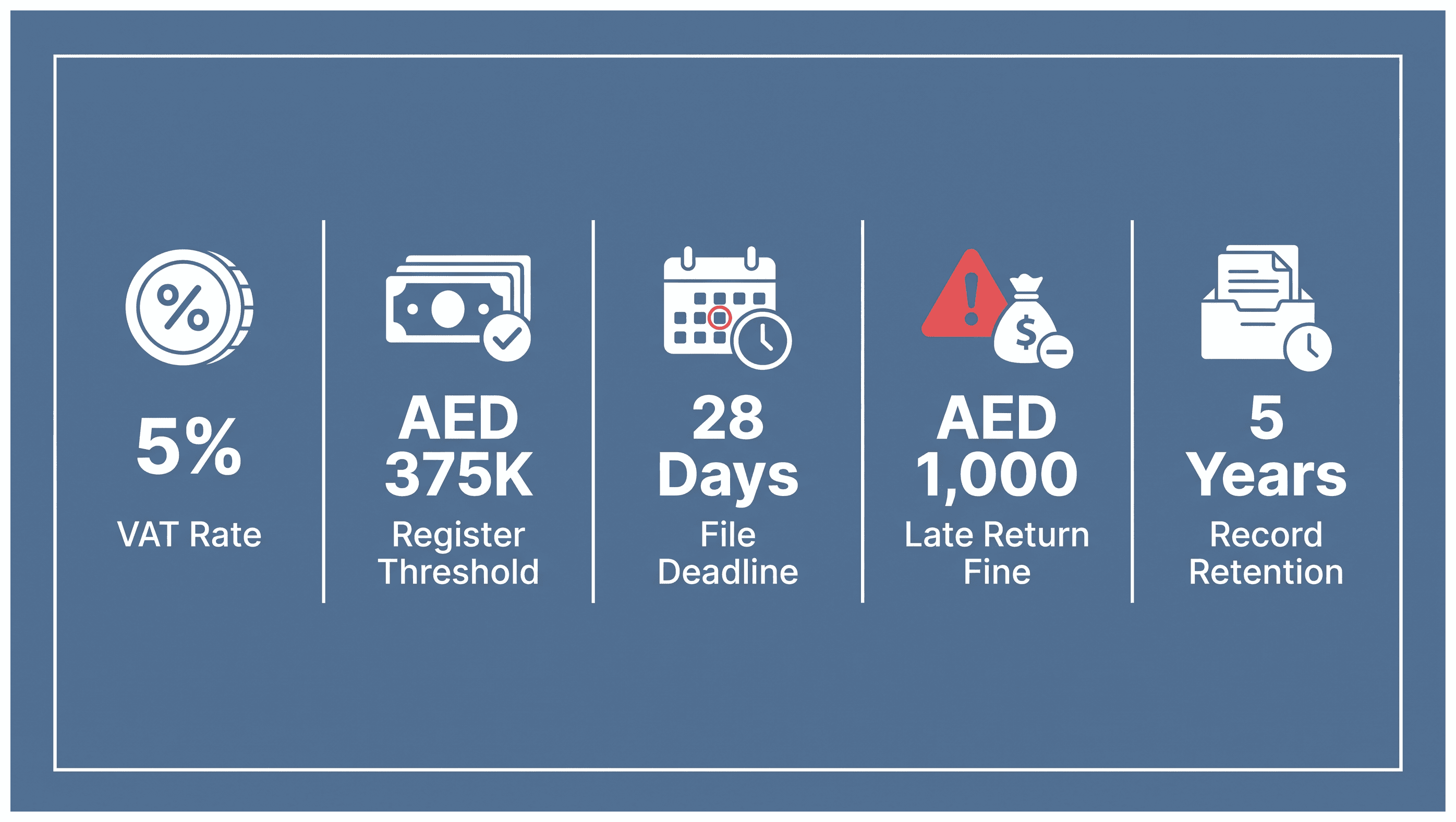
Dubai companies must submit VAT returns within 28 days of each tax period end via the FTA's EmaraTax portal, pay any net VAT due by the same date, and retain all supporting records for at least five years. A late return costs AED 1,000 for a first offence and AED 2,000 for a repeat within 24 months.
Filing Frequency: Quarterly vs. Monthly Cycles
Most businesses are assigned a quarterly cycle by default. Tax periods end on 31 January, 30 April, 31 July, and 31 October, giving you 28 days from each of those dates to file and pay. A newly licensed Dubai South Business Hub company with standard trading activity will typically land on the quarterly cycle from the outset.
The FTA can assign monthly filing to businesses with high turnover or complex VAT positions.
Your assigned cycle appears on your VAT registration certificate inside EmaraTax.
Switching cycles requires FTA approval, do not self-adjust.
For banking and taxation services that include VAT filing support, your service provider can confirm your assigned cycle on registration day.
Penalty Structure for Late Returns and Late Payment
Late return, first offence: AED 1,000.
Late return, repeat within 24 months: AED 2,000.
Late payment surcharge: 2% of unpaid tax on the day after the due date; a further 4% after seven days; then 1% per day from day 31, capped at 300% (Federal Tax Authority, 2026).
Penalties are assessed automatically, no warning letter arrives first.
A voluntary disclosure filed before an FTA audit reduces but does not eliminate penalties.
Real-world impact: a company that misses its quarterly deadline by 10 days on AED 10,000 of unpaid VAT faces an AED 1,000 late-return fine plus AED 400 in late-payment surcharges on day one alone.
How to Register for VAT Before Your First Filing
To register for VAT in Dubai, create an EmaraTax account on the Federal Tax Authority portal, complete the VAT registration form with your trade license, financial records showing turnover, and bank details, then submit. The FTA typically issues your Tax Registration Number (TRN) within 20 business days.
Documents You Need Before You Apply
Valid trade license copy, issued by your free zone authority or DET.
Passport and Emirates ID of all owners or authorised signatories.
UAE business bank account details.
Financial records or sales projections evidencing turnover above AED 375,000.
Memorandum or Articles of Association.
A Dubai South Business Hub licensee should have their trade license, share register, and the most recent three months of sales invoices ready before opening EmaraTax. That preparation cuts the application time significantly and reduces back-and-forth with the FTA during the 20-business-day review window. If you're still planning your structure, use the business setup cost in dubai calculator to budget before you commit.
Navigating the EmaraTax Portal
Go to tax.gov.ae and log in with UAE Pass, no separate password needed if you already use UAE Pass for other government portals.
Select "Register for VAT" under the Tax Registration module.
Complete the business details, activity description, and turnover evidence sections.
Nominate an authorised signatory who will sign all future returns.
Save and submit, then note your reference number for follow-up.
Step-by-Step Guide to Submitting Your VAT Return in Dubai
Log into EmaraTax, open the VAT return for the relevant tax period, enter output tax from your sales, input tax from purchases, and any adjustments, then review the net figure. Confirm and submit before the 28-day deadline, then pay any amount due via the integrated payment gateway.
Step 1: Reconcile Your Sales and Purchase Records
Pull every tax invoice you issued during the period, these form your output tax figure.
Pull all valid tax invoices received from VAT-registered suppliers, these form your input tax.
Exclude exempt or out-of-scope supplies from your output total.
Flag any credit notes or prior-period adjustments that need carrying forward.
A consultancy closing a quarterly period on 31 January should reconcile every invoice dated 1 November through 31 January before opening EmaraTax. All source documents must be retained for five years under Federal Decree-Law No. 8 of 2017 on VAT (still accurate as of 2026).
Dubai VAT Return Compliance Calendar: Quarterly Deadlines
Quarter | Tax Period | Filing and Payment Deadline |
|---|---|---|
Q1 | 1 November – 31 January | 28 February |
Q2 | 1 February – 30 April | 28 May |
Q3 | 1 May – 31 July | 28 August |
Q4 | 1 August – 31 October | 28 November |
Monthly filers | Each calendar month | 28 days after the last day of that month |
Step 2: Complete and Submit the Return Form
Log into EmaraTax and select the open VAT return for your tax period.
Enter Standard Rated Supplies (Box 1), Zero Rated Supplies (Box 2), and Exempt Supplies (Box 3).
Enter input tax on purchases and imports in the relevant boxes.
Review the auto-calculated net payable or refund figure before submitting.
Submit, then pay any net VAT due via the EmaraTax payment gateway, bank transfer and card are both accepted.
A trading company entering AED 10,000 output tax and AED 6,000 input tax will see EmaraTax auto-populate a net payable of AED 4,000 before the final submission screen. That auto-calculation is reliable, but always cross-check it against your reconciliation spreadsheet before you hit confirm.
VAT Return Compliance Calendar for Dubai Companies
Dubai companies on a standard quarterly VAT cycle face four filing and payment deadlines per year: 28 February, 28 May, 28 August, and 28 November, each covering the preceding three-month tax period. Missing any deadline triggers automatic penalties with no grace period from the Federal Tax Authority.
Quarterly Deadline Dates at a Glance
Q1 (Nov–Jan): return and payment due 28 February.
Q2 (Feb–Apr): return and payment due 28 May.
Q3 (May–Jul): return and payment due 28 August.
Q4 (Aug–Oct): return and payment due 28 November.
If the 28th falls on a Friday or public holiday, the deadline does not automatically shift, confirm with the FTA each cycle (UAE Ministry of Finance, 2026).
A Dubai South Business Hub trading company whose tax period runs February through April must submit its return and pay by 28 May, not the end of May. That three-day difference has caught out more than a few founders who assumed end-of-month was safe.
Three Internal Checkpoints That Prevent Missed Deadlines
Month 1: reconcile all invoices and flag missing supplier tax invoices.
Month 2: review credit notes, adjustments, and import VAT entries.
Month 3, week 2: run a draft return in EmaraTax to catch discrepancies before the deadline.
Assign one person or your business support UAE provider as the EmaraTax account owner to avoid login disputes on filing day.
A two-person startup at Dubai South Business Hub can split the workload neatly: one director handles invoice reconciliation each month, the other reviews and submits the EmaraTax return in week three of the final month.
Common VAT Filing Mistakes Dubai Founders Make
The most common VAT filing mistakes for Dubai companies include claiming input tax on non-business expenses, misclassifying zero-rated and exempt supplies, failing to account for import VAT under the reverse charge mechanism, and keeping records for fewer than five years. Each error can trigger FTA penalties or a blocked refund.
Input Tax Errors That Trigger FTA Audits
Claiming input tax on entertainment expenses for non-employees, these are blocked under UAE VAT law.
Recovering input tax on a supplier invoice that is not a valid tax invoice (missing TRN, date, or itemised amounts).
Claiming input tax on personal expenses run through the company account.
Forgetting the reverse charge mechanism on imported services from overseas suppliers.
Here's a specific scenario worth flagging. A Dubai consultancy that pays a London-based software firm for a SaaS license must self-assess VAT under the reverse charge mechanism. Failing to do so understates output tax and overstates input tax simultaneously, two errors in one return, both visible to the FTA's automated audit system.
Zero-Rated vs. Exempt: Why the Distinction Matters
Zero-rated supplies, such as exports and international transport, carry 0% VAT but still allow full input tax recovery. Exempt supplies, such as certain financial services and residential property leases, carry no VAT but block input tax recovery on all directly related costs.
Misclassifying an exempt supply as zero-rated inflates your recoverable input tax and creates an FTA liability on audit.
A company exporting goods out of the UAE correctly reports these as zero-rated supplies and recovers all related input tax, a legitimate and widely used VAT planning point for trading license holders.
When in doubt, request a written ruling from the FTA before you file.
What happens if you file a VAT return with errors in Dubai?
If you discover an error after filing, submit a voluntary disclosure through EmaraTax before the FTA contacts you. Voluntary disclosure reduces penalties but does not eliminate them. Errors discovered during an FTA audit carry higher penalties and may trigger a broader review of your records going back five years.
How Your Company Structure Affects VAT Return Filing in Dubai
Your company structure, whether mainland or free zone, does not change your core VAT obligations if you exceed AED 375,000 in taxable supplies. Free zone companies supplying goods or services to UAE mainland customers must charge 5% VAT, while qualifying supplies between designated zones may be suspended. Dubai South Business Hub is not a designated zone.
Free Zone Companies and Standard VAT Obligations
Free zone companies are treated as UAE businesses for VAT purposes. The same AED 375,000 registration threshold, 28-day filing deadline, and penalty structure apply regardless of where your license is issued.
Supplies from a free zone company to a UAE mainland customer are standard-rated at 5%.
Supplies between two free zone companies are also generally standard-rated unless both are in designated zones.
Dubai South Business Hub is not a designated zone, so duty-suspension rules for goods do not alter your VAT treatment.
References
Frequently Asked Questions