Topic Summary
What Is UAE VAT on Services Exported Outside the UAE
UAE VAT on services exported outside the UAE is the 0% rate the FTA applies when a UAE supplier serves a customer outside the UAE and the GCC implementing states. You still register, file the VAT201 and keep evidence, but you charge no output VAT and can recover input VAT.
Conditions a Service Must Meet to Qualify as a Zero-Rated Export
Conditions a Service Must Meet to Qualify as a Zero-Rated Export
Zero-Rated Exports Compared With Exempt and Standard-Rated Services
Zero-rated exports carry 0% VAT and allow full input recovery. Exempt supplies, such as certain financial services, block recovery. Standard-rated services carry 5%. Exporters often sit in refund positions because input VAT exceeds output VAT. A consultancy paying AED 20,000 in annual input VAT with only export revenue can reclaim it through EmaraTax, as covered in VAT refund for companies in the UAE.
How to Report UAE VAT on Services Exported Outside the UAE
To report UAE VAT on services exported outside the UAE: confirm the customer's location, test Article 31, invoice at 0%, keep evidence, report on the VAT201 via EmaraTax, and file by the 28th day after the period ends.
Documents and Evidence to Keep for Every Exported Service
Keep the contract, tax invoice, overseas payment proof, proof of the client's establishment, and delivery correspondence. The FTA requires five years of records, and missing evidence can push a sale to 5%.
Common Mistakes With UAE VAT on Services Exported Outside the UAE
Typical errors: zero-rating UAE-property services, treating GCC clients as automatic exports, skipping evidence, and ignoring that exports count toward the AED 375,000 threshold.
Setting Up a Free Zone Company to Handle Export VAT Correctly
A Dubai South Business Hub Free Zone company gets a trade license, residency visa package and UAE base for overseas invoicing. Free zone status doesn't change VAT treatment of services. Once supplies pass AED 375,000, follow VAT registration for service businesses.
More than 350,000 UAE businesses are VAT-registered (Federal Tax Authority, 2025), yet many still charge 5% to overseas clients. This guide helps free zone owners and finance managers apply UAE VAT on services exported outside the UAE correctly.
What Is UAE VAT on Services Exported Outside the UAE
UAE VAT on services exported outside the UAE is the 0% rate the FTA applies when a UAE supplier serves a customer outside the UAE and the GCC implementing states. You still register, file the VAT201 and keep evidence, but you charge no output VAT and can recover input VAT.
Zero-Rated Is Not Outside the Scope
Exports are taxable supplies at 0%, so they count toward the AED 375,000 mandatory threshold (voluntary: AED 187,500). The basis is Federal Decree-Law No. 8 of 2017 and Cabinet Decision No. 52 of 2017. A Dubai South consultancy invoicing a German client charges no 5%, yet reports the sale on its VAT201.
Why It Matters to You
A free zone license doesn't remove VAT duties for service companies. Late registration costs AED 10,000 (FTA, 2026).
Over-charging 5% means credit notes.
Zero-rating without proof invites assessments.
Conditions a Service Must Meet to Qualify as a Zero-Rated Export
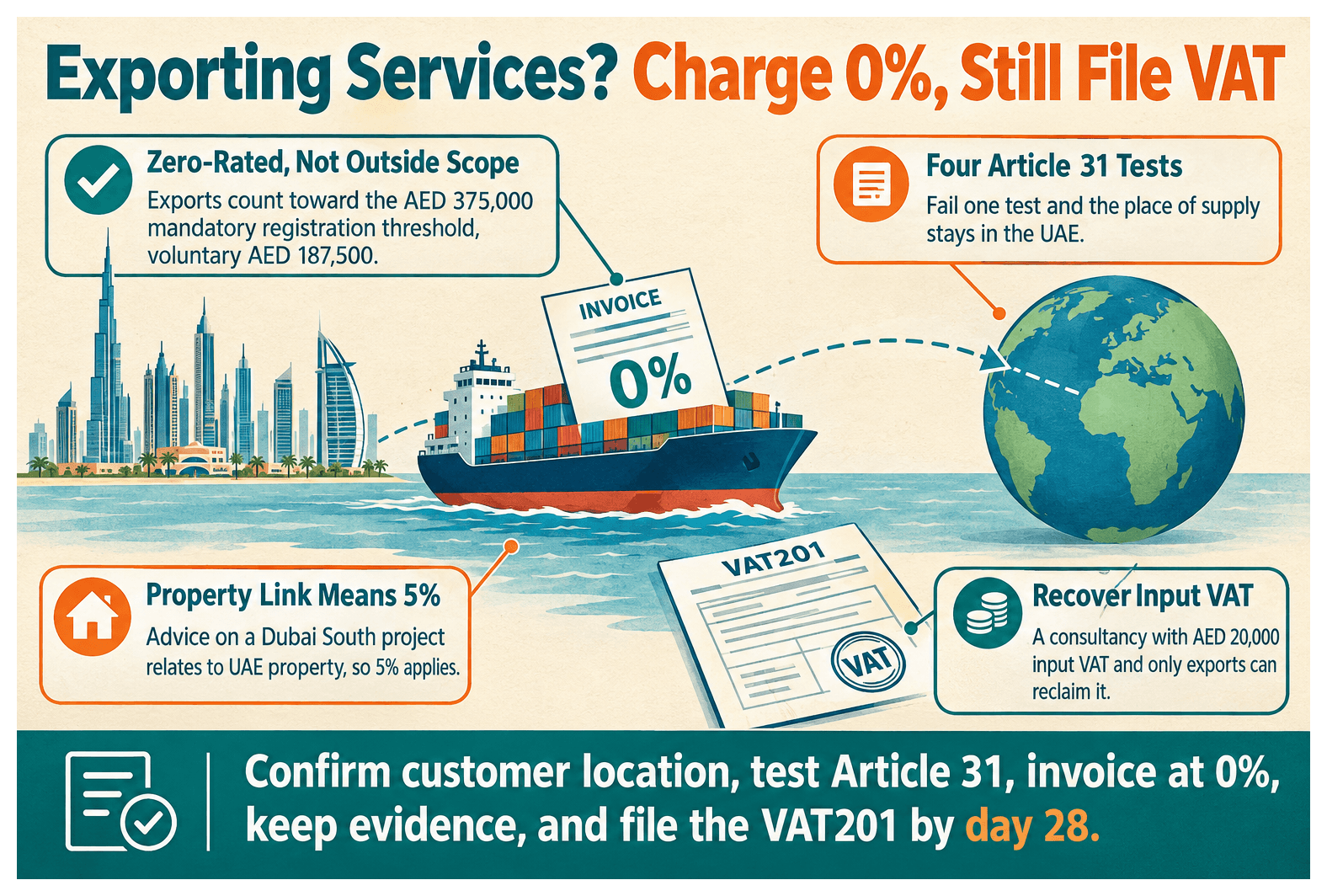
Under Article 31, an export of services needs a UAE supplier, a recipient with no residence in the UAE or implementing states, a recipient outside the UAE during performance, and no link to UAE property. Fail one test and the place of supply stays in the UAE.
The Four Tests in Plain English
You're located in the UAE.
The client has no UAE or implementing-state residence.
The client is abroad when you perform the work.
The service doesn't relate to UAE property.
Remote marketing for a Singapore company with no UAE presence passes all four.
Zero-Rated, Exempt and Standard-Rated Services Compared
Feature | Zero-Rated Export of Services | Standard-Rated Service (5%) |
|---|---|---|
VAT rate charged to the customer | 0% | 5% |
Input VAT recovery | Full recovery, often a refund position | Full recovery, offset against output tax |
Customer location | Outside the UAE and implementing states | UAE, or any Article 31 test failed |
Reporting on the VAT201 | Zero-rated supplies box, no output tax | Standard-rated box with 5% output tax |
Evidence required | Proof of overseas customer and delivery | Standard tax invoice and records |
When the Place of Supply Stays in the UAE
Design work on a Dubai property is taxed at 5%. So is advice to a foreign investor on a Dubai South project, because it relates to UAE property. A client's UAE branch also triggers 5%.
Special Cases
For a foreign parent, residence of the recipient decides, not who pays. Bundled supplies may need splitting. A free zone management company billing its Indian parent for shared IT services still applies the tests.
Zero-Rated Exports Compared With Exempt and Standard-Rated Services
Zero-rated exports carry 0% VAT and allow full input recovery. Exempt supplies, such as certain financial services, block recovery. Standard-rated services carry 5%. Exporters often sit in refund positions because input VAT exceeds output VAT. A consultancy paying AED 20,000 in annual input VAT with only export revenue can reclaim it through EmaraTax, as covered in VAT refund for companies in the UAE.
How to Report UAE VAT on Services Exported Outside the UAE
To report UAE VAT on services exported outside the UAE: confirm the customer's location, test Article 31, invoice at 0%, keep evidence, report on the VAT201 via EmaraTax, and file by the 28th day after the period ends.
Collect the client's incorporation certificate and billing address.
Sign off a one-page Article 31 checklist.
Issue the invoice within 14 days with your TRN and 0% rate, following tax invoice requirements in the UAE.
Reconcile bank receipts, converting at the Central Bank of the UAE rate.
Then file, as explained in VAT return filing for Dubai companies.
Documents and Evidence to Keep for Every Exported Service
Keep the contract, tax invoice, overseas payment proof, proof of the client's establishment, and delivery correspondence. The FTA requires five years of records, and missing evidence can push a sale to 5%.
Signed contract with the foreign address.
Invoice at 0%.
Overseas bank receipts.
Emails or timesheets showing delivery.
If you can't prove client location on AED 300,000 of sales, the FTA can assess AED 15,000 plus penalties. A voluntary disclosure fixes errors before an audit.
Common Mistakes With UAE VAT on Services Exported Outside the UAE
Typical errors: zero-rating UAE-property services, treating GCC clients as automatic exports, skipping evidence, and ignoring that exports count toward the AED 375,000 threshold.
GCC Customers Trap
A Riyadh client sits in an implementing state, so the analysis differs. Check the FTA's current list first.
Registration and Reverse Charge
Paying a foreign subcontractor may trigger reverse charge VAT on the purchase side, even while your sales are zero-rated.
Setting Up a Free Zone Company to Handle Export VAT Correctly
A Dubai South Business Hub Free Zone company gets a trade license, residency visa package and UAE base for overseas invoicing. Free zone status doesn't change VAT treatment of services. Once supplies pass AED 375,000, follow VAT registration for service businesses.
Match licensed activity to invoiced services.
Review new overseas contracts monthly.
Reconcile zero-rated sales before each VAT201.
Calendar the 28-day deadline.
Next Moves for Your Export Invoices
Prove the customer's overseas location, apply the Article 31 tests, invoice at 0%, keep five years of evidence and report on the VAT201 within 28 days. Review your overseas contracts against the checklist today, then speak with Dubai South Business Hub about company formation, trade licenses and residency visa packages.
References
Frequently Asked Questions