Topic Summary
What Is Input VAT and How to Claim It Back in the UAE: The Core Definition
Input VAT is the 5% VAT a VAT-registered UAE business pays on taxable purchases and expenses. You claim it back by deducting it from the output VAT you collect on sales in your VAT201 return, or by requesting a refund from the Federal Tax Authority through EmaraTax when input tax exceeds output tax.
Which Costs Free Zone Companies Can Recover as Input VAT
Which Costs Free Zone Companies Can Recover as Input VAT
Conditions the FTA Requires Before You Recover Input Tax
To recover input VAT, you must hold a valid tax invoice showing the supplier's TRN and VAT amount, use the purchase for taxable activity, and claim within the permitted period. Non-compliant invoices are the leading cause of rejected claims.
How to Claim Input VAT and Get It Back in the UAE Through EmaraTax
Log in to EmaraTax, collect compliant invoices, total your recoverable input VAT, enter it in the VAT201, then file and pay any net VAT by the due date. If input exceeds output, request a refund.
Common Input VAT Mistakes That Delay or Reduce Recovery
The most common mistakes are claiming blocked expenses, using invoices without a supplier TRN, forgetting reverse-charge entries, missing deadlines and skipping apportionment. A monthly review before filing prevents most issues.
Input VAT and How to Claim It Back in the UAE: Refund or Carry Forward?
When input VAT exceeds output VAT, you can request a cash refund or carry the credit forward. Refunds suit ongoing excess credits. Carry-forward suits companies expecting taxable sales to rise.
Next Steps
Input VAT is the 5% you pay on taxable costs. Recovering it is simple once invoices are compliant. Review your last period's invoices this week, then speak with the Dubai South Business Hub Free Zone team about company formation, trade licensing and visa packages so your VAT setup is right from day one.
More than 350,000 businesses are VAT-registered in the UAE (Federal Tax Authority, 2025), and the standard rate is 5%. Registration becomes mandatory at AED 375,000 in taxable supplies over 12 months. Returns fall due 28 days after each period, and a first late filing costs AED 1,000. This guide is for free zone owners and finance managers who want to master input VAT and how to claim it back in the UAE.
What Is Input VAT and How to Claim It Back in the UAE: The Core Definition
Input VAT is the 5% VAT a VAT-registered UAE business pays on taxable purchases and expenses. You claim it back by deducting it from the output VAT you collect on sales in your VAT201 return, or by requesting a refund from the Federal Tax Authority through EmaraTax when input tax exceeds output tax.
Input Tax Versus Output Tax in Plain Terms
Output tax is what you charge customers. Input tax is what suppliers charge you. Net VAT payable is output minus recoverable input.
Take a free zone consultancy that invoices AED 100,000 plus AED 5,000 VAT and pays AED 1,200 VAT on software and services. It remits AED 3,800 net.
Who Is Entitled to Recover It
Only businesses holding a Tax Registration Number (TRN) can recover input tax, and the cost must relate to taxable supplies. A newly registered trading company, for instance, can recover VAT on its first stock purchase. Voluntary registration is available below the AED 375,000 mandatory threshold.
Recoverable Versus Blocked Input VAT Costs
Feature | Usually Recoverable | Blocked or Restricted |
|---|---|---|
Professional and licensing service fees | 5% VAT recoverable when the invoice is compliant and the service supports taxable sales | Not recoverable if the service supports exempt supplies |
Import VAT on goods for taxable supplies | Claimable on the VAT201 with customs documentation in your name | Held up if the declaration names a forwarder instead |
Business entertainment | Staff-only events may qualify, depending on use | Blocked, so a client dinner's AED 150 VAT stays out of the return |
Vehicles available for personal use | Recoverable for vehicles used solely for business, such as delivery vans | Blocked when staff or owners can use them personally |
Costs linked to exempt supplies | Only the taxable share of mixed-use costs | No recovery on the exempt share |
Which Costs Free Zone Companies Can Recover as Input VAT
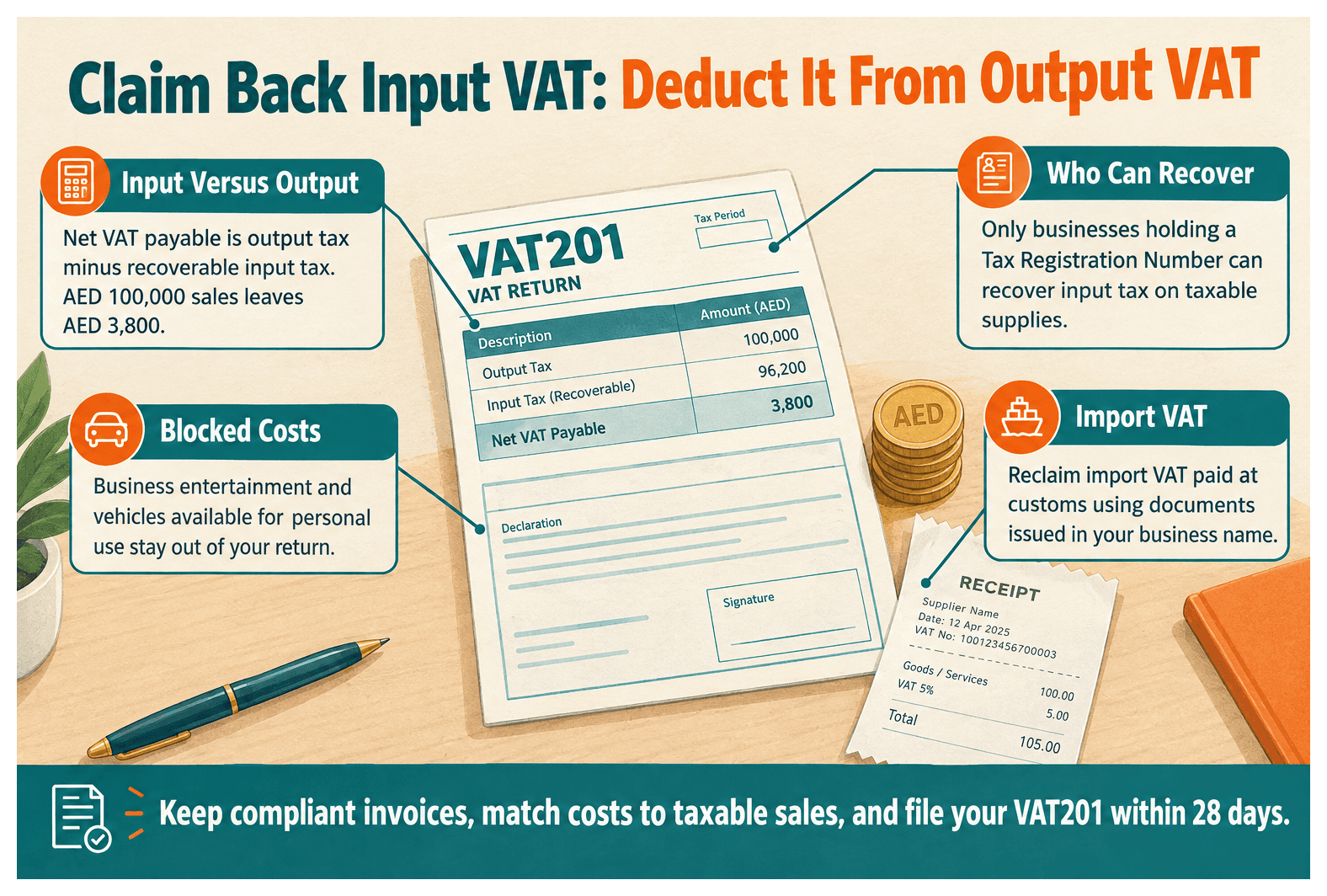
Free zone companies can recover input VAT on business costs tied to taxable supplies, such as professional fees, office rent, software, marketing, stock and import VAT paid at customs. Blocked items include business entertainment and vehicles available for personal use. This input tax recovery in the UAE never applies to exempt supplies.
Recoverable Business Expenses
Professional and licensing fees carrying 5% VAT.
Rent, utilities, software and advertising.
Import VAT paid at customs on stock.
Reverse-charge services, where you self-account for both sides.
A Dubai South Business Hub Free Zone trading company, for example, can recover import VAT on stock and VAT on its setup service fees.
Costs the FTA Blocks or Restricts
Entertainment and personal-use vehicles are blocked. Mixed-use costs need apportionment. Treatment also depends on whether your zone is a Designated Zone for VAT, so confirm that with the FTA first. Don't assume any supply is outside VAT.
Import VAT and Reverse Charge Scenarios
You can reclaim import VAT on a Dubai trading license using customs documents. Paying a foreign software vendor triggers reverse charge VAT in the UAE: you report 5% as output and as input.
Conditions the FTA Requires Before You Recover Input Tax
To recover input VAT, you must hold a valid tax invoice showing the supplier's TRN and VAT amount, use the purchase for taxable activity, and claim within the permitted period. Non-compliant invoices are the leading cause of rejected claims.
A Compliant Tax Invoice Is Non-Negotiable
The words "Tax Invoice".
Supplier name, address and TRN.
Date, description and amount.
VAT charged in AED.
One missing supplier TRN can cost you AED 2,500 of input tax. See the tax invoice requirements in the UAE for the full list.
Record Keeping and Claim Windows
Keep tax records for five years, and claim within five years of the tax period's end. Build a monthly folder matching invoices, customs entries and payment proof to each VAT201 period.
How to Claim Input VAT and Get It Back in the UAE Through EmaraTax
Log in to EmaraTax, collect compliant invoices, total your recoverable input VAT, enter it in the VAT201, then file and pay any net VAT by the due date. If input exceeds output, request a refund.
Step 1: Gather and Validate Invoices
Check the TRN, VAT amount and date on every invoice. Separate blocked and mixed-use costs. A monthly reconciliation sheet that flags invalid invoices saves rework.
Step 2: Complete the VAT201 Return
Enter standard-rated expenses, import VAT and reverse-charge input tax in the right boxes. File within 28 days of period end. A quarterly filer submitting on day 25 avoids the AED 1,000 penalty. Our guide to VAT return filing for Dubai companies covers the details.
Step 3: Offset, Pay or Request a Refund
If output exceeds input, pay the net. If input exceeds output, choose refund or carry forward, and keep your portal bank details current. See VAT refund for companies in the UAE.
Common Input VAT Mistakes That Delay or Reduce Recovery
The most common mistakes are claiming blocked expenses, using invoices without a supplier TRN, forgetting reverse-charge entries, missing deadlines and skipping apportionment. A monthly review before filing prevents most issues.
Invoice and Documentation Errors
Missing TRN or VAT breakdown.
Invoices addressed to another entity.
Customs declarations in a forwarder's name.
That last one has held up refund requests for weeks.
Classification and Timing Errors
Over-claiming blocked costs or claiming outside five years invites queries. If you find an over-claim, correct it through a voluntary disclosure.
Input VAT and How to Claim It Back in the UAE: Refund or Carry Forward?
When input VAT exceeds output VAT, you can request a cash refund or carry the credit forward. Refunds suit ongoing excess credits. Carry-forward suits companies expecting taxable sales to rise.
When a Cash Refund Makes Sense
Start-ups with heavy stock costs and exporters with zero-rated sales gain most. An exporter might request a refund every quarter to protect cash flow. Expect the FTA to ask for supporting documents.
When Carry Forward Is the Smarter Choice
A seasonal events company can carry a Q1 credit against Q2 output tax. It means less documentation friction, and EmaraTax still tracks the credit.
Next Steps
Input VAT is the 5% you pay on taxable costs. Recovering it is simple once invoices are compliant. Review your last period's invoices this week, then speak with the Dubai South Business Hub Free Zone team about company formation, trade licensing and visa packages so your VAT setup is right from day one.
References
Frequently Asked Questions