
Topic Summary
Know the Zero-Rated vs. Exempt Distinction
Zero-rated exported services let you charge 0% VAT while still recovering input VAT on your costs, whereas exempt supplies block that recovery entirely. Misclassifying a qualifying export as exempt can silently cost your business thousands of dirhams per filing period.
Meet All Four Qualifying Conditions
A service export only qualifies for the 0% rate when the supplier is UAE VAT-registered, the recipient is established outside the UAE, the recipient is not present in the UAE during performance, and the service has no direct connection to UAE land or property. Missing even one condition means the standard 5% rate applies.
Prove the Recipient Is Truly Overseas
The supply must be made to the foreign entity, not a local UAE branch of that same company. Supporting documents such as a foreign trade license, company registration certificate, or overseas correspondence address are required to substantiate the customer's location.
Watch Where the Service Is Actually Consumed
An offshore contract alone does not guarantee zero-rating if any part of the service is consumed inside the UAE. For example, testing software at a foreign client's UAE pop-up office could expose that portion of the supply to standard VAT during an audit.
Register Before Hitting the AED 375,000 Threshold
UAE VAT registration becomes mandatory once taxable turnover reaches AED 375,000, and late registration carries a flat AED 10,000 penalty. Monitoring your threshold proactively is especially important for fast-growing consultancies and technology firms billing overseas clients.
File Returns Within 28 Days of Each Period
VAT returns must be submitted no later than 28 days after each tax period closes, regardless of whether your exports are zero-rated. Missing this deadline adds penalties on top of any substantive VAT errors already in dispute.
Retain All Export Documents for Five Years
The Federal Tax Authority requires businesses to keep records supporting zero-rated export claims for a minimum of five years. Contracts, invoices, proof of the recipient's overseas establishment, and payment records should all be stored in an audit-ready format from day one.
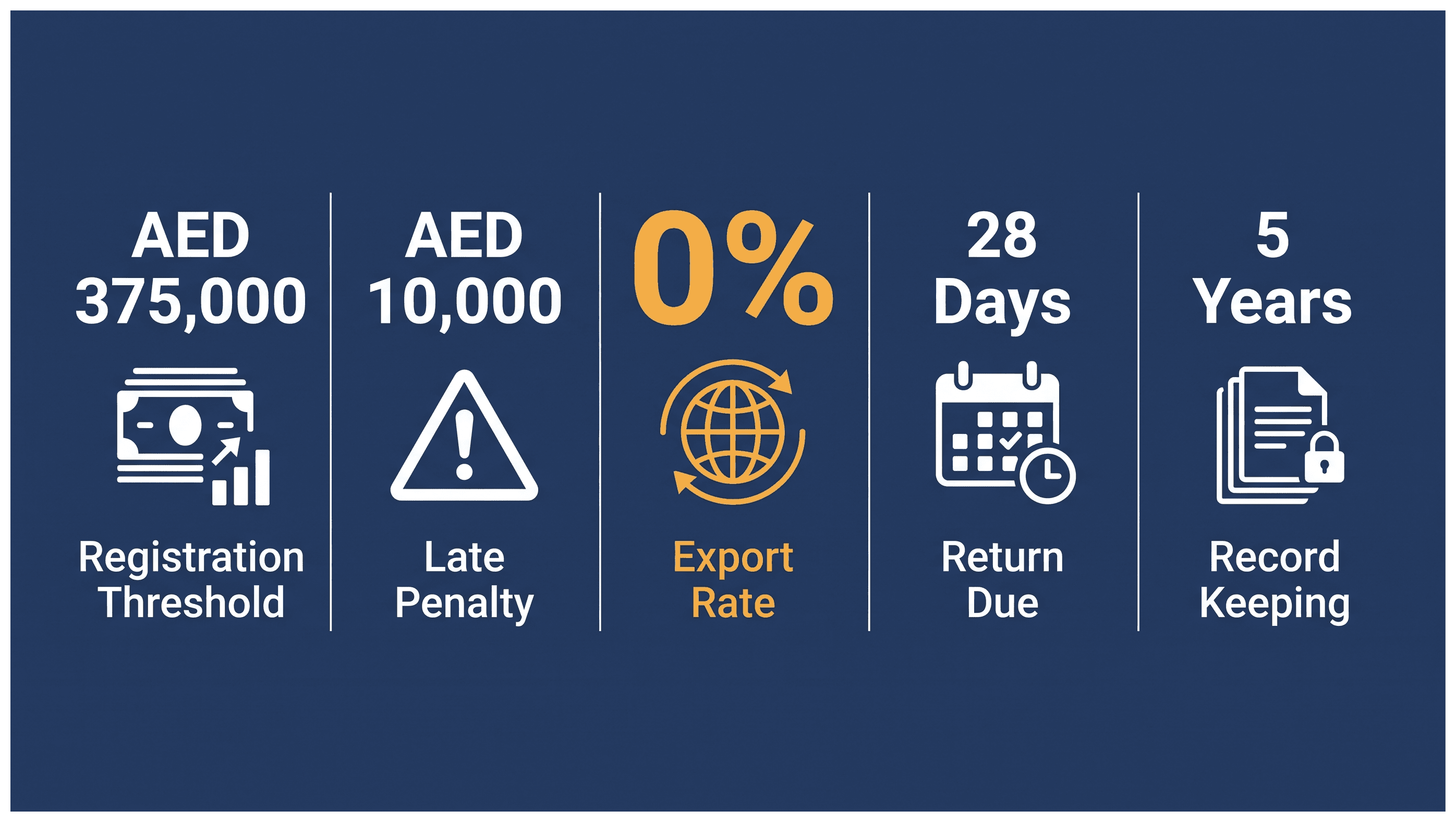
Since the UAE introduced VAT in January 2018, the Federal Tax Authority has processed more than six full annual cycles, yet VAT on services exported from the UAE remains one of the most misunderstood areas of the regime. The mandatory registration threshold sits at AED 375,000 [1]. Late registration triggers a flat AED 10,000 penalty [2]. Returns are due 28 days after each tax period closes [3]. The zero rate for qualifying exports is 0% [4], and the five-year document retention rule is non-negotiable [5]. Thousands of UAE-based consultants, technology firms, and professional service providers bill overseas clients every month, yet many still apply the wrong VAT rate because they misread the four qualifying conditions.
This VAT services exported UAE guide explains exactly when a service qualifies for the 0% rate, what documentary proof you need, when penalties apply, and how a free zone structure simplifies your compliance from day one.
What Is VAT on Exported Services and Why It Matters for Your UAE Business
VAT on exported services in the UAE refers to the VAT treatment applied when a UAE-registered business supplies services to a customer outside the UAE. Qualifying exports are zero-rated at 0%, meaning no VAT is charged to the client but the supplier can still recover input VAT paid on related costs. That's a meaningful financial distinction, and getting it wrong costs real money.
Zero-Rated vs. Exempt: A Distinction That Affects Your Cash Flow
Zero-rated supplies attract 0% output VAT but preserve the right to recover input VAT on costs. Exempt supplies also carry 0% output VAT but block input VAT recovery entirely, making them costlier in practice. Exported services that qualify fall into the zero-rated category, not the exempt category, and this distinction is critical when you file.
Here's a concrete example. A Dubai-based management consultancy bills a London client AED 200,000 for a strategy project. If zero-rated correctly, it charges 0% VAT on the invoice and reclaims AED 9,000 in input VAT paid on its UAE office costs. If wrongly treated as exempt, that AED 9,000 becomes an unrecoverable expense. Same invoice, very different cash flow.
Where UAE VAT Law Defines Exported Services
The legal basis is Federal Decree-Law No. 8 of 2017 and its Executive Regulation, specifically Article 31 covering zero-rated services. The Federal Tax Authority publishes a dedicated VAT guide on exported services that interprets these provisions for businesses (tax.gov.ae, 2024).
Understanding the statutory definition prevents the most common audit failure: applying zero-rating to a service partly consumed inside the UAE. An IT company in Dubai provides software development services to a German firm. The contract is offshore, but the developer tests the software at the German client's UAE pop-up office. The Federal Tax Authority may treat part of that supply as domestically consumed and subject to standard VAT. The offshore contract alone isn't enough protection.
The Four Conditions That Make a Service Export Zero-Rated
A UAE-supplied service qualifies for 0% VAT when four conditions are all met: the supplier is UAE VAT-registered, the recipient is established or resident outside the UAE, the recipient is not present in the UAE when the service is performed, and the service is not directly connected to land or real property inside the UAE. Miss one condition and the standard rate applies.
Condition One: The Recipient Must Be Outside the UAE
The customer's place of establishment or fixed establishment must be outside the UAE at the time of supply. Having a UAE branch or office doesn't automatically disqualify the customer, but the supply must be made to the overseas entity, not the local branch. Documentary evidence such as a foreign trade license, company registration certificate, or correspondence address is required to substantiate this condition.
A Dubai marketing agency signs a retainer with a Singapore-headquartered tech company that also has a DIFC representative office. If the contract and invoices are with the Singapore entity and all deliverables go to Singapore, the zero-rate condition is met. The DIFC office is irrelevant as long as it's not the contracting party.
Condition Two: No Physical Presence in the UAE at Time of Supply
Even if the recipient is a foreign entity, zero-rating fails if that recipient is physically present in the UAE when the service is actually performed. This catches training delivered in Dubai to foreign employees who have flown in specifically for that session. The Federal Tax Authority applies the presence test at the moment of performance, not the moment of contracting.
A UAE training firm contracts with a French multinational to deliver a leadership workshop. If the French executives attend the workshop at a Dubai hotel, the supply is treated as locally consumed and subject to 5% VAT, not zero-rated. The contract date doesn't matter; the delivery location does.
Conditions Three and Four: No UAE Land Connection and No Domestic Benefit
Services directly connected to land or real property inside the UAE cannot be zero-rated, regardless of who the client is.
Services that effectively benefit a UAE resident or UAE-based person, even when billed to an overseas entity, may be reclassified as local supplies.
Legal, architectural, and engineering services referencing UAE-based assets are the most common categories caught by these two conditions.
A UAE architectural firm is commissioned by a Saudi developer to design a building on a Dubai plot. Even though the client is Saudi, the service relates directly to UAE land and is subject to 5% VAT. The client's nationality is irrelevant; the asset's location is what matters.
How to Register for VAT and Meet Your Filing Deadlines
UAE businesses must register for VAT with the Federal Tax Authority once taxable supplies exceed AED 375,000 in any 12-month period. The registration deadline is 30 days from the date that threshold is crossed. Late registration carries a flat AED 10,000 penalty. Returns are due 28 days after each tax period ends. These are the VAT services UAE deadline figures you need to know before your first overseas invoice goes out.
Registration Thresholds and the AED 10,000 Penalty
Mandatory threshold: AED 375,000 in taxable supplies over any 12-month period.
Voluntary threshold: AED 187,500, useful for businesses that want to recover input VAT before crossing the mandatory line.
Late registration penalty: A flat AED 10,000 administrative penalty if you don't register within 30 days of breaching the mandatory threshold.
Registration portal: The Federal Tax Authority's EmaraTax online platform.
A newly licensed Dubai consultancy closes its first overseas contracts totalling AED 400,000 in month nine of trading. It must apply for VAT registration within 30 days of crossing the AED 375,000 mark or face the AED 10,000 penalty. That's a straightforward, avoidable cost.
VAT Return Filing and Payment Schedule
Most UAE businesses file quarterly VAT returns. Businesses with annual turnover above AED 150 million file monthly. Returns and payment are both due 28 days after the end of the tax period.
Late filing and late payment are penalised separately: 2% of unpaid tax is due immediately, rising to 4% after seven days, then 1% daily thereafter up to a maximum of 300%. Zero-rated exports must still be declared in the VAT return even though no output tax is due. A free zone technology company with a calendar-quarter tax period ending 31 March must file its return and pay any VAT due by 28 April.
Is zero-rated the same as not having to file a VAT return?
No. Zero-rated exported services still appear in your VAT return, reported in Box 2. Filing is mandatory even when your output tax liability is nil. Skipping the return because you owe nothing is a common mistake that triggers late-filing penalties from the Federal Tax Authority.
Step-by-Step Guide to Applying Zero-Rating to Your Exported Services
To correctly apply zero-rating to an exported service in this VAT services exported UAE guide: confirm all four legal conditions are met, gather documentary evidence of the recipient's overseas status, issue the invoice at 0% VAT with the correct annotation, record the supply in Box 2 of your VAT return, and retain all supporting documents for five years for Federal Tax Authority audit purposes.
Step 1: Verify the Four Conditions Before Issuing Any Invoice
Confirm the client is established outside the UAE.
Confirm the client has no physical presence in the UAE at the time of service.
Confirm the service has no direct connection to UAE land or real property.
Confirm no UAE-based person is the effective beneficiary of the service.
If any condition fails, apply 5% VAT by default. Never assume zero-rating without completing the check. A Dubai HR consulting firm creates a one-page pre-invoice checklist. Before billing any overseas client, the account manager runs through all four points. It takes two minutes and avoids a potential 30% accuracy penalty on the full invoice value.
Step 2: Gather and Retain the Right Evidence
Collect the following before raising the invoice:
Client's foreign trade license or certificate of incorporation.
Signed contract specifying the overseas delivery location.
Bank records showing payment from an overseas account.
The Federal Tax Authority requires records to be retained for five years from the end of the tax period to which they relate. Digital copies stored securely in your accounting system satisfy that requirement. An audit of a Dubai design agency revealed it could not produce foreign registration documents for three overseas clients. The Federal Tax Authority reclassified those invoices as domestic supplies and assessed 5% VAT plus a 30% accuracy penalty on the full invoice values.
Step 3: Record the Supply Correctly in Your VAT Return
Report zero-rated exported services in Box 2 of the UAE VAT return, not Box 1.
Report recoverable input VAT attributable to those exports in Box 10.
If your return shows a net credit position, submit a refund request via EmaraTax.
A Dubai-based software company exports 95% of its services to clients in Europe. Its quarterly return consistently shows a refund position because input VAT on UAE office costs exceeds zero output VAT. It submits a refund request via EmaraTax and typically receives the credit within 20 business days. That's a real cash-flow benefit that zero-rating, not exempt treatment, makes possible.
VAT Compliance Calendar for UAE Service Exporters
Obligation | Tax Period | Return and Payment Due Date |
|---|---|---|
Q1 Filing | January to March | 28 April |
Q2 Filing | April to June | 28 July |
Q3 Filing | July to September | 28 October |
Q4 Filing | October to December | 28 January (following year) |
Annual Threshold Review | Rolling 12-month check | AED 375,000 mandatory; AED 187,500 voluntary |
Document Retention Deadline | Rolling from each tax period end | Five years from end of relevant tax period |
VAT Compliance Calendar for UAE Service Exporters
A VAT compliance calendar for UAE service exporters covers four key dates per quarter: the tax period end date, the 28-day return and payment deadline, the annual registration review date, and the five-year document retention rolling deadline. Missing any of these triggers financial penalties from the Federal Tax Authority. The VAT services UAE deadline discipline is what separates compliant exporters from those facing assessments.
Quarterly Filing Calendar for Most UAE Businesses
Q1 (January to March): Return and payment due 28 April.
Q2 (April to June): Return and payment due 28 July.
Q3 (July to September): Return and payment due 28 October.
Q4 (October to December): Return and payment due 28 January of the following year.
A Dubai professional services firm sets four recurring calendar alerts each year, timed for the 18th of April, July, October, and January. That gives the finance manager 10 days to reconcile invoices, confirm zero-rating documentation, and submit via EmaraTax before the 28th deadline. Simple, repeatable, penalty-free.
Annual Tasks That Service Exporters Often Overlook
Review your 12-month rolling turnover every quarter to catch if you're approaching the AED 375,000 mandatory registration threshold.
Confirm your tax group status annually if you're part of a corporate group, group registration can simplify cross-entity supplies.
Refresh your client evidence files annually: foreign trade licenses expire and must be replaced to maintain your zero-rating records.
A startup that registers voluntarily at AED 200,000 turnover should still monitor monthly rolling figures. If it crosses AED 375,000 mid-year, no additional registration action is needed, but its compliance obligations intensify significantly.
How a Free Zone License Supports Zero-Rated Service Exports
A UAE free zone license gives service exporters a credible registered address, a corporate structure that clearly separates UAE and overseas operations, and access to banking and professional services that simplify VAT compliance. Free zone businesses exporting services still register for VAT with the Federal Tax Authority under the same rules that apply to mainland businesses. The structure doesn't create a separate VAT regime, but it does make compliance far more manageable.
What a Free Zone Setup Gives You on Day One
A free zone license issued in one business day provides the legal entity you need to open a UAE corporate bank account and issue compliant VAT invoices to overseas clients. Dubai South Business Hub packages start at AED 12,500 for a 0 Visa Package, rising to AED 16,350 for a 1 Visa Package and AED 18,200 for a 2 Visa Package.
Every package includes the license, Articles of Association, share register, flexi-desk space, the registered address that banks and the Federal Tax Authority both recognise. DSBH is not a designated zone, so standard VAT rules on exported services apply without additional complexity.
A UK-based digital marketing consultant relocates to Dubai and sets up a company at Dubai South Business Hub. The license is issued in one day. She opens a corporate bank account the following week, registers for VAT voluntarily at AED 187,500, and begins billing her European clients at 0% VAT with full input tax recovery from month one.
Banking and Accounting Infrastructure for Exporters
A UAE corporate bank account is required to receive overseas payments in foreign currencies and to demonstrate the overseas payment trail that supports zero-rating claims. You can explore banking and taxation support services to configure your chart of accounts to separate zero-rated, standard-rated, and exempt supplies from the start.
Choosing accounting software that integrates with EmaraTax from day one eliminates manual data entry errors on VAT returns. A Dubai fintech startup that connects its cloud accounting platform directly to EmaraTax finds that zero-rated export invoices auto-populate Box 2 of the VAT return each quarter, reducing filing time from two days to under two hours.
Common Mistakes That Trigger Federal Tax Authority Audits
The most common VAT mistakes by UAE service exporters, as covered in any practical VAT services UAE guide, include applying zero-rating without retaining evidence of the recipient's overseas status, zero-rating services where the recipient was physically present in the UAE, misreporting supplies in the wrong VAT return box, and failing to register before crossing the AED 375,000 mandatory threshold.
Documentation Failures That Reclassify Zero-Rated Supplies
The Federal Tax Authority's audit approach starts with documentation. If you can't prove the recipient is overseas, the supply is reclassified as standard-rated and 5% VAT is assessed on the full invoice value. Expired foreign trade licenses, missing contracts, and invoices without a clear delivery jurisdiction are the three most common documentation
References
Frequently Asked Questions