
Topic Summary
What Are the Ongoing Compliance Requirements of a Dubai South Company and Why They Matter
The ongoing compliance requirements of a Dubai South company are the recurring legal duties a licensed entity must meet after incorporation. They cover AML/KYC controls, goAML reporting, UBO disclosure, license renewal, corporate tax, audited accounts, and record-keeping. Missing them risks fines, blocked renewals, and suspended licenses.
UAE AML Legislation Every Dubai South Company Must Know
UAE AML Legislation Every Dubai South Company Must Know
How CBUAE Guidance Shapes AML and KYC Duties for Free Zone Companies
The Central Bank of the UAE (CBUAE) sets AML/CFT standards for banks and licensed financial institutions (CBUAE, 2025) [5]. Free zone companies feel it through bank onboarding, source-of-funds checks, and periodic reviews. Your bank will ask for current ownership and activity documents.
Step-by-Step Checklist for the Ongoing Compliance Requirements of a Dubai South Company
To meet the ongoing compliance requirements of a Dubai South company, maintain UBO records, run CDD, screen sanctions, register on goAML if required, file tax returns, complete audits, and renew on time. A dated calendar tracks each deadline.
How goAML Reporting Works for a Dubai South Company
goAML is the UAE Financial Intelligence Unit's platform for suspicious transaction reports. Supervised entities such as DNFBPs must register, appoint a compliance officer, and report promptly (Ministry of Finance, 2025) [4].
Corporate Tax, Audit, and Record-Keeping Obligations Beyond AML
Beyond AML, you must register for corporate tax, file annual returns, and keep financial records. Qualifying Free Zone Persons need audited statements (Federal Tax Authority, 2025) [2]. Records must be producible on request.
Common Compliance Mistakes and How to Avoid Them
Common failures include stale UBO records, missing CDD files, late renewals, unfiled returns, and no named compliance officer. A dated calendar and periodic internal review prevent most of them.
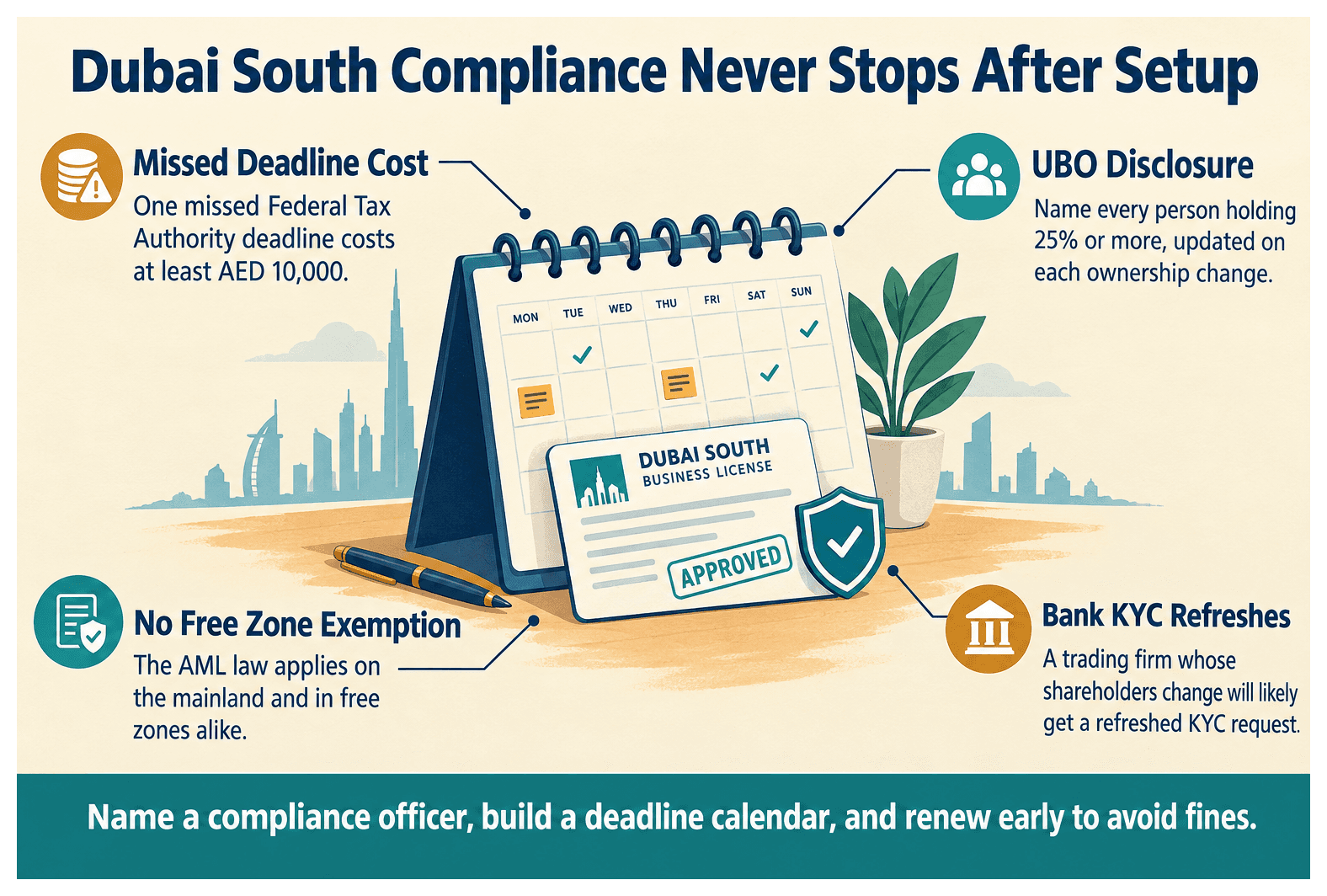
The ongoing compliance requirements of a Dubai South company apply to more than 25,000 businesses in 2026 [1]. One missed Federal Tax Authority deadline costs at least AED 10,000 [2]. Licenses start at AED 12,500 a year [1]. UBO disclosure applies at a 25% ownership threshold [3]. This guide helps compliance officers and owners build a working calendar.
What Are the Ongoing Compliance Requirements of a Dubai South Company and Why They Matter
The ongoing compliance requirements of a Dubai South company are the recurring legal duties a licensed entity must meet after incorporation. They cover AML/KYC controls, goAML reporting, UBO disclosure, license renewal, corporate tax, audited accounts, and record-keeping. Missing them risks fines, blocked renewals, and suspended licenses.
Compliance Is Continuous, Not a Setup Task
Free zone status doesn't exempt you from federal AML and tax law. Picture a trading company that clears incorporation, then forgets its first UBO update. Its renewal gets blocked, and the owner scrambles. Dubai South rules and UAE federal rules stack together.
Owners and Compliance Officers Share Accountability
Owners carry ultimate liability for filings. Compliance officers run the controls and reporting. In one owner-managed firm, naming a compliance officer to own the deadline calendar ended the habit of last-week renewals. Penalty exposure starts at AED 10,000 per missed filing.
UAE AML Legislation Every Dubai South Company Must Know
UAE AML legislation rests on Federal Decree-Law No. 20 of 2018 and Cabinet Decision No. 10 of 2019, as later amended. Free zone companies must run risk-based customer due diligence (CDD), screen sanctions, and report suspicious activity to the Financial Intelligence Unit (Ministry of Finance, 2025) [4].
No Free Zone Carve-Out
The law applies on the mainland and in free zones alike. A Dubai South consultancy must complete CDD on a new foreign client before onboarding, not after the first invoice.
Who Counts as a DNFBP?
Real estate agents and brokers
Dealers in precious metals and stones
Lawyers and accountants
Corporate service providers
The Ministry of Finance supervises most of these. An auditing firm at Dubai South should confirm its status early. Penalties include administrative fines, license action, and personal liability for managers in serious breaches. Failing to keep CDD records is a typical trigger.
How CBUAE Guidance Shapes AML and KYC Duties for Free Zone Companies
The Central Bank of the UAE (CBUAE) sets AML/CFT standards for banks and licensed financial institutions (CBUAE, 2025) [5]. Free zone companies feel it through bank onboarding, source-of-funds checks, and periodic reviews. Your bank will ask for current ownership and activity documents.
Most Dubai South companies aren't CBUAE-licensed. Still, a trading firm whose shareholders change will likely get a refreshed KYC request from its bank.
Ongoing Compliance Obligations at a Glance
Feature | Obligation | Frequency and Authority |
|---|---|---|
UBO record maintenance and updates | Name every person holding 25% or more | On each ownership change; free zone authority |
CDD, KYC, and sanctions screening | Verify identity, source of funds, PEP and sanctions status | At onboarding, then risk-based reviews; banks and supervisors |
goAML registration and STR filing | Register if supervised; file reports without tipping off | Promptly after suspicion arises; Financial Intelligence Unit |
Corporate tax registration and annual return | Register, file, keep financial statements | Annually; Federal Tax Authority, AED 10,000 late registration penalty |
License and visa renewal | Renew license and aligned residency visas | Yearly; Dubai South Business Hub, licenses from AED 12,500 |
Core KYC Elements You Must Maintain
IDs for shareholders, directors, and UBOs
Source of funds and wealth records
Customer risk ratings and review dates
Sanctions and PEP screening results
A corporate shareholder with a layered chain needs a file tracing each layer to a natural person. See how to add a corporate shareholder properly.
Step-by-Step Checklist for the Ongoing Compliance Requirements of a Dubai South Company
To meet the ongoing compliance requirements of a Dubai South company, maintain UBO records, run CDD, screen sanctions, register on goAML if required, file tax returns, complete audits, and renew on time. A dated calendar tracks each deadline.
Step 1: Maintain Your UBO Records
Identify every person owning or controlling 25% or more. Update records on any change. For help, read what UBO disclosure requires.
Step 2: Run CDD, Screening, and Risk Rating
Verify identity before onboarding. Screen against UN and UAE local terrorist lists. Apply enhanced due diligence to high-risk clients, such as a new overseas supplier before the first payment.
Step 3: Register on goAML and Report
Register where required and appoint a compliance officer. File an STR if a client requests unusual cash settlement.
Step 4: File Taxes, Audit, and Renew
Register for corporate tax, file annually, and book renewals 60 days ahead. Our license renewal process guide explains the timeline.
How goAML Reporting Works for a Dubai South Company
goAML is the UAE Financial Intelligence Unit's platform for suspicious transaction reports. Supervised entities such as DNFBPs must register, appoint a compliance officer, and report promptly (Ministry of Finance, 2025) [4].
A real estate brokerage at Dubai South needs its trade license, officer details, and signatory ID ready.
STRs and SARs for suspicious activity
Reports for sanctions matches
Never tell the customer about a filing
Corporate Tax, Audit, and Record-Keeping Obligations Beyond AML
Beyond AML, you must register for corporate tax, file annual returns, and keep financial records. Qualifying Free Zone Persons need audited statements (Federal Tax Authority, 2025) [2]. Records must be producible on request.
Corporate Tax Duties
Federal corporate tax has applied to free zone companies since June 2023. Qualifying status changes your rate, so don't call any structure tax free. Review Dubai South corporate tax requirements before your first return.
Audit and Record Retention
Keep AML, CDD, and transaction records
Store files in a retrievable format
Lost invoices can block renewal
Check what records a Dubai South company must keep.
Common Compliance Mistakes and How to Avoid Them
Common failures include stale UBO records, missing CDD files, late renewals, unfiled returns, and no named compliance officer. A dated calendar and periodic internal review prevent most of them.
Ownership changes missing from records
License renewed, employee visas lapsed
Stale KYC files
Map every deadline, set reminders 60 to 90 days ahead, and assign a named owner. A quarterly KYC review on a shared calendar works well. Our compliance checklist adds detail.
Your Next Move
The ongoing compliance requirements of a Dubai South company work best as one calendar-driven system under Federal Decree-Law No. 20 of 2018. Review your UBO, KYC, and renewal records against this checklist. Then speak to the Dubai South Business Hub team about licensing and residency visa packages.
References
Dubai Chamber, 2026
Federal Tax Authority, 2025
UAE Cabinet, 2025
Ministry of Finance, 2025
Central Bank of the UAE, 2025
Frequently Asked Questions