Topic Summary
What Is a UAE Transfer Pricing Master File and Local File and Why It Matters
Under UAE transfer pricing rules, a Master File is a group-level report describing a multinational's global operations, policies and financial position. A Local File is an entity-level report detailing the UAE company's related-party transactions and arm's length pricing. Both sit under Federal Decree-Law No. 47 of 2022 and Ministerial Decision No. 97 of 2023, which follow OECD BEPS Action 13.
Transfer Pricing Threshold UAE: Who Must Prepare Which File
Transfer Pricing Threshold UAE: Who Must Prepare Which File
What Does a Local File Contain Beyond the Master File
A Local File holds the UAE entity's management structure, strategy, each controlled transaction, the pricing method, benchmarking and financial statements. It proves each related-party price is arm's length. The Master File stays at group level.
How to Prepare a Master File and Local File in the UAE Step by Step
Identify related parties, list controlled transactions, test thresholds, gather agreements and financials, pick a method, run benchmarking, draft both files, review for consistency and store them securely. Keep them ready for the Federal Tax Authority.
Master File vs Local File: Cost, Effort and Timing Compared
A Master File is group-level, usually prepared once by the parent and reused. A Local File is entity-specific and needs UAE benchmarking, so it carries more of the compliance effort and cost. The fees in the table above are market estimates as of May 2026, not government fees. Confirm them with your adviser.
Penalties, Deadlines, and Retention Rules for Transfer Pricing Documentation
The Federal Tax Authority can request both files and typically expects them within 30 days of notice, so verify current guidance. Failure to keep or provide them can trigger administrative penalties and price adjustments. Keep records for at least seven years.
Common Mistakes in UAE Transfer Pricing Master File and Local File Preparation
Common mistakes: assuming small entities are exempt from everything, copying the group Master File without UAE detail, using stale benchmarks, skipping written agreements and contradicting facts between files. Each weakens your arm's length position.
The UAE transfer pricing master file local file rules apply to a small group of large taxpayers, but every related-party deal still has to be priced at arm's length. With more than 350,000 businesses registered with the Federal Tax Authority in 2026 [1], that duty reaches a lot of owners. A Master File is due at AED 3.15 billion of group revenue and a Local File at AED 200 million of entity revenue [2]. Taxable income above AED 375,000 is taxed at 9% [1], so an adjusted price costs real money. Records must be kept for seven years [3]. This guide is for owners and finance leads who want to know which files apply and how to prepare them.
What Is a UAE Transfer Pricing Master File and Local File and Why It Matters
Under UAE transfer pricing rules, a Master File is a group-level report describing a multinational's global operations, policies and financial position. A Local File is an entity-level report detailing the UAE company's related-party transactions and arm's length pricing. Both sit under Federal Decree-Law No. 47 of 2022 and Ministerial Decision No. 97 of 2023, which follow OECD BEPS Action 13.
Master File Explained in Plain Terms
Think of the Master File as the group blueprint: structure, business lines, intangibles, financing and tax positions. The same document usually serves every group entity. A European manufacturer with a Dubai South distribution subsidiary reuses its global file and adds UAE detail only in the Local File.
Local File Explained in Plain Terms
The Local File is the UAE entity's story: management structure, controlled transactions, benchmarking and financials. Say a UAE trading company buys stock from its Singapore parent. The file records the price, the method chosen and the comparables behind it.
Why Documentation Protects Your Business
It moves the burden of proof off you in a review.
It cuts adjustment and penalty exposure.
It closes queries fast. One management fee query ended in days because the agreement and benchmarking were already filed.
For wider context, read our guide to transfer pricing documentation in the UAE.
Transfer Pricing Threshold UAE: Who Must Prepare Which File
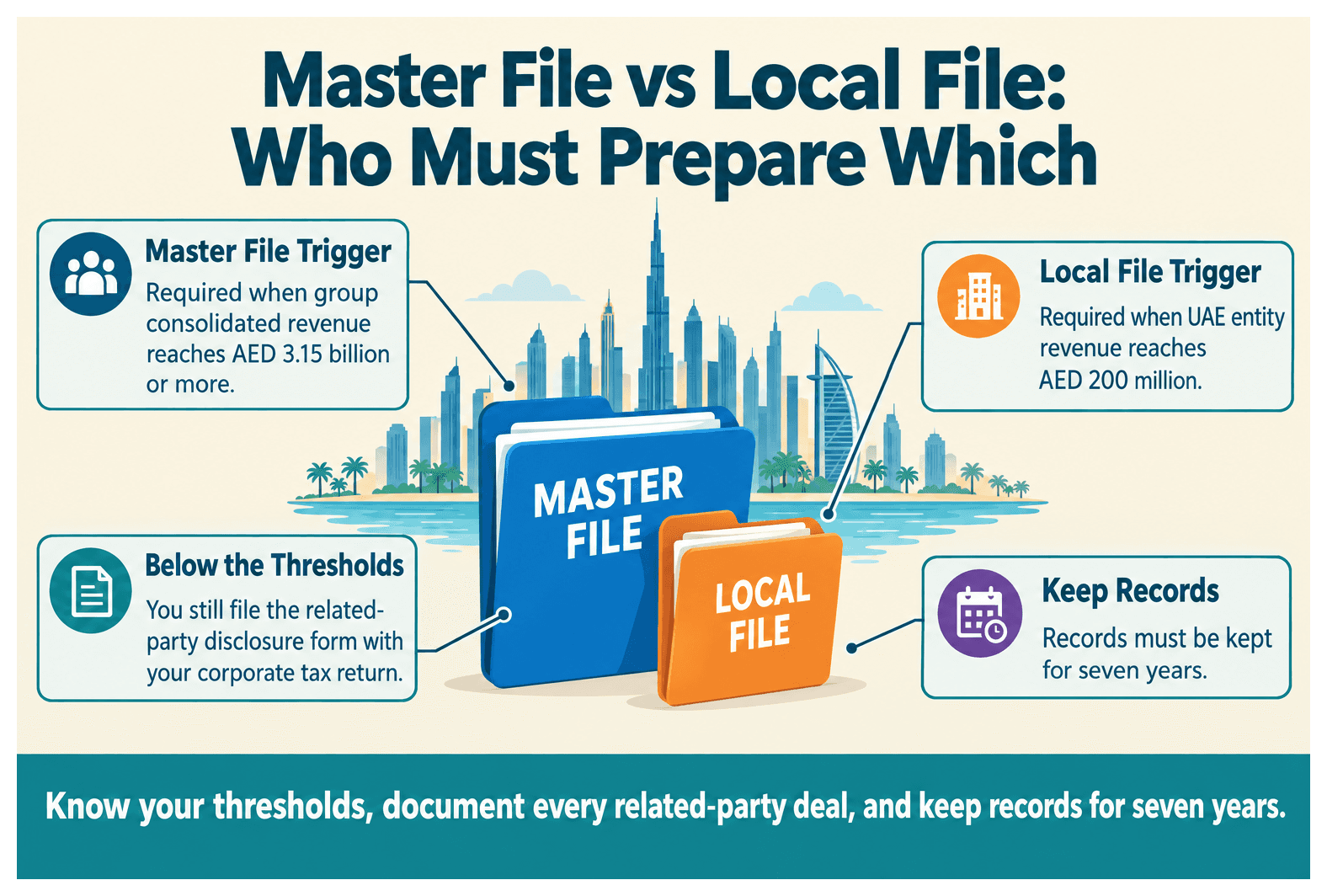
A Master File is required when the group's consolidated revenue is AED 3.15 billion or more. A Local File is required when the UAE taxable person's revenue reaches AED 200 million, or when it belongs to a group that must prepare a Master File. Disclosure rules apply separately.
Master File Threshold and Who It Catches
The test uses group consolidated revenue, not local revenue. A small regional subsidiary of a group above AED 3.15 billion is caught anyway. Most owner-managed SMEs fall well below it.
Local File Threshold and Related-Party Disclosure
Below the thresholds, you still file the related-party disclosure form with your corporate tax return. A UAE company with AED 60 million revenue and a Cayman parent needs no Local File, yet it must disclose and keep supporting records. The arm's length principle has no size floor. Verify current figures on tax.gov.ae before relying on them.
Related Parties, Connected Persons and Group Structure
Shareholders, directors and their relatives can be connected persons.
A corporate tax group changes which dealings are tested.
Free zone entities, including Qualifying Free Zone Persons, face the same rules.
A Dubai South company paying its owner's holding company a service fee has a controlled transaction.
What Does a Local File Contain Beyond the Master File
A Local File holds the UAE entity's management structure, strategy, each controlled transaction, the pricing method, benchmarking and financial statements. It proves each related-party price is arm's length. The Master File stays at group level.
Core Contents of the Local File
Entity overview, organisation chart and restructurings.
Parties, amounts and contracts for every controlled transaction.
Financials reconciled to audited accounts.
A UAE logistics entity, for example, lists intra-group freight charges with contracts and invoices attached.
Benchmarking and Method Selection
Accepted methods are CUP, resale price, cost plus, TNMM and profit split. You search recognised databases for comparables and explain why your method fits best. A service entity using TNMM might set a cost-plus margin inside the interquartile range of its comparables.
How the Master File Differs in Scope
The Master File covers the value chain, intangibles, financing and group tax positions. The Local File covers your UAE numbers. Keep them consistent. If one says the parent owns a brand and the other says the UAE entity does, expect an FTA query.
How to Prepare a Master File and Local File in the UAE Step by Step
Identify related parties, list controlled transactions, test thresholds, gather agreements and financials, pick a method, run benchmarking, draft both files, review for consistency and store them securely. Keep them ready for the Federal Tax Authority.
Step 1: Map Related Parties and Controlled Transactions
Build a register of shareholders, affiliates and connected persons.
Capture loans, services, royalties, goods and guarantees.
Value each in AED. A finance lead can export intercompany ledger balances to start.
Step 2: Test Against the Thresholds
Compare group revenue to AED 3.15 billion.
Compare entity revenue to AED 200 million.
Record the conclusion in writing. A group at AED 3.4 billion confirms a Master File is due.
Master File vs Local File in the UAE: Comparison
Feature | Master File | Local File |
|---|---|---|
Scope | Whole multinational group | Single UAE taxable person |
UAE threshold (AED) | 3.15 billion group revenue | 200 million entity revenue, or in a Master File group |
Who prepares it | Usually the parent, reused across entities | The UAE entity with its adviser |
Main content | Value chain, intangibles, financing, group tax positions | Controlled transactions, method, benchmarking, financials |
Indicative professional fee (AED, dated) | Often absorbed by the parent; market estimate AED 15,000 to 40,000 (May 2026) | Market estimate AED 20,000 to 60,000 (May 2026) |
Step 3: Gather Contracts, Financials and Benchmarks
Collect intercompany agreements, invoices and pricing policies.
Pull audited accounts. See who must file annual financial statements in the UAE.
Commission or run a benchmarking study.
Step 4: Draft, Review and Store the Files
Draft both files with the same facts.
Get an adviser to review them, ideally after choosing an approved auditor.
Store them for seven years. A CFO should sign off before the return is filed.
Master File vs Local File: Cost, Effort and Timing Compared
A Master File is group-level, usually prepared once by the parent and reused. A Local File is entity-specific and needs UAE benchmarking, so it carries more of the compliance effort and cost. The fees in the table above are market estimates as of May 2026, not government fees. Confirm them with your adviser.
Where the Time Actually Goes
Data gathering and benchmarking take longest. An SME with one related-party loan needs a far lighter file than a group with ten intercompany flows. Start collecting in the final quarter and tie your calendar to the return deadline. To budget the wider picture, estimate your setup costs first.
Penalties, Deadlines, and Retention Rules for Transfer Pricing Documentation
The Federal Tax Authority can request both files and typically expects them within 30 days of notice, so verify current guidance. Failure to keep or provide them can trigger administrative penalties and price adjustments. Keep records for at least seven years.
Submission Timing and FTA Requests
Have files ready by your return due date. A company that received an FTA notice answered inside the window because its files already existed. Understanding how a tax audit works in the UAE helps you plan.
Penalty Exposure and Pricing Adjustments
Penalty amounts change, so check the dated schedule on tax.gov.ae.
An adjusted price lifts taxable income, taxed at 9% above AED 375,000.
A raised management fee adjustment means more tax payable.
Timely documentation avoids most of this.
Record Retention and Treaty Interaction
Keep files for seven years in a secure, retrievable format. If a treaty partner challenges a price, your Local File backs the UAE position.
Common Mistakes in UAE Transfer Pricing Master File and Local File Preparation
Common mistakes: assuming small entities are exempt from everything, copying the group Master File without UAE detail, using stale benchmarks, skipping written agreements and contradicting facts between files. Each weakens your arm's length position.
Treating Thresholds as a Free Pass
Below-threshold entities still follow the arm's length principle.
They still disclose related-party transactions.
A AED 50 million company with no files can't defend a below-market loan rate.
Weak Evidence and Inconsistent Facts
No signed intercompany agreements.
Outdated or irrelevant comparables.
Invoices that don't match agreement terms, which invites adjustment.
Our checklist of audit documents for a Dubai company covers the supporting records.
What Should You Do Next to Meet UAE Transfer Pricing Master File and Local File Requirements
Map your related-party transactions, test them against AED 3.15 billion and AED 200 million, and confirm your duties with a qualified tax adviser. Then set up your UAE entity with a clear name, license and cost plan.
Build Compliance Into Your Setup
Dubai South Business Hub offers free zone company formation, trade licenses and residency visa packages tied to a company license. Corporate tax still applies, so plan for it. Check your company name early, price your license, and diarise your tax documentation calendar in one sitting.
Stay Current With Regulatory Changes
Watch FTA and Ministry of Finance updates, including new UAE tax procedures.
Review documentation annually.
Set a yearly reminder to retest thresholds.
Conclusion
UAE transfer pricing master file local file duties come down to clear thresholds (AED 3.15 billion group revenue, AED 200 million entity revenue), solid arm's length evidence and timely records. Even below the thresholds, disclosure and pricing discipline still apply. Confirm your obligations with a tax adviser, then check your company name and estimate your setup costs with Dubai South Business Hub.
References
Federal Tax Authority, Corporate Tax guidance, 2026
Ministry of Finance, Ministerial Decision No. 97 of 2023 on transfer pricing documentation
Ministry of Finance, Federal Decree-Law No. 47 of 2022 on Corporate Tax
Frequently Asked Questions