Topic Summary
Who Counts as a Related Party or Connected Person
Who Counts as a Related Party or Connected Person
How the Arm's Length Principle Shapes Your Tax Bill
How the Arm's Length Principle Shapes Your Tax Bill
Six Practical Actions to Manage Related Party Transactions
To manage related party transactions for UAE corporate tax, list every party, write contracts, benchmark prices, keep records, disclose, and review yearly. These steps make your pricing defensible.
Why Related Party Dealings Matter for Free Zone Companies
Free zone companies get 0% only as Qualifying Free Zone Persons on qualifying income. Related mainland dealings can create non-qualifying income and push profit into the 9% rate.
Common Mistakes and Exemptions to Check
Verbal agreements, ignored owner payments, missing disclosure and unbenchmarked prices cause most related party transaction problems.
Next Steps for Your Dubai South Company
A related party transaction and why it matters for UAE CT comes down to one idea: price connected dealings like an independent party would, and prove it. That protects deductions and qualifying status.
A related party transaction is any transfer of goods, services, money or assets between a taxable person and a party it owns, controls or is connected to. The Federal Tax Authority can adjust any price that departs from market value.
The stakes are real. The UAE charges 9% corporate tax on taxable income above AED 375,000 under Federal Decree-Law No. 47 of 2022 (Federal Tax Authority, 2026). Understanding a related party transaction and why it matters for UAE CT helps you protect that bottom line.
Plain-Language Definition for Founders
It's any deal between you and a shareholder, sister company, director or family member. Loans, management fees, rent, royalties, staff secondments and goods sales all count. No cash needs to move for the deal to be caught.
Picture a Dubai South company paying its overseas parent AED 400,000 a year as a management fee, with no written agreement. That's exactly the sort of arrangement an auditor will question.
Why the Tax Authority Pays Attention
Connected parties can set prices to shift profit toward lower-tax entities. Inflated costs shrink taxable income. So do undervalued sales, such as selling goods to a sister firm at half the going price. Adjustments can raise taxable income and trigger penalties.
Who Counts as a Related Party or Connected Person
Related parties include entities under common ownership or control, typically 50% or more, plus relatives up to the fourth degree and partners. A connected person is an owner, director or officer, and payments to them can be non-deductible above market value (Ministry of Finance, 2023).
Ownership and Control Tests
The 50% ownership or control test is central.
Parents, subsidiaries and sister companies are covered.
Individuals and relatives form part of the chain.
Example: you own 60% of a Dubai South free zone company and 100% of a mainland trading firm. They're related parties.
Common Related Party Transactions and Their Tax Treatment
Feature | Transaction Type | Key Corporate Tax Consideration |
|---|---|---|
Management fees to a parent company | Annual charge for group services | Deductible only if services are real and priced at market value |
Shareholder loans and interest | Funding from an owner | Interest rate and terms should match an independent lender's |
Sales of goods between sister companies | Intragroup trading | Undervalued prices can be lifted to market, raising taxable income |
Director or owner remuneration | Salary, fees or consulting invoices | Excess over market value can be disallowed |
Royalties for intellectual property | License of brand or software | Rate needs benchmarking; check withholding tax in the UAE too |
Connected Persons and Owner Payments
Say a director invoices AED 600,000 for consulting that a market provider would charge AED 150,000 for. The AED 450,000 gap is at risk. Keep contracts and invoices showing the real service delivered.
Where Corporate Tax Groups Fit
Qualifying groups, typically with 95% ownership, can be taxed as one person, and internal deals are generally ignored. Check the conditions in our guide to corporate tax groups in the UAE before assuming relief.
How the Arm's Length Principle Shapes Your Tax Bill
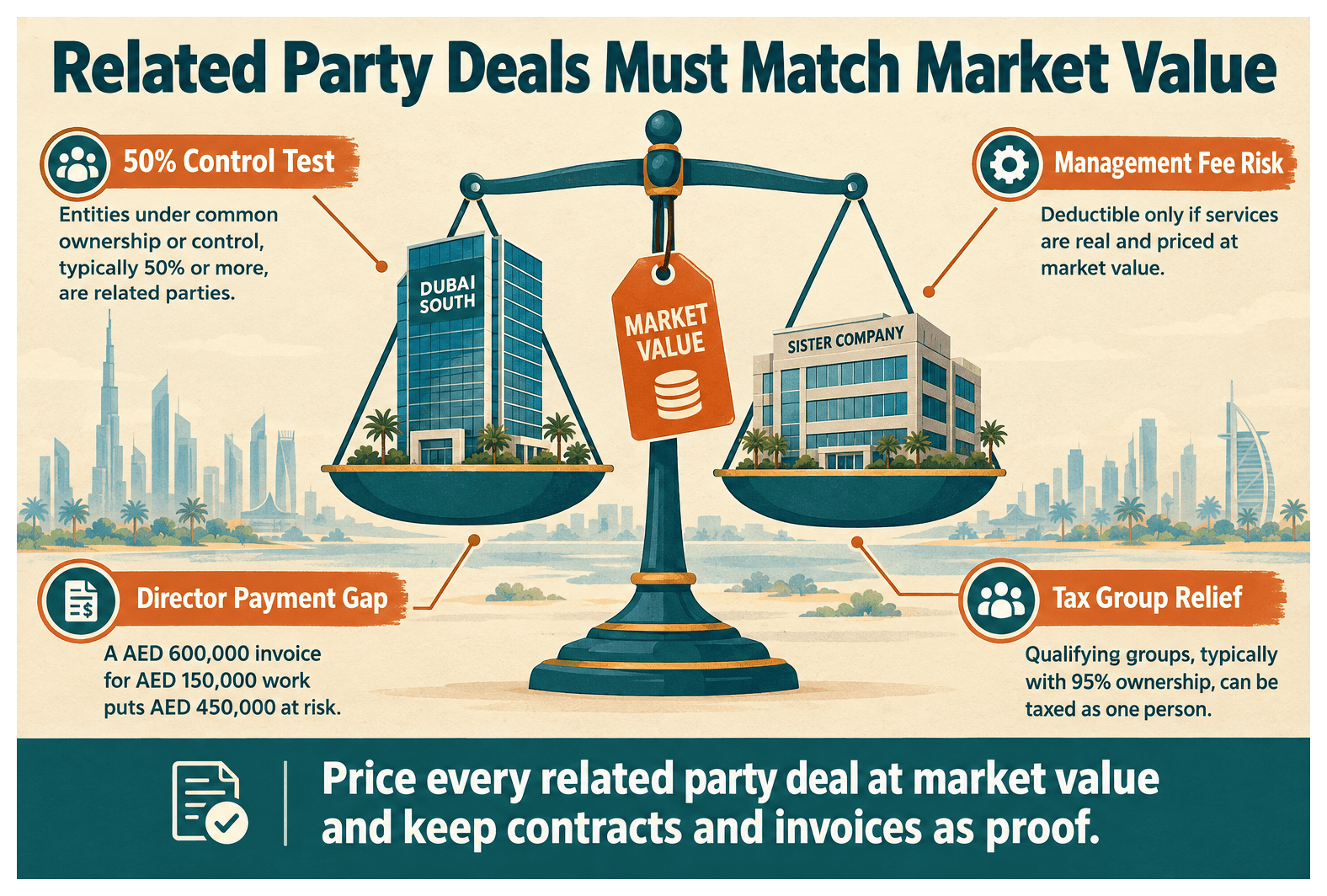
The arm's length principle requires related parties to price deals as unrelated parties would. If your price differs, the Federal Tax Authority can adjust your income, which may raise UAE corporate tax and create penalty exposure.
Choosing a Pricing Method
Comparable uncontrolled price.
Resale price.
Cost plus.
Profit-based methods.
Pick the one your data supports, and record why. A Dubai South IT firm charging an affiliate cost plus 10% for development should benchmark that against independent providers.
What Happens When Prices Miss the Mark
Suppose a review lifts a below-market intragroup sale and adds AED 1 million to taxable income. That's AED 90,000 of extra tax at 9%, before penalties. Early documentation cuts dispute risk. See our guide to transfer pricing documentation in the UAE.
Six Practical Actions to Manage Related Party Transactions
To manage related party transactions for UAE corporate tax, list every party, write contracts, benchmark prices, keep records, disclose, and review yearly. These steps make your pricing defensible.
Actions 1 to 3: Identify, Contract and Price
Map all related parties, including owners' other companies and relatives.
Sign written agreements before services start.
Benchmark prices against independent data.
One founder signed a AED 25,000 monthly marketing agreement with her mainland company, priced against agency quotes. Agreements made at the time carry more weight.
Actions 4 to 6: Document, Disclose and Review
Keep invoices, payment proof and benchmarking files.
Complete the related party disclosure with your return, due within 9 months of year end.
Review pricing yearly and after restructuring.
Local file rules apply from AED 200 million revenue. Below that, simpler records still help.
Why Related Party Dealings Matter for Free Zone Companies
Free zone companies get 0% only as Qualifying Free Zone Persons on qualifying income. Related mainland dealings can create non-qualifying income and push profit into the 9% rate.
Qualifying Income and Related Mainland Entities
Imagine a Dubai South Business Hub trading company selling to a founder-owned mainland distributor. It must check how that income is classified, and de minimis limits apply. Read more on corporate tax for free zone companies with mainland clients and qualifying activities.
Staying Compliant From Day One
Set up contracts and bookkeeping when your license is issued. Invoice each entity separately. Agree a written management-fee policy with an overseas parent before the first invoice. Records must be kept for 7 years (UAE Government Portal, 2026).
Common Mistakes and Exemptions to Check
Verbal agreements, ignored owner payments, missing disclosure and unbenchmarked prices cause most related party transaction problems.
Frequent Errors That Trigger Adjustments
No written contract or invoice trail.
Unrecorded interest-free shareholder loans.
Owner fees far above market rates.
Example: an AED 2 million loan with no terms or repayment schedule.
Exemptions and Reliefs Worth Checking
Small business relief has an AED 3 million revenue limit. One founder assumed it applied, then found the limit was exceeded. Eligibility doesn't remove the need for records. Review corporate tax exemptions in the UAE and confirm status with an adviser.
Next Steps for Your Dubai South Company
A related party transaction and why it matters for UAE CT comes down to one idea: price connected dealings like an independent party would, and prove it. That protects deductions and qualifying status.
Review your related party list and agreements now. Then speak with the Dubai South Business Hub team about licensing, company setup and residency visa packages built with corporate tax compliance in mind.
References
Frequently Asked Questions