
Topic Summary
Bank Deposits Demand Serious Upfront Capital
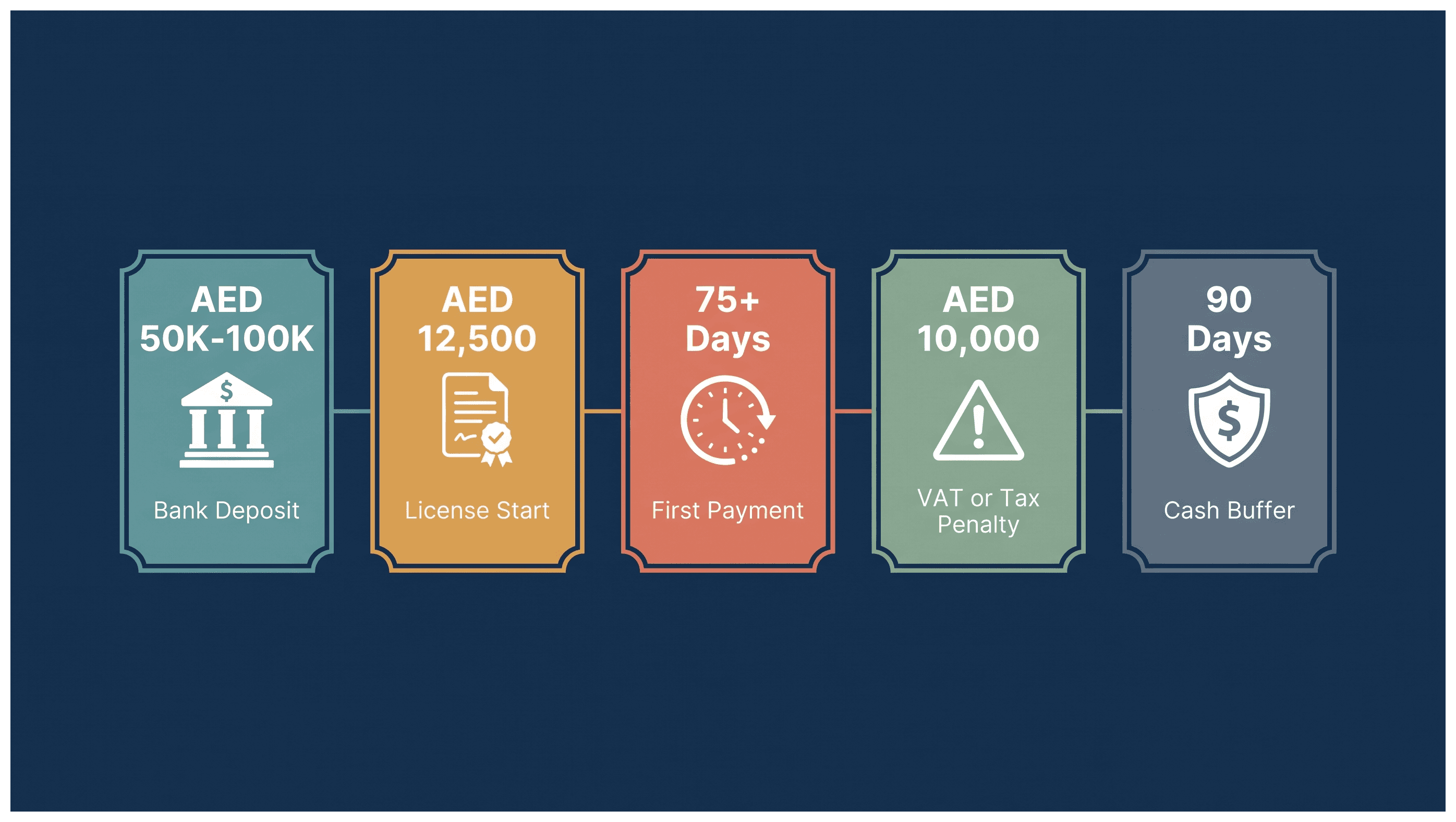
UAE free zone companies must meet AED 50,000 to AED 100,000 in bank deposit requirements before they can begin trading. These minimums vary by institution and are often not disclosed until account onboarding starts, making early budgeting difficult.
License Costs Are Just the Starting Point
Dubai South Business Hub Free Zone packages begin at AED 12,500 and reach AED 18,200, but visa processing fees are quoted separately and must be added to your opening budget. Treating the license fee as your total setup cost is a common and costly mistake.
Missing Tax Registrations Costs AED 10,000 Each
Late VAT registration and late corporate tax registration each carry a flat AED 10,000 penalty. A structured working capital plan should reserve for both of these amounts in advance, since corporate tax registration is mandatory for all UAE entities regardless of profit.
Build a 90-Day Operating Buffer as a Minimum
A consultancy spending AED 50,000 per month needs AED 150,000 in buffer before accounting for license fees, visa costs, or bank deposits. Best practice adds a further 10 to 15 percent contingency on top of that figure.
VAT Timing Mismatches Drain Cash Silently
VAT-registered businesses must remit output VAT within 28 days of the tax period end, even when clients have not yet paid their invoices. Reserving the VAT component in a separate sub-account from day one prevents this from becoming a crisis by quarter two.
Bank Account Opening Can Take Up to Eight Weeks
All operating costs during the account opening period must be funded from shareholder funds. Submitting a complete document pack on the day of license issuance and responding to bank queries within 24 hours can compress the timeline toward the four-week end of the range.
Review Your Plan at Months Three, Six, and Twelve
Actual client payment terms routinely run 15 to 20 days longer than projected, and catching that gap at month three gives a founder six months to improve collections before the shortfall becomes critical. Regular reviews turn a static plan into a living cash-flow management tool.
In 2026, World Bank research consistently identifies inadequate working capital as one of the top three reasons small and medium enterprises in emerging markets fail within their first two years. UAE free zone companies face AED 50,000 to AED 100,000 in bank deposit requirements before they can trade. License packages at Dubai South Business Hub Free Zone start at AED 12,500. VAT late registration carries a flat AED 10,000 penalty. Corporate tax late registration adds another AED 10,000 one-time flat penalty. And standard UAE client payment terms run 30 to 60 days, meaning cash from your first invoice may not arrive for 75 days or more.
This working capital planning Dubai guide walks free zone company owners and finance managers through the requirements, costs, and exact steps needed to build a cash-flow foundation that keeps a new business operational from day one.
Topic Summary
Working capital gaps kill new Dubai businesses early.
The World Bank identifies working capital shortfalls as a top-three cause of SME failure in emerging markets. For UAE free zone companies, the risk is acute: government fee cycles cluster in year one, banks require AED 50,000 to AED 100,000 in deposits, and clients pay 30 to 60 days after invoice.
Regulatory thresholds create hard cash exposure.
VAT registration becomes mandatory at AED 375,000 taxable turnover. Corporate tax registration is mandatory for all UAE entities regardless of profit. Missing either deadline costs AED 10,000 per registration in penalties, both of which a structured working capital plan should reserve for in advance.
License costs are predictable; visa and banking costs are not.
Dubai South Business Hub Free Zone packages range from AED 12,500 to AED 18,200. Visa processing fees are quoted separately and must be added to your opening budget. Bank deposit minimums vary by institution and are not disclosed until account onboarding begins.
A 90-day operating buffer is the practical minimum.
A consultancy projecting AED 50,000 per month in costs needs AED 150,000 in buffer alone, before adding license fees, visa costs, and bank deposits. Working capital planning Dubai best practice sets a 10 to 15% contingency on top of that figure.
VAT timing mismatches drain cash silently.
VAT-registered companies must remit output VAT within 28 days of the tax period end, even if clients have not yet paid. Reserving the VAT component in a separate sub-account from day one prevents this from becoming an operational crisis in quarter two.
Bank account opening takes four to eight weeks.
All operating costs during this period must come from shareholder funds. Submitting a complete document pack on day one of license issuance, and responding to bank queries within 24 hours, can compress the timeline toward the four-week end of that range.
Review the plan at month three, six, and twelve.
Actual payment terms routinely run 15 to 20 days longer than projected. A founder who identifies a 50-day average versus a 30-day projection at month three has six months to adapt collections before the shortfall becomes critical.
What Is Working Capital Planning for a Dubai Company and Why It Matters
Working capital planning for a Dubai company is the process of forecasting, allocating, and managing the short-term cash a business needs to cover operating costs, regulatory fees, and supplier obligations before client revenue becomes consistent. It determines whether a new company can sustain daily operations without interruption.
The Core Components of Working Capital
Working capital is current assets minus current liabilities. In a Dubai free zone context, that formula translates into three asset buckets and three liability buckets that every finance manager should track separately.
The asset side covers: cash and bank balances, receivables from clients (invoices issued but not yet paid), and prepaid government fees such as license deposits or visa processing payments already made. The liability side covers: trade payables owed to suppliers, VAT output tax collected from clients but not yet remitted to the Federal Tax Authority, and accrued payroll for any hired staff.
Free zone companies have a distinct profile compared to mainland businesses. Physical inventory is typically low or absent, but regulatory-fee cycles are annual and lump-sum, which creates predictable but large outflows that must be reserved for. A two-person consultancy at Dubai South Business Hub Free Zone holding AED 80,000 in cash, AED 30,000 in outstanding invoices, and owing AED 15,000 in supplier fees has working capital of AED 95,000. That number tells you how many weeks of operations the business can self-fund.
Why New Dubai Businesses Face a Higher Working Capital Risk
New companies have no receivables history. That makes UAE banks conservative about extending credit facilities, so almost all early-stage working capital must come from shareholder funds rather than borrowed lines.
Government fee cycles cluster heavily in year one. License issuance, establishment card fees, and visa processing all land within the first 60 to 90 days. Annual renewal then arrives 12 months later, whether or not the business has reached profitability.
Standard UAE client payment terms of 30 to 60 days create an immediate gap between service delivery and cash receipt. A trading company that issues its first invoice on day 30 but operates on 45-day payment terms will not receive cash until day 75, requiring 75 days of entirely self-funded operations. The World Bank's SME finance data confirms that working capital shortfalls, not market failure, account for a disproportionate share of early business closures in the MENA region (World Bank, 2024). Plan for the gap before you start your business, not after your first invoice goes out.
Working Capital Dubai Requirements: What the Regulations Demand
Dubai free zone companies must meet bank minimum deposit requirements, VAT registration thresholds at AED 375,000 turnover, and corporate tax registration obligations. There is no universal statutory minimum share capital for most free zones, but each regulatory layer creates a cash commitment that must be factored into your opening working capital.
Share Capital and Bank Deposit Minimums
Most Dubai free zones do not legislate a minimum paid-up share capital, but don't confuse that with having no cash requirement. The figure on your Memorandum of Association and the cash your bank expects to see in your account are two entirely separate numbers.
UAE commercial banks typically require AED 50,000 to AED 100,000 in initial deposits as part of their account-opening due diligence. This is an internal bank policy, not a free zone requirement, and it varies by institution and account type. The Central Bank of the UAE sets the regulatory framework within which all licensed commercial banks operate their deposit and onboarding policies.
A professional services company may list AED 10,000 share capital on its Memorandum of Association but still need AED 75,000 in a bank account to satisfy the relationship manager's onboarding criteria. Both figures must appear separately in your working capital plan.
What are the VAT and corporate tax thresholds for Dubai companies?
VAT mandatory registration applies at AED 375,000 taxable turnover. Corporate tax registration is compulsory for all UAE entities regardless of profit level. Missing either deadline triggers a flat AED 10,000 penalty per registration, making proactive calendar management a direct cash-saving measure for any new business.
The key thresholds you need to build into your working capital reserve:
VAT mandatory registration: AED 375,000 taxable turnover (register before crossing, not after)
VAT voluntary registration: AED 187,500 (strategically useful for early input tax recovery)
VAT late registration penalty: AED 10,000 flat (Federal Tax Authority, 2026)
Corporate tax registration: mandatory for all UAE entities, no profit threshold
Corporate tax late registration penalty: AED 10,000 one-time flat
Corporate tax rate: 9% on taxable income above AED 375,000; 0% on income up to AED 375,000
The 0% rate for Qualifying Free Zone Persons (QFZP) requires all four conditions to be met: adequate substance in the free zone, qualifying income as defined under the law, no election out of the regime, and full transfer-pricing compliance. Missing any one of the four conditions removes the 0% benefit entirely.
A technology firm that crosses AED 375,000 in month eight but delays VAT registration until month ten faces an immediate AED 10,000 penalty. A well-structured working capital plan would have reserved that amount from month one.
Dubai Free Zone Working Capital Cost Summary
Cost Item | Amount / Notes |
|---|---|
0 Visa License Package | AED 12,500, includes license, Articles of Association, share register, flexi-desk space |
1 Visa License Package | AED 16,350, adds one investor or partner visa allocation and establishment card |
2 Visa License Package | AED 18,200, adds two investor or partner visa allocations and establishment card; maximum 2 allocations |
Visa Processing Fees | Quoted separately, covers entry permit, status change, medical, Emirates ID per person |
Bank Deposit Minimum | Typically AED 50,000 to AED 100,000, bank-specific; confirm before selecting account type |
VAT Late Registration Penalty | AED 10,000 flat, applies if registration is not completed before taxable turnover reaches AED 375,000 |
Corporate Tax Late Registration Penalty | AED 10,000 one-time flat, mandatory registration for all UAE entities regardless of profit level |
Working Capital Dubai Costs: License, Visas, and Operating Expenses
The upfront working capital cost for a Dubai free zone company includes the license package, separately quoted visa processing fees, bank deposit minimums, and three months of operating expenses as a buffer. This working capital Dubai guide uses Dubai South Business Hub Free Zone pricing as the reference point: packages start at AED 12,500 and rise to AED 18,200 for the 2 Visa Package.
License Package Costs at Dubai South Business Hub Free Zone
Every package includes the license, Articles of Association, share register, flexi-desk space. The 1 and 2 Visa packages add the investor or partner visa allocation and establishment card. The license is issued in one business day once documentation is complete.
0 Visa Package: AED 12,500, license, Articles of Association, share register, flexi-desk, lease agreement
1 Visa Package: AED 16,350, adds one investor or partner visa allocation and establishment card
2 Visa Package: AED 18,200, adds two investor or partner visa allocations and establishment card (maximum 2 allocations)
Visa processing is always quoted separately and covers entry permit, status change, medical examination, Emirates ID application. These fees must be added to your working capital projection before you commit to a package. A husband-and-wife trading partnership choosing the 2 Visa Package at AED 18,200 must also budget separately for two complete sets of visa processing fees before either partner can legally reside in the UAE under the company. Use the business setup cost calculator to confirm your exact total before finalising your opening budget.
Recurring and Hidden Operating Costs to Plan For
Annual license renewal falls due every 12 months. Reserve for it in cash from month one; don't assume client revenue will cover it when the date arrives.
Flexi-desk and lease fees are bundled in all packages. Upgrading to a private office adds a separate cost that must appear in your budget.
Payroll for hired staff creates a fixed monthly outflow. Wages Protection System (WPS) compliance under MoHRE is mandatory and must be factored into your cash flow timing.
Bank charges, accounting software, and professional service retainers are recurring costs that new owners routinely underestimate.
Some business activities in Dubai require separate regulator approval fees on top of the free zone package. An ICT company adding a software-development activity needing a regulator's approval faces both the free zone license fee and a separate government authority fee. Both must appear in the working capital budget.
Step-by-Step Working Capital Planning Process for a New Dubai Company
To build a working capital plan for a new Dubai company, map all fixed setup costs first, then project 90 days of operating expenses, add regulatory reserves for VAT and corporate tax penalties, confirm your bank deposit requirement, and open your business account before committing to supplier or payroll obligations.
Planning Steps
List every known setup cost. Include the license package, visa processing fees, bank deposit minimum, any office fit-out costs, and regulator approval fees for your chosen business activities. Nothing should be estimated as zero until you have a confirmed quote.
Project 90 days of fixed operating costs. Cover payroll, accounting fees, software subscriptions, and flexi-desk or office rent. A 90-day buffer is the practical minimum for a new Dubai company with no receivables history.
Model your receivables cycle. Identify your expected client payment terms and calculate the cash gap between service delivery and cash receipt. If you expect 45-day terms, you're self-funding for at least 75 days from your first engagement.
Calculate your VAT position. If projected turnover approaches AED 375,000 within the first 12 months, reserve AED 10,000 for registration and budget for quarterly VAT output payments due 28 days after each tax period closes.
Register for corporate tax before the deadline. Reserve the AED 10,000 one-time flat penalty provision in case of processing delays. Registration is mandatory regardless of profit level.
Add a 10 to 15% contingency. Apply this to your total operating cost projection, not just to the license fees. Unexpected bank charges, regulator fees, and delayed client payments all erode working capital faster than most founders anticipate.
Confirm your bank deposit requirement before opening. Account opening takes four to eight weeks. All costs during that period come from shareholder funds. A consultancy proj
References
Frequently Asked Questions