What Australia Tax Rules Apply When You Also Own a Dubai Company

Topic Summary
Separate Residency From Registration
A Dubai free zone company does not by itself end Australian tax obligations. The ATO considers your home, personal ties and time spent in Australia when assessing residency.
Identify Income and Work Location
Salary, dividends, company profits and other distributions may be treated differently. Keep evidence of where services are performed and where business decisions are made.
Review CFC Rules Before Filing
Controlled foreign company rules may attribute certain income in specified circumstances, but they do not automatically tax every Dubai company profit. Ask an adviser to assess control, income categories and potential exemptions.
Coordinate Australian and UAE Filings
Australian owners should review foreign-income and foreign-interest reporting, while UAE companies must meet applicable registration, record-keeping, return and payment duties. ASIC requirements may also apply depending on the Australian business presence and structure.
Track Separate Tax Calendars
Keep Australian personal filing dates separate from UAE company deadlines. The UAE Federal Tax Authority administers corporate tax, generally at 9% on taxable income above AED 375,000 in 2026.
Align Records Across Both Countries
Maintain consistent ownership, income, accounts, contracts and decision-making records for Australian and UAE compliance. Coordinate with advisers in both countries, including on any double tax treaty questions.
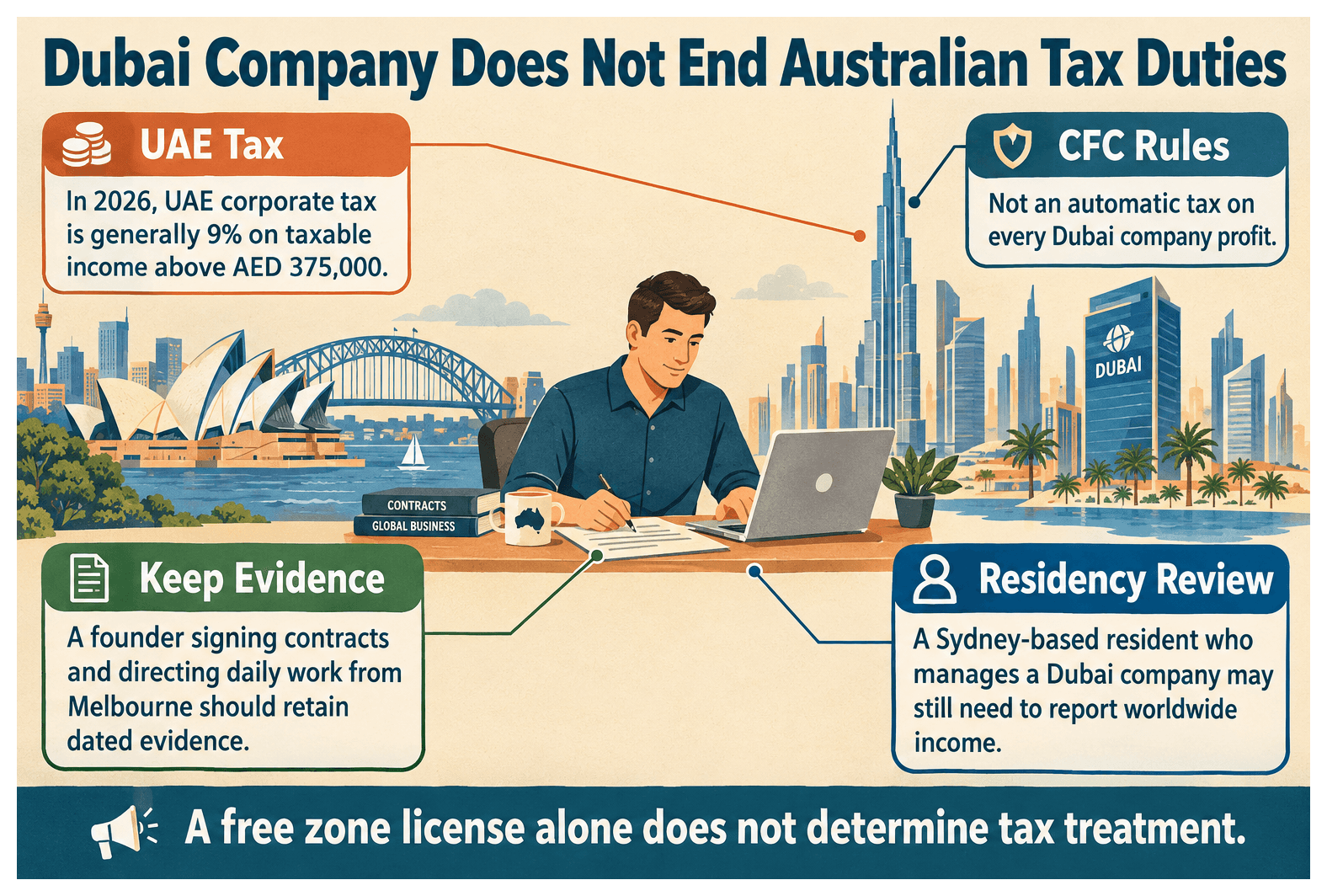
In 2026, UAE corporate tax is generally 9% on taxable income above AED 375,000 [1]. Australia tax rules dubai company owners face depend on personal tax residency, company control and income type. Registering a Dubai South Business Hub (DSBH) Free Zone company does not itself end Australian tax obligations. This guide helps Australian founders identify residency, controlled foreign company (CFC) and reporting issues to discuss with advisers.
Separate Your Personal Residency From Company Registration
The Australian Taxation Office (ATO) considers your circumstances, including home, ties and time spent in Australia; no single factor settles every case. A Sydney-based resident who manages a Dubai company may still need to report worldwide income. Review Dubai company Australian tax residency separately from company registration.
Identify the Activities and Income Behind the Structure
Salary, dividends, company profits and other distributions can receive different treatment. If you perform client work from Australia, document where services happen and where decisions are made. A free zone license alone does not determine tax treatment. That distinction is central to Australia tax rules dubai company owners should assess early.
How Australia Tax Rules Dubai Company Ownership and Tax Residency
Australian tax residents may have obligations on foreign income, even when they own a UAE company. CFC rules can attribute certain foreign income in specified circumstances. The outcome depends on statutory tests, ownership, control and income categories, so Australian founder Dubai tax planning needs a fact-based review.
Assess Whether Controlled Foreign Company Rules May Apply
CFC rules are an anti-deferral regime, not an automatic tax on every Dubai company profit. Have an adviser assess control, attribution, active-income rules and potential exemptions. For example, an Australian resident with a controlling interest should review the company’s income categories before filing, rather than assume incorporation location settles liability.
Check Where Work, Decisions and Management Actually Occur
Contracts, staff, service delivery and decision-making help explain how the business operates. A founder signing contracts and directing daily work from Melbourne should retain dated evidence. See setting up and running a Dubai company from Australia.
Australian Owner and UAE Company Compliance Responsibilities
Feature | Australian Owner Obligations | UAE Company Obligations |
|---|---|---|
Residency and foreign income review | Review personal residency and foreign income reporting. | Keep company income and ownership records. |
CFC and ownership assessment | Ask an adviser to test control and attribution. | Provide accurate ownership and accounts information. |
Company registration and tax returns | Check Australian registration or reporting needs. | Meet applicable UAE registration and return duties. |
Records and filing calendar | Track personal filing dates and supporting documents. | Track company filings, accounts and tax dates. |
Adviser coordination | Coordinate Australian tax advice. | Coordinate UAE corporate tax advice. |
What Australian and UAE Reporting Does a Dubai Company Require
Australian owners should check personal income tax and foreign-interest reporting. The UAE company must meet applicable registration, record-keeping, return and payment duties under Federal Decree-Law No. 47 of 2022 [2]. ASIC requirements can also arise depending on Australian business presence and structure. Australian tax dubai free zone compliance involves separate calendars, not a single combined filing.
Coordinate ATO, ASIC and UAE Company Obligations
The Federal Tax Authority (FTA) administers UAE corporate tax. The general rate is 9% above AED 375,000 of taxable income [1]. For example, a founder with Australian operations can track personal returns separately from UAE company filings. Review Dubai corporate tax filing services for operational context.
Steps to Keep Australian and UAE Company Tax Compliance on Track
Good records make Australia tax rules dubai company obligations easier to assess. Confirm residency, review CFC exposure, map income and coordinate advisers before filing.
Map Residency, Ownership and Income
Record residency facts, ownership percentages and control.
Classify salary, dividends and business income.
Keep travel and living-arrangement evidence, especially during relocation.
For broader moving to Dubai from Australia planning, remember that relocation alone doesn’t settle tax residency.
Align Filing Calendars and Supporting Records
Save contracts, invoices, accounts and board minutes.
Track Australian and UAE deadlines in one calendar.
Review tax treatment before dividends or major changes.
How the UAE-Australia Double Tax Treaty Coordinates Tax
The UAE-Australia Double Tax Treaty coordinates taxing rights and addresses specified double-tax cases. It doesn’t automatically exempt a company or owner, or replace domestic residency, CFC and reporting rules.
Review Treaty Relief Alongside Domestic Tax Rules
If income appears taxable in both countries, have advisers assess the relevant treaty article and domestic relief before filing. Treatment depends on income type and eligibility. Read double tax treaties and your UAE company for broader context.
Keep Your Australian and UAE Company Records Aligned
Australia tax rules dubai company owners need to consider depend on real operations, not just a license. Immigration records support administration but don’t determine Australian tax residency. The Federal Authority for Identity, Citizenship, Customs and Port Security (ICP), General Directorate of Residency and Foreigners Affairs Dubai (GDRFA) and Emirates ID records should remain consistent with actual circumstances.
Plan the Dubai License With Cross-Border Advice
A consulting founder can confirm the proposed activity and estimate license costs before obtaining tax advice. Use the Business Activities and Cost Calculator to assess setting up or buying a license, then confirm your position with qualified Australian and UAE advisers. Australia tax rules dubai company cases require tailored advice, not assumptions.
References
what-australia-tax-rules-apply-when-you-also-own-a-dubai-company