Tax Treaty Between the UAE and Australia: What It Means for Your Company

Topic Summary
How the Treaty Works
The UAE-Australia treaty allocates taxing rights and may provide relief from double taxation on covered income. It works alongside domestic tax rules and does not automatically exempt a company or its owner.
Income Covered by the Treaty
The treaty addresses categories including business profits, dividends, interest, royalties and employment income. The relevant article’s conditions, residency and beneficial ownership can affect eligibility.
Treaty Relief Is Not Automatic
A UAE incorporation, free zone licence or tax registration alone does not establish treaty eligibility or end an owner’s Australian tax residency. Check the income source, residence evidence and relevant treaty article.
Compare Treaty and Tax Obligations
Treaty relief concerns taxing rights on particular income, while domestic rules may still require UAE corporate tax reviews, registrations or filings and Australian reporting. Assess the company and founder separately.
Four Checks Before Claiming Relief
Identify the taxpayer and income category, assess the relevant residence position, check the treaty article’s conditions, and prepare supporting records. Do not assume a withholding rate or reduction without confirming eligibility.
Plan Your Position Before Setup
Review UAE corporate tax conditions and possible Australian tax exposure before establishing a Dubai South Business Hub Free Zone company. Treaty status does not guarantee qualifying free zone treatment.
The UAE-Australia tax treaty entered into force in 2004, more than 20 years ago. For Australian entrepreneurs, the tax treaty UAE Australia sets rules for allocating taxing rights and addressing double taxation on covered income. This guide explains what it may mean for your Dubai South Business Hub Free Zone company, the separate UAE and Australian tax checks, and the records to prepare before claiming relief.
What Is the Tax Treaty UAE Australia and How Does It Work?
The UAE-Australia Double Tax Treaty allocates taxing rights between the countries and provides relief where covered income could otherwise face tax in both. For a founder with a UAE company, the tax treaty UAE Australia works alongside domestic tax rules. It doesn’t automatically exempt the company or its owner.
Which Income and Taxpayers the Treaty Covers
The official agreement is the UAE-Australia Double Taxation Agreement, referred to here as the Treaty. It addresses income categories including business profits, dividends, interest, royalties and employment income, subject to each article’s conditions. Residency, beneficial ownership and the income’s circumstances matter. The UAE Ministry of Finance lists the agreement in its treaty information.
An Australian resident who owns a UAE company must assess company income separately from personal income. The Australian tax residency position needs its own analysis.
Why Treaty Relief Is Not Automatic
Incorporation, a free zone license or UAE tax registration doesn’t prove treaty eligibility. A founder’s UAE company registration alone doesn’t show that they’ve stopped being an Australian tax resident. Check the income source, residence evidence and relevant article. The rules for UAE company treaty claims provide useful context.
Which Taxes Can the Tax Treaty UAE Australia Reduce or Eliminate?
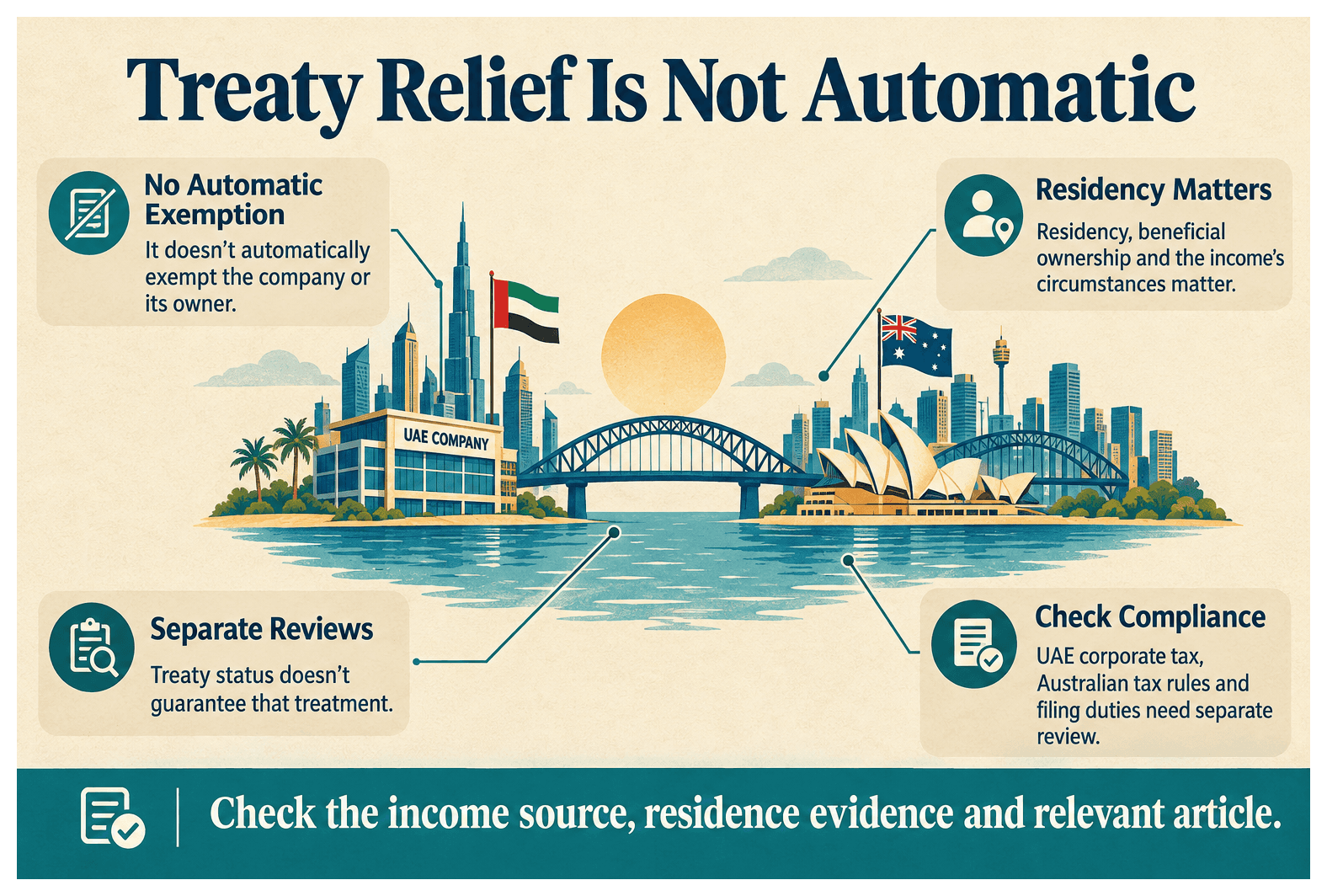
The tax treaty UAE Australia may reduce or eliminate tax on particular covered income when its conditions are met. Relief can involve source-country withholding limits or relief in the country of residence. It doesn’t remove every obligation: UAE corporate tax, Australian tax rules and filing duties need separate review.
Withholding Tax and Cross-Border Income
Dividends, interest and royalties can have different treaty provisions. Don’t assume a particular rate or reduction without checking the relevant article and eligibility. UAE domestic withholding treatment is a separate question. For example, a UAE company receiving Australian-source income should confirm the income category and retain evidence of residence before seeking a treaty outcome.
UAE Corporate Tax and Australian Tax Exposure
Federal Decree-Law No. 47 of 2022 governs UAE corporate tax. A qualifying free zone person must meet statutory conditions; treaty status doesn’t guarantee that treatment. The Federal Tax Authority (FTA) administers UAE tax matters, and its corporate tax guidance is a starting point. The Australian Taxation Office (ATO) may require Australian residents to report relevant foreign income, with treaty relief assessed under Australian rules. DSBH company income still needs a UAE corporate tax review.
Treaty Relief and Domestic Tax Compliance at a Glance
Feature | Treaty relief | Domestic tax compliance |
|---|---|---|
Who may be taxed | Assesses treaty rights for the relevant taxpayer. | Checks UAE company and Australian resident obligations. |
Income category | Apply the article for profits, dividends, interest or royalties. | Classify income under each country’s domestic rules. |
Residence and eligibility evidence | Support residence and beneficial ownership where relevant. | Assess residence separately for founder and company. |
UAE filing or registration check | Confirm the route for treaty relief on the income. | Review FTA registration, returns and corporate tax conditions. |
Australian reporting check | Consider relief under the relevant treaty article. | Check ATO reporting obligations and applicable relief. |
Key Facts Australian Founders Should Compare Before Claiming Relief
Compare the income type, its recipient, residence and filing route before claiming relief. A dubai free zone australian company license doesn’t establish personal residence or treaty entitlement. Keep the tax treaty UAE Australia analysis distinct from local company compliance.
Compare the Treaty Test With Domestic Tax Duties
A founder living in Australia while managing a Dubai company should assess residence and management facts, not rely on the company’s location alone. Three separate checks apply: treaty eligibility, UAE compliance and Australian compliance.
Where a Free Zone Company Fits
A Dubai South Business Hub Free Zone company provides a UAE business structure and license, not automatic treaty relief or a particular tax rate. Match licensed activities to actual operations. For relocation planning, see the Moving to Dubai from Australia guide.
How to Claim Tax Treaty UAE Australia Benefits in Four Steps
To claim tax treaty UAE Australia benefits, identify the income and treaty article, confirm claimant eligibility, gather records, then follow the relevant tax authority process. Keep payment and withholding evidence. Get advice if residence, permanent establishment or corporate tax treatment is uncertain.
Classify income. A dividend and consulting fee may fall under different treaty provisions. Check the article instead of assuming every receipt qualifies.
Confirm residence. Assess the founder and company separately under relevant domestic tests and treaty rules. UAE incorporation doesn’t automatically change the founder’s Australian status.
Gather evidence. Keep contracts, invoices, payment records, proof of tax withheld and residence documents. ASIC requirements apply to relevant Australian company registration or reporting, not treaty approval.
Submit and track. The claim route depends on withholding, return or refund circumstances. The Federal Authority for Identity, Citizenship, Customs and Port Security (ICP), General Directorate of Residency and Foreigners Affairs (GDRFA) and Emirates ID handle identity or residency administration, not treaty claims. Retain forms and responses.
For service revenue, keep the customer contract, invoice, payment trail and records showing where work took place. Immigration steps and tax claims are separate processes.
Plan Your Australian Company Dubai Tax Position Before Setup
Map your structure, licensed activity, residence and expected income before setup. The tax treaty UAE Australia may help prevent double taxation when its conditions apply, but it sits alongside UAE corporate tax, Australian reporting, licensing and recordkeeping.
Check Your Activity, Structure and Tax Assumptions
A consulting founder should confirm the DSBH license activity and forecast where company and personal income will be reported. Compare setup requirements using the Dubai company cost and timeline guide.
Get Advice on Cross-Border Reporting
If you manage the UAE company from Australia, get coordinated Australian and UAE tax advice on residence and permanent establishment before relying on expected relief. Use the Business Activities and Cost Calculator to plan setting up a company or buying a license.
References
tax-treaty-between-the-uae-and-australia-what-it-means-for-your-company