Repatriating Profits From a Dubai Company to Australia

Topic Summary
Classify the Payment First
Identify whether the transfer is a dividend, salary, director payment, or loan repayment. The classification affects how it should be documented and assessed.
Prepare Company and Bank Records
Reconcile accounts and confirm the company has authority to make the payment. Keep supporting records such as statements, accounts, resolutions, and payment details.
Check UAE Tax Obligations
Review taxable income, filing status, payment deadlines, and liabilities before remitting funds. The general UAE corporate tax rate is 9% on taxable income above AED 375,000, subject to applicable rules and reliefs.
Document the Transfer Clearly
Match the company account to the Australian recipient account and record the amount, currency, date, and purpose. Keep debit confirmation and Australian credit advice.
Assess Australian Tax Treatment
Check how the payment is treated for the recipient and consider residency and any relevant treaty relief. The transfer itself does not determine the tax outcome.
Use a Pre-Transfer Facts Table
Bring together the recipient, payment classification, amount, exchange rate, fees, and supporting records before sending funds. This can help identify missing information and avoid costly gaps.
In 2026, 9% is the UAE corporate tax rate generally applied to taxable income above AED 375,000 [1]. Repatriating profits dubai australia starts with classification, not a bank instruction. Federal Decree-Law No. 47 of 2022 governs the UAE corporate tax framework [1]. This guide shows Australian founders how to document a lawful transfer from a Dubai South Business Hub Free Zone company, check obligations on both sides, and coordinate with banks. Use it alongside Moving From Australia to Dubai for the wider relocation picture.
What Is Repatriating Profits From a Dubai Company to Australia and Why It Matters
Repatriating profits dubai australia means transferring company earnings to an Australian recipient through documented, legitimate channels. The transfer itself isn’t a tax assessment: recipient, accounts, residency, UAE rules, and Australian treatment shape the outcome.
Distinguish Company Funds From Owner Distributions
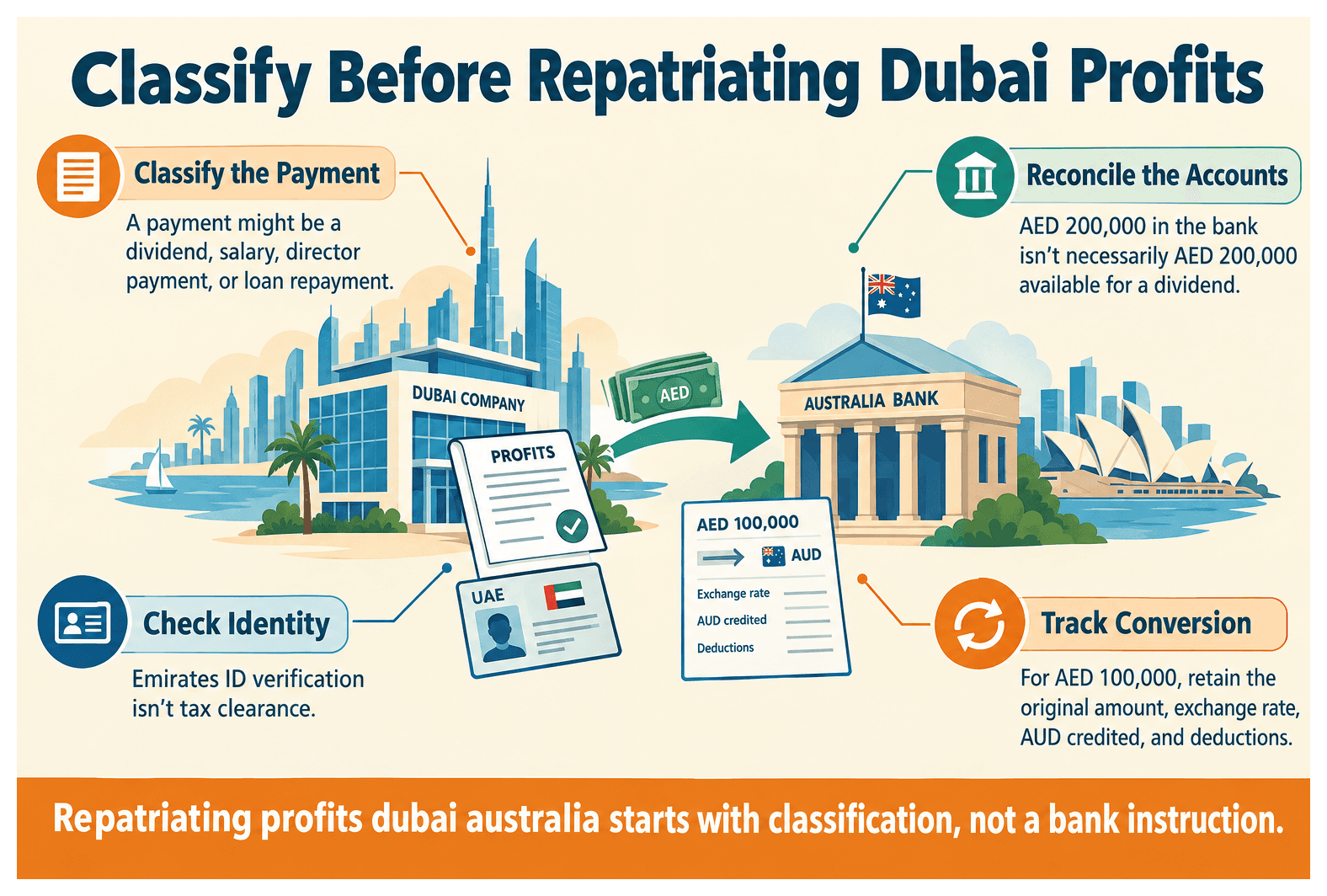
A payment might be a dividend, salary, director payment, or loan repayment. A transfer to an owner isn’t automatically a deductible expense. An Australian founder receiving a declared dividend should retain the company resolution and payment record, not label it a generic remittance. For operating context, see running a Dubai company from Australia.
Identify the Recipient and Purpose Before Sending Funds
Match the sending company account to the documented transaction and Australian recipient account. Banks may request evidence of source and purpose. Record amount, currency, recipient, date, and purpose. Personal expenses paid from the company account need proper classification before transfer.
Prepare Your Dubai Company and Bank Records for a Transfer
To transfer money UAE to Australia, reconcile company accounts, confirm authority, and gather evidence explaining the funds. License, statements, accounts, and distribution records help establish a genuine transaction.
Reconcile Earnings, Tax Records, and Company Accounts
The Federal Tax Authority (FTA) administers corporate tax registration, returns, and payments. Match the proposed amount against accounts, filings, liabilities, and distributable profits. AED 200,000 in the bank isn’t necessarily AED 200,000 available for a dividend.
Keep Identity and Company Details Consistent
The Federal Authority for Identity, Citizenship, Customs and Port Security (ICP) and General Directorate of Residency and Foreigners Affairs (GDRFA) handle relevant identity and residency services. Emirates ID verification isn’t tax clearance. Banks set their own review requirements.
Check names and account details.
Resolve passport-name differences before a large transfer.
Plan Currency Conversion and Bank Fees
Compare exchange margins and intermediary charges. For AED 100,000, retain the original amount, exchange rate, AUD credited, and deductions. See UAE multi-currency account considerations. Keep debit confirmation and Australian credit advice.
Check UAE Corporate Tax and Company Obligations Before Remitting
A remittance doesn’t remove UAE compliance duties. Review taxable income, filing status, payment deadlines, accounts, and distribution authority under Federal Decree-Law No. 47 of 2022.
Separate Corporate Tax From the Cash Transfer
Corporate tax isn’t simply a charge for money crossing a border. The general 9% rate applies to taxable income above AED 375,000, subject to applicable rules and reliefs (FTA, 2026) [1]. A dividend’s size alone doesn’t determine taxable profit. Check current FTA corporate tax guidance.
Confirm Records, Filing, and Distribution Authority
Review accounts, returns, company constitutional records, and license details. Directors should document approval and account for unpaid liabilities. See Dubai company setup costs and timeline. Free zone status alone doesn’t establish tax exemption.
Follow These Steps to Transfer Profits From Dubai to Australia
Repatriating profits dubai australia works best as a documented sequence. Classify the payment, confirm authority, provide bank evidence, and reconcile the Australian credit.
Step 1: Classify and Approve the Payment
Record whether it’s a dividend, salary, or loan repayment. Approve the amount and confirm liabilities are covered. Don’t misdescribe it to simplify bank processing.
Step 2: Assemble Evidence and Request the Transfer
Prepare statements, license, accounts, approval, and recipient details. Ask your bank about its document requirements, limits, and processing time. For company paperwork background, see Australian founder document requirements.
Step 3: Reconcile the Australian Credit
Compare the credit with the original amount, rate, and fees. For AED 150,000, keep bank advice explaining any lower AUD receipt.
Assess Australian Tax and Treaty Relief Before Receiving Profits
Australian tax treatment depends on recipient, payment type, residency, and structure. The Australian Taxation Office (ATO) guidance and UAE-Australia Double Tax Treaty may matter; relief isn’t automatic. Ask an adviser about reporting and foreign tax credits.
Determine Australian Residency and Reporting Treatment
An Australian resident receiving a Dubai company dividend should obtain advice on reporting in their circumstances. Company profits and a personal distribution raise different questions. See Australian tax residency considerations.
Dubai-to-Australia Profit Transfer: Key Facts to Check
Feature | Transfer item | What to confirm and retain |
|---|---|---|
Payment type and company approval | Dividend, salary, or repayment | Resolution and matching entry |
Source of funds and accounting records | Available earnings | Accounts, statements, liabilities |
Sending and receiving account details | Company and recipient identity | Matching account names and bank advice |
Currency conversion, fees, and net AUD received | AED transfer to AUD credit | Rate, charges, net amount |
UAE corporate tax and filing review | Tax and filing status | Returns, payment records, FTA review |
Australian tax, treaty, and company-record review | Recipient-side treatment | ATO advice, treaty eligibility, ASIC records |
Check Treaty Relief and Australian Company Records
The UAE-Australia Double Tax Treaty applies according to the income and parties involved. Retain evidence of UAE tax paid before discussing relief with an adviser. The Australian Securities and Investments Commission (ASIC) expects accurate company records; a proprietary company receiving related-party funds should record their true nature.
Use a Pre-Transfer Review to Avoid Costly Gaps
A free zone Australian remittance review can catch missing approvals, unclear descriptions, or incomplete tax records. Repatriating profits dubai australia requires clear records before funds leave the UAE.
Before instructing the bank, confirm payment classification, source, account names, currency costs, and adviser review. Pause if a receipt could be a dividend or related-party loan. Repatriating profits dubai australia is manageable when the records agree. Use the Business Activities and Cost Calculator to explore company setup or a license, and consult qualified UAE and Australian advisers before distributing funds.
References
repatriating-profits-from-a-dubai-company-to-australia