VAT Obligations for Australian Entrepreneurs With a Dubai Company

Topic Summary
Know When Registration Is Required
UAE VAT registration is generally mandatory when taxable supplies and imports exceed AED 375,000 over a 12-month period. Voluntary registration may be available from AED 187,500 in eligible supplies or expenses.
Classify Every Business Supply
Each transaction should be assessed as standard-rated, zero-rated, exempt or outside the scope of UAE VAT. Customer location alone does not determine the treatment; supply details and place-of-supply rules matter.
Remember Free Zones Still Have VAT
A Dubai free zone company is not exempt from UAE VAT just because of its location or license. Its activities and transactions determine its obligations.
Check Export Zero-Rating Conditions
Services provided to overseas customers may qualify for zero-rating, but an overseas customer does not make a supply automatically zero-rated. Review the applicable conditions and retain supporting evidence.
Keep Registration Evidence Organized
Prepare relevant trade license and incorporation documents, invoices, contracts and identification details for an FTA registration application. Track taxable supplies and imports on a rolling basis.
Reconcile Records And Filing Dates
Reconcile invoices regularly and keep records that support the VAT treatment reported. The FTA sets filing periods, so check the account for each return deadline.
Treat Australian Reporting Separately
UAE VAT compliance and Australian tax reporting are separate workstreams. The founder’s nationality does not determine a Dubai company’s UAE VAT treatment; its activities and transactions do.
In 2026, UAE VAT is 5%, and mandatory registration generally starts above AED 375,000 in taxable supplies and imports [1]. The UAE introduced VAT in January 2018 [1]. Voluntary registration may be available from AED 187,500 [1]. The assessment period is 12 months [1]. Zero-rating requires conditions [1]. The Federal Tax Authority (FTA) sets filing periods [1]. This guide helps Australian founders understand vat obligations australian dubai company owners face, including export treatment, returns and Australian reporting. Your nationality doesn’t decide the company’s VAT treatment; its activities and transactions do.
What Are VAT Obligations for Australian Entrepreneurs With a Dubai Company
VAT obligations for Australian entrepreneurs with a Dubai company mean assessing taxable supplies, registering when required, accounting for VAT correctly and filing returns. A Dubai South Business Hub Free Zone company doesn’t escape UAE VAT simply because it is based in a free zone.
How UAE VAT Applies to a Free Zone Company
VAT is charged on taxable supplies of goods and services. The FTA administers registration and returns. For example, an Australian-owned design consultancy in Dubai South Business Hub Free Zone should review UAE client invoices separately from overseas contracts. Incorporation and tax compliance are separate workstreams. See setting up and running a Dubai company from Australia for broader operating considerations.
Which Business Activities Affect VAT Treatment
Classify each supply as standard-rated, zero-rated, exempt or outside scope. A Dubai consultant serving a UAE customer may charge 5%, while a qualifying service to an Australian customer may meet export zero-rating conditions. Customer location alone doesn’t settle the treatment. Contracts, service details and place-of-supply rules matter.
UAE VAT Thresholds and Compliance Duties
Feature | Requirement | What the Founder Should Check |
|---|---|---|
Mandatory registration threshold | AED 375,000 | Taxable supplies and imports |
Voluntary registration threshold | AED 187,500 | Eligible supplies or expenses |
Turnover assessment period | 12 months | Monitor on a rolling basis |
Standard VAT rate | 5% | Apply supply-specific treatment |
FTA return filing period | Assigned by the FTA | Check the account deadline |
How VAT Obligations for Australian Entrepreneurs With a Dubai Company Work
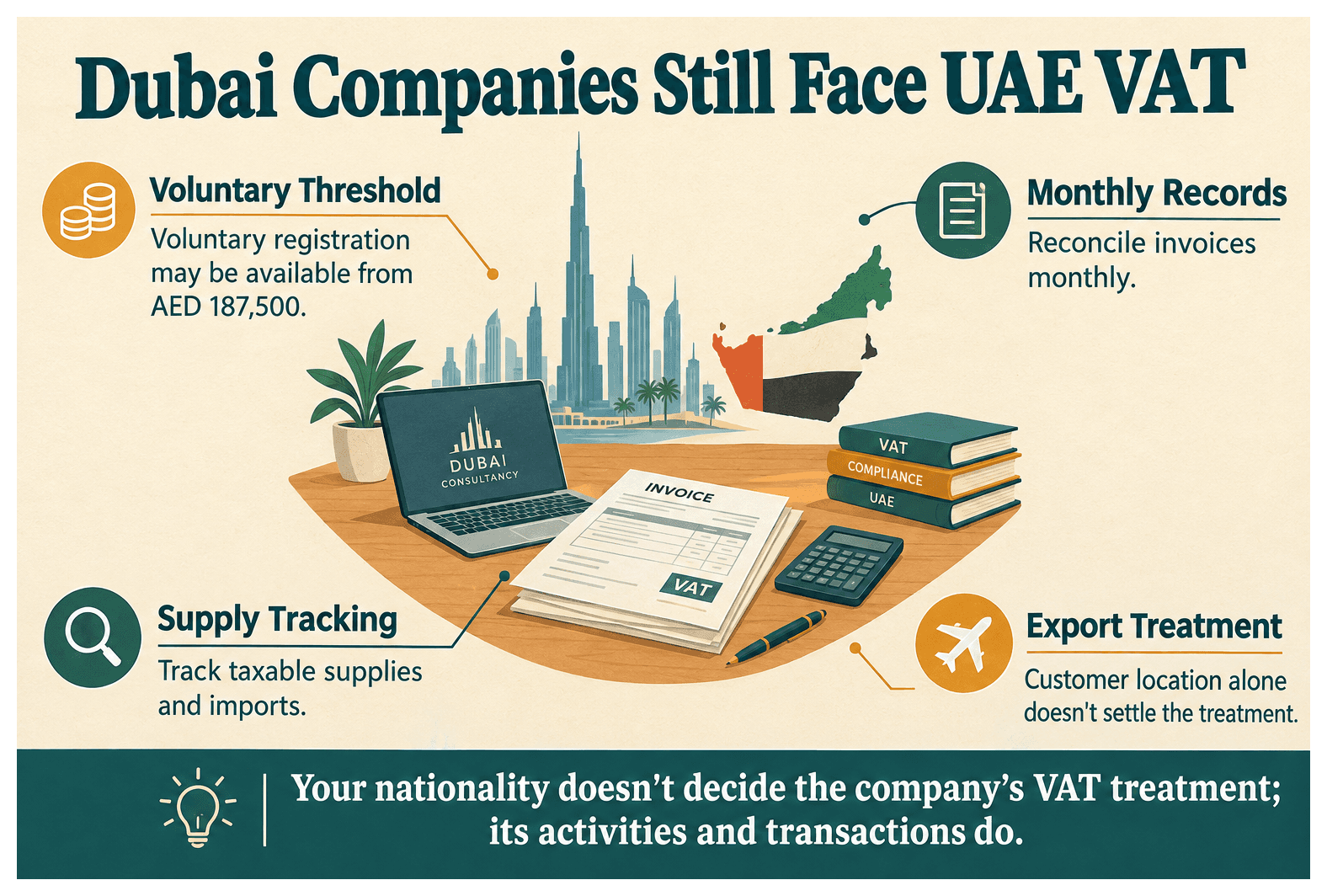
A UAE business generally must register after taxable supplies and imports exceed AED 375,000 over 12 months. Voluntary registration may be available above AED 187,500 in taxable supplies or expenses. These thresholds don’t change with a free zone license.
Track Thresholds and Prepare Registration Evidence
If your company reaches AED 380,000 in taxable supplies in a rolling year, promptly review mandatory registration and timing with the FTA. Prepare the trade license, incorporation documents, invoices, contracts and identification details as applicable. Registration runs through FTA channels, not immigration authorities. For a UAE VAT registration guide, check the application steps before filing.
Reconcile invoices monthly.
Track taxable supplies and imports.
Keep contracts and supporting records ready.
How Zero-Rating Works for Exports From a Dubai Company
Some UAE exports may qualify for zero-rating, but overseas customers don’t automatically make a supply zero-rated. The dubai free zone vat australian founders need to assess depends on the transaction, relevant export conditions and evidence.
Check Conditions and Keep Supporting Evidence
A Dubai company billing an Australian business for consulting should review customer status, place of supply and applicable conditions before applying zero-rating. Keep the signed contract, invoice, customer details, service records and relevant correspondence. Match the evidence to the return period. This is a key point for any australia entrepreneur uae vat review. Read the rules for services exported from the UAE.
Steps to Manage VAT Obligations for Australian Entrepreneurs With a Dubai Company
To manage vat obligations australian dubai company owners should map supplies, monitor thresholds, issue compliant invoices, keep records and file by the FTA-assigned deadline. Australian reporting needs separate attention.
Map Transactions, Reconcile and File
Separate UAE consultancy revenue from qualifying overseas work. Record customer location and supply details.
Register when required. Reconcile sales invoices, receipts and recoverable input VAT.
Check the FTA account deadline. Submit accurate figures and retain filing and payment confirmations.
Use invoice guidance for Dubai companies and VAT return filing guidance to tighten your process.
Keep Each Compliance Workstream Separate
Workstream | Authority or rule | Founder action |
|---|---|---|
UAE VAT | FTA | Register and file returns |
Australian tax | ATO | Review residency and income |
Company obligations | ASIC requirements | Check applicable reporting |
How Australian Tax and UAE VAT Rules Interact
UAE VAT is separate from Australian income tax and company reporting. An Australian resident director receiving distributions should assess personal reporting with the ATO, while checking applicable ASIC requirements. The UAE-Australia Double Tax Treaty relates to income-tax questions; it doesn’t replace VAT rules.
Separate Tax, Corporate and Immigration Matters
Federal Decree-Law No. 47 of 2022 establishes the UAE corporate tax framework, not VAT. ICP (Federal Authority for Identity, Citizenship, Customs & Port Security) and GDRFA (General Directorate of Residency and Foreigners Affairs) handle relevant immigration administration; Emirates ID is an identity credential, not a VAT registration. Review Australian tax residency considerations separately.
Build a Practical VAT Compliance Routine for Your Dubai Company
A monthly review gives you early warning as turnover grows. Check both thresholds, reconcile sales and purchase invoices, and refresh your analysis when services, customers or delivery methods change.
Review Records and Plan the License
Flag turnover approaching AED 375,000 for adviser review. Match your Dubai South Business Hub Free Zone license activity to planned operations, then use the Dubai company setup cost and timeline guide as you plan. Your vat obligations australian dubai company checklist should remain separate from setup and residency paperwork.
For broader relocation planning, follow the Moving to Dubai Australia guide. Use the Business Activities and Cost Calculator to plan a Dubai South Business Hub Free Zone setup or license purchase.
References
Federal Tax Authority, UAE VAT guidance.
Australian Taxation Office, international tax guidance.
UAE Ministry of Finance, corporate tax and treaty information.
vat-obligations-for-australian-entrepreneurs-with-a-dubai-company