VAT Obligations for Chinese Entrepreneurs With a Dubai Company

Topic Summary
What Are the VAT Obligations for a Chinese Dubai Company and Why They Matter
VAT obligations for a Chinese-owned Dubai company are the legal duties to register with the Federal Tax Authority (FTA), charge 5% VAT on taxable supplies, issue compliant tax invoices and file returns. Registration is mandatory above AED 375,000 in taxable turnover over 12 months and voluntary above AED 187,500.
Registration Thresholds and Timing for Chinese Free Zone Owners
Registration Thresholds and Timing for Chinese Free Zone Owners
Zero-Rating for Exports and Cross-Border Sales From a Dubai Company
Exports of goods outside the GCC are zero-rated: 0% VAT is charged while input VAT stays recoverable. You need proof of export, such as customs documents, commercial invoices and shipping records. Sales to UAE mainland customers are generally taxed at 5%, which matters to any China entrepreneur's UAE VAT planning.
How Corporate Tax and VAT Differ for a Free Zone License Holder
VAT is a consumption tax on supplies, while corporate tax under Federal Decree-Law No. 47 of 2022 (the Corporate Tax Law) applies to profits. A free zone company can face both. Qualifying income may be taxed at 0%, but VAT registration and filing still apply.
Numbered Checklist to Register and File VAT Returns
To meet VAT obligations, create an EmaraTax account, register once you pass the threshold, issue compliant invoices, record all supplies and expenses, and file by the 28th day after each tax period. Most small companies file quarterly and pay any VAT due with the return.
Documents and Identity Details the FTA Expects From Chinese Founders
The FTA typically asks for the trade license, passport and Emirates ID of the owner or manager, a bank certificate and proof of business activity. Residency issued through the Federal Authority for Identity, Citizenship, Customs and Port Security (ICP) and the General Directorate of Residency and Foreigners Affairs (GDRFA) supports that Emirates ID.
Cross-Border Rules Chinese Owners Must Align With China
UAE VAT doesn't replace China-side duties. Owners may still report overseas income and holdings to the State Administration of Taxation (SAT), follow SAFE regulations on foreign exchange and outbound funds, and check relief under the UAE-China Double Tax Treaty. Confirm each with a licensed adviser.
More than 350,000 businesses are VAT-registered in the UAE (FTA, 2025) [1], and a missed deadline costs a flat AED 10,000. This guide covers the VAT obligations a Chinese Dubai company faces, written for founders holding a Dubai South Business Hub license. It builds on our guide to setting up a trading company in Dubai from China.
What Are the VAT Obligations for a Chinese Dubai Company and Why They Matter
VAT obligations for a Chinese-owned Dubai company are the legal duties to register with the Federal Tax Authority (FTA), charge 5% VAT on taxable supplies, issue compliant tax invoices and file returns. Registration is mandatory above AED 375,000 in taxable turnover over 12 months and voluntary above AED 187,500.
How UAE VAT Works for a Free Zone License Holder
Free zone status doesn't exempt you. Picture a Shenzhen founder reselling electronics to UAE buyers: once thresholds are met, every one of those sales carries 5%. That's the core of any UAE VAT China founder checklist.
Why Chinese Founders Face Extra Compliance Pressure
Many owners run the company from China, across a time zone and a different invoicing culture. A UAE tax invoice isn't a fapiao, and leaving off the Tax Registration Number (TRN) is a classic slip. Penalties apply regardless of nationality. See the tax invoice requirements in the UAE.
Registration Thresholds and Timing for Chinese Free Zone Owners
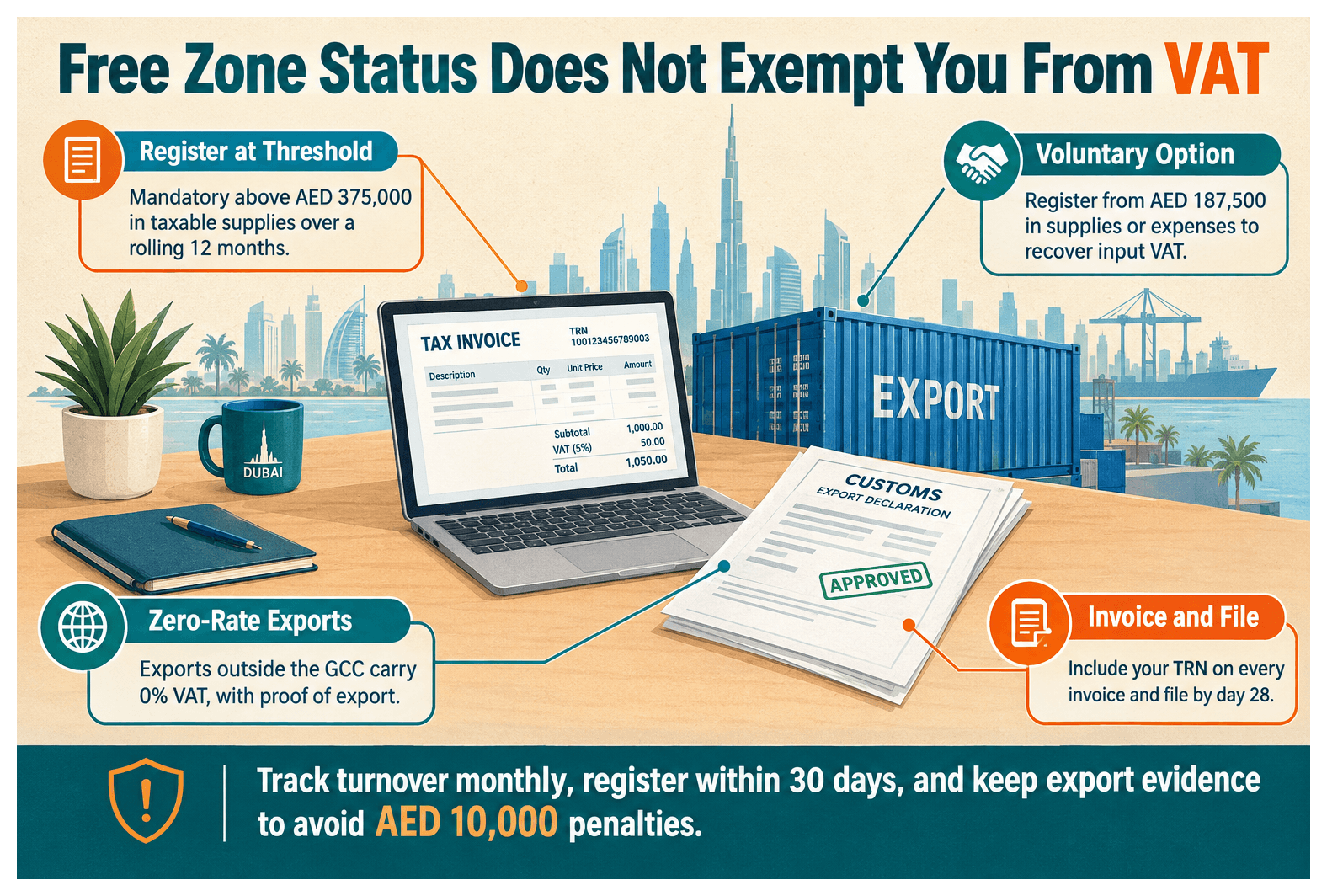
A free zone company must register within 30 days of crossing AED 375,000 in taxable supplies over any rolling 12 months, or when it expects to cross it within 30 days. Voluntary registration starts at AED 187,500 in supplies or expenses. This is the heart of Dubai free zone VAT for Chinese owners.
Mandatory Versus Voluntary Registration
The test uses taxable supplies, not profit.
It runs on a rolling 12 months, not the calendar year.
Start-ups buying heavy stock can register early to recover input VAT.
Timing Registration After Company Formation
Check turnover monthly from your first invoice. If a large China-to-UAE contract pushes you over the line in month four, the 30-day clock has already started. Register through the FTA's EmaraTax portal; see VAT registration timing after company formation.
Zero-Rating for Exports and Cross-Border Sales From a Dubai Company
Exports of goods outside the GCC are zero-rated: 0% VAT is charged while input VAT stays recoverable. You need proof of export, such as customs documents, commercial invoices and shipping records. Sales to UAE mainland customers are generally taxed at 5%, which matters to any China entrepreneur's UAE VAT planning.
Evidence Needed to Zero-Rate Exports to China
Keep customs declarations, bills of lading and invoices together.
Goods must leave the GCC within the required period.
Zero-rated isn't exempt. You still register and file.
Key UAE VAT Facts for a Chinese-Owned Free Zone Company
VAT Topic | What Applies |
|---|---|
Standard VAT rate | 5% on most goods and services |
Mandatory registration threshold | AED 375,000 in taxable supplies over 12 months |
Voluntary registration threshold | AED 187,500 in supplies or expenses |
Export of goods outside the GCC | 0% with proof of export |
Return filing deadline | 28th day after the tax period ends |
Late registration penalty | AED 10,000 flat (FTA) |
Imports From China and Import VAT
Customs charges 5% on goods entering the UAE. A registered trader can treat it as input tax, as a Dubai company importing Chinese machinery would on its return. Read more on importing Chinese goods through a Dubai company.
How Corporate Tax and VAT Differ for a Free Zone License Holder
VAT is a consumption tax on supplies, while corporate tax under Federal Decree-Law No. 47 of 2022 (the Corporate Tax Law) applies to profits. A free zone company can face both. Qualifying income may be taxed at 0%, but VAT registration and filing still apply.
Two Taxes, Two Sets of Rules
One founder assumed a 0% qualifying rate erased VAT duties and missed his first return. Don't copy him. Free zone status shapes licensing and corporate tax treatment; VAT depends on turnover and the type of supply. Source: Ministry of Finance. Also see invoicing UAE mainland clients.
Numbered Checklist to Register and File VAT Returns
To meet VAT obligations, create an EmaraTax account, register once you pass the threshold, issue compliant invoices, record all supplies and expenses, and file by the 28th day after each tax period. Most small companies file quarterly and pay any VAT due with the return.
Step 1: Prepare Your Company Records and Portal Access
Gather the trade license, shareholder passports and bank details.
Create the EmaraTax account with your authorized signatory.
Step 2: Register With the FTA and Obtain Your TRN
Submit the application and wait for your TRN.
Update your invoice template the same day.
Step 3: Issue Invoices, Keep Records and File on Time
Keep records for five years.
Reconcile output and input VAT monthly, then pay with the return.
Our guide to VAT return filing for Dubai companies goes deeper.
Documents and Identity Details the FTA Expects From Chinese Founders
The FTA typically asks for the trade license, passport and Emirates ID of the owner or manager, a bank certificate and proof of business activity. Residency issued through the Federal Authority for Identity, Citizenship, Customs and Port Security (ICP) and the General Directorate of Residency and Foreigners Affairs (GDRFA) supports that Emirates ID.
Residency, Emirates ID and Authorized Signatory Checks
Residency is tied to your company license.
Complete the visa first, then use the new Emirates ID to authorize the application.
Without residency, passport-based documents can still work.
Translating and Legalizing Chinese Documents
A Chinese business license copy must be apostilled and translated before submission. Use our legalization checklist for Chinese documents.
Cross-Border Rules Chinese Owners Must Align With China
UAE VAT doesn't replace China-side duties. Owners may still report overseas income and holdings to the State Administration of Taxation (SAT), follow SAFE regulations on foreign exchange and outbound funds, and check relief under the UAE-China Double Tax Treaty. Confirm each with a licensed adviser.
SAT Reporting and SAFE Fund Movements
When you move profit from Dubai to China, keep VAT returns, invoices and bank records consistent with what you report to SAT. They're your supporting file.
What the UAE-China Double Tax Treaty Does and Does Not Cover
The treaty addresses income tax relief, not VAT. Relief on dividends won't change the 5% charged on your sales.
Keeping Your VAT Position Clean
These VAT obligations for a Chinese Dubai company come down to three habits: watch the AED 375,000 threshold, document every export, and file on time. Planning your residency? Read the investor visa guide for Chinese nationals. Then use the Business Activities and Cost Calculator to set up or buy a license with Dubai South Business Hub.
References
vat-obligations-for-chinese-entrepreneurs-with-a-dubai-company