
Topic Summary
What Is a Dubai Company Accept Online Payments Without a Bank Account Setup and Why It Matters
A Dubai company can technically start taking online payments before its corporate account is live, using a gateway or aggregator that holds funds temporarily. But payouts must land in a UAE account in the company's name, so a bank account isn't avoidable long term.
How Payment Gateways Work and Where Settlement Funds Go
How Payment Gateways Work and Where Settlement Funds Go
Legitimate Ways to Collect Payments Before Your Bank Account Opens
Founders can use aggregator wallets with held balances, invoice-based bank transfers, or digital business accounts such as Wio. Treat each as a bridge. If you're asking whether a Dubai company accept online payments without a bank account route is permanent, it isn't.
Steps to Start Collecting Online Payments as a Free Zone Company
To make a Dubai company accept online payments without a bank account delay, run the bank and gateway steps in parallel. Allow roughly two to six weeks end to end.
Which UAE Banks Suit Online Sellers and Digital Businesses
Emirates NBD, Mashreq, RAKBank, FAB, ADCB and Wio all serve free zone companies. Wio and RAKBank are often considered for startups, while Emirates NBD, FAB and ADCB suit higher-volume operations. A UAE corporate bank account approval always depends on your profile.
Common Mistakes That Block Online Payment Setup and How to Avoid Them
The usual blockers are an activity mismatch, unclear source of funds, a website without terms, and inconsistent names. Fix these first, and you can accept online payments with fewer delays.
Your Next Step
Can a Dubai company accept online payments without a bank account? Only as a short-term bridge. Settlement, compliance and credibility depend on a UAE account in your company's name, so file the application alongside your payment setup. Our guide to opening a corporate bank account for your Dubai free zone company walks through it. Speak to the DSBH banking support team to prepare documents and shortlist banks.
Roughly 40% of new Dubai online store applications stall at banking or payment integration [1]. Many founders assumed a payment tool could replace a bank account. So, can a Dubai company accept online payments without a bank account? Only briefly. This guide is for free zone owners who want to start collecting money without a rejection.
What Is a Dubai Company Accept Online Payments Without a Bank Account Setup and Why It Matters
A Dubai company can technically start taking online payments before its corporate account is live, using a gateway or aggregator that holds funds temporarily. But payouts must land in a UAE account in the company's name, so a bank account isn't avoidable long term.
Defining the Setup in Plain Terms
Online payments have three layers: the checkout, the gateway, and the settlement account. Without a bank account, the first two can sometimes run. The third has nowhere to go.
Picture a new consultant who collects AED 8,000 through a checkout link. The funds sit on hold until a settlement account is verified. Personal accounts generally can't receive company revenue under provider terms, and the Central Bank of the UAE supervises more than 40 licensed banks (Central Bank of the UAE, 2025) [2].
Why Founders Ask This Question
Your Dubai South Business Hub license can be active while the bank's KYC (know your customer) review is still pending. That gap is frustrating, and it's common. Read why some Dubai companies cannot open a bank account before you apply.
How Payment Gateways Work and Where Settlement Funds Go
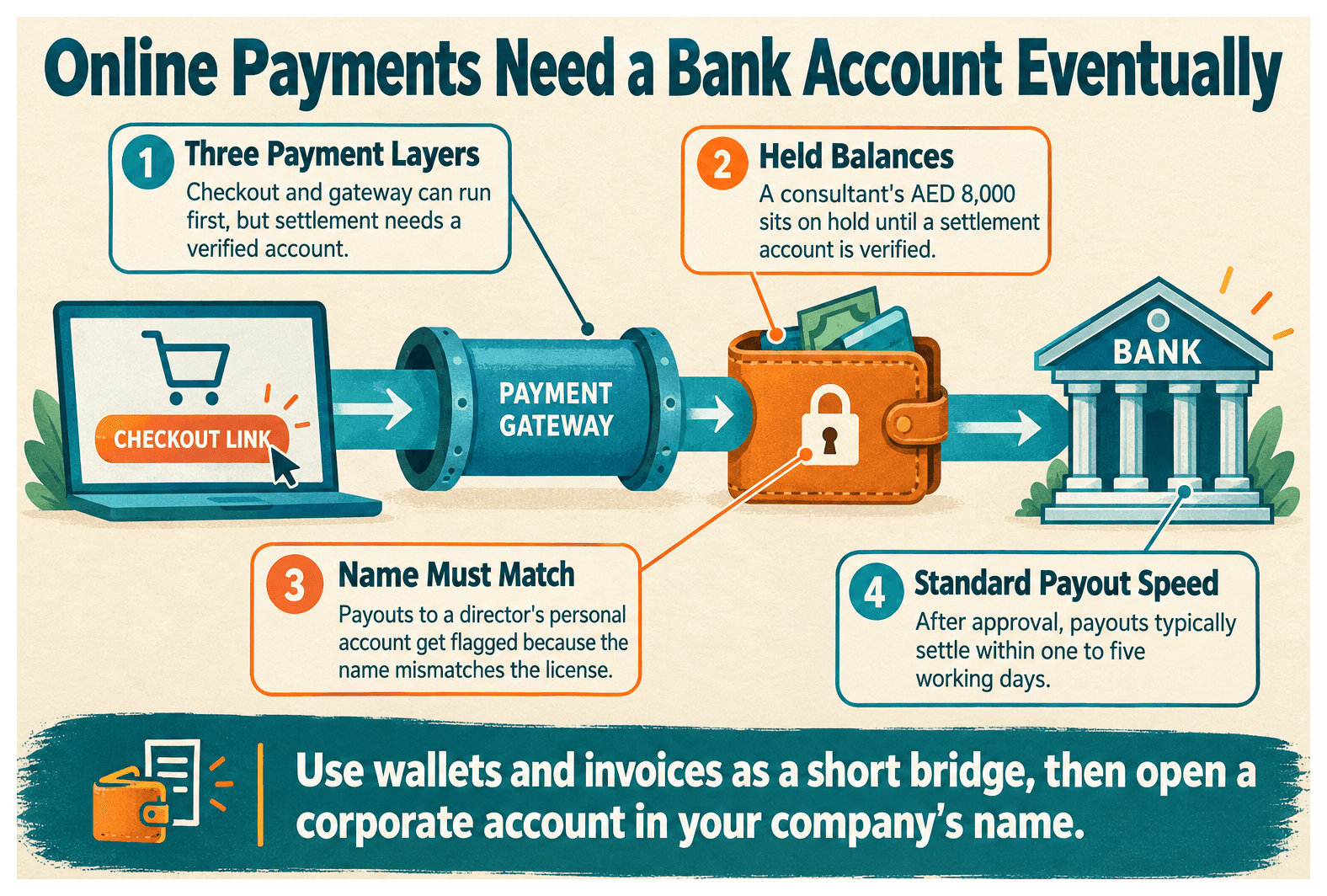
A gateway authorises a card transaction, then the acquirer settles the money into the merchant's bank account, usually within one to five working days. Without a corporate account in your company's name, most UAE providers hold funds or decline onboarding.
Gateway vs Merchant Account Explained
The gateway handles checkout and authorisation. The merchant account handles settlement. Aggregators pool merchants under one account, which is faster to start but comes with holds and caps. UAE e-commerce revenue has crossed AED 110 billion (Statista, 2025) [3]. See merchant account vs payment gateway for UAE businesses.
Payment Collection Options Before and After Bank Account Approval
Feature | Before Bank Account Opens | After Bank Account Opens |
|---|---|---|
Settlement destination | Provider wallet or held balance | Corporate account in the company name |
Withdrawal limits | Caps and hold periods of several days to weeks | Standard payouts in 1 to 5 working days |
Provider onboarding | Limited to aggregators with lighter checks | Direct merchant accounts open to you |
Compliance risk | Higher: frozen funds, beneficiary mismatches | Lower: names and license activity align |
Suitability for long-term use | Short-term bridge only | Built for ongoing trading |
Why Providers Require a Verified Account
KYC and AML rules need payouts to a named business account.
Mismatched beneficiary names trigger holds.
Licensed activity must match what you sell.
A payout to a director's personal account gets flagged because the name doesn't match the license.
Legitimate Ways to Collect Payments Before Your Bank Account Opens
Founders can use aggregator wallets with held balances, invoice-based bank transfers, or digital business accounts such as Wio. Treat each as a bridge. If you're asking whether a Dubai company accept online payments without a bank account route is permanent, it isn't.
Aggregators and Held Balances
Funds accumulate in a wallet until a settlement account is verified. Check withdrawal caps, hold periods and fees, and confirm the provider accepts your licensed activity. A design studio, for instance, might collect three client payments and withdraw once the account is active.
Digital Business Accounts as a Faster Route
Wio and similar providers may onboard simple structures faster, subject to approval. They still require a license, shareholder documents and KYC. Here's the full process for opening a bank account for a newly formed Dubai company.
Risks of Using Personal Accounts for Company Revenue
It breaches provider terms and can freeze funds.
It muddies VAT and accounting records.
It invites bank scrutiny later.
Steps to Start Collecting Online Payments as a Free Zone Company
To make a Dubai company accept online payments without a bank account delay, run the bank and gateway steps in parallel. Allow roughly two to six weeks end to end.
Step 1: Confirm Your License Covers Your Activity
Billed services must match the licensed activity.
Providers check this at onboarding.
Step 2: Prepare Documents and Apply for the Account
Gather your license, MOA, share certificate, passports, Emirates ID or visa, and proof of address.
Add a business plan with expected monthly volumes.
Expect a review of about 2 to 4 weeks.
Step 3: Choose and Verify Your Payment Provider
Compare fees (typically 2% to 3%), settlement time and AED payouts.
Submit license, website, refund policy and bank details.
Start with payment gateway UAE options.
Step 4: Test, Go Live and Reconcile
Run an AED 50 test payment and confirm it settles.
Match payouts to invoices for VAT.
Keep records for audit.
Which UAE Banks Suit Online Sellers and Digital Businesses
Emirates NBD, Mashreq, RAKBank, FAB, ADCB and Wio all serve free zone companies. Wio and RAKBank are often considered for startups, while Emirates NBD, FAB and ADCB suit higher-volume operations. A UAE corporate bank account approval always depends on your profile.
Matching Your Profile to the Right Bank
A solo consultancy might apply to Wio and RAKBank. A trading firm with larger flows may approach Emirates NBD and FAB. Policies change, so confirm current criteria.
What Banks Ask Online Sellers For
Website screenshots and platform details.
Supplier invoices.
A six-month turnover projection.
Your refund policy.
More detail sits in what UAE banks ask an online seller for.
Common Mistakes That Block Online Payment Setup and How to Avoid Them
The usual blockers are an activity mismatch, unclear source of funds, a website without terms, and inconsistent names. Fix these first, and you can accept online payments with fewer delays.
Activity and Website Mismatches
A services-licensed company that launches a product store gets declined. Your site should show the company name, license details, contact information and policies.
Documentation and Source-of-Funds Gaps
Spell names identically across passport, license and MOA.
Back your plan with contracts, invoices or LOIs.
One name mismatch can add 1 to 3 weeks.
Practical Tips to Avoid Rejection
Apply to two banks in parallel.
Be open about volumes and customer countries.
Prepare a one-page business summary.
Your Next Step
Can a Dubai company accept online payments without a bank account? Only as a short-term bridge. Settlement, compliance and credibility depend on a UAE account in your company's name, so file the application alongside your payment setup. Our guide to opening a corporate bank account for your Dubai free zone company walks through it. Speak to the DSBH banking support team to prepare documents and shortlist banks.
References
Frequently Asked Questions