Topic Summary
What Is UAE Corporate Tax for Healthcare Companies and Why It Matters
UAE corporate tax for healthcare companies is a federal tax of 0% on taxable income up to AED 375,000 and 9% above that. It covers clinics, hospitals, labs, pharmacies and medical suppliers, with separate treatment for qualifying free zone entities. Registration with the Federal Tax Authority is mandatory.
Free Zone Corporate Tax 2026 for Healthcare Companies
Free Zone Corporate Tax 2026 for Healthcare Companies
How Exempt and Zero-Rated Medical Supplies Are Treated
Exempt and zero-rated medical supplies are VAT concepts, not corporate tax exemptions. Preventive and basic healthcare services and certain medicines are zero-rated for VAT. The income from them still forms part of taxable income unless another exemption applies.
Step-by-Step Registration and Filing for UAE Corporate Tax for Healthcare Companies
To register and file, create an EmaraTax account, submit your registration, receive your Tax Registration Number (TRN), keep audited records and file within nine months of year-end. Free zone entities must also prepare audited financial statements.
How Much Does It Cost and How Long Does It Take
Corporate tax registration costs AED 0, but audit and filing support carry separate fees. Registration typically takes a few working days once documents are complete. Verify any quoted fee and its date before budgeting.
Regulations in the UAE That Shape Healthcare Company Tax
Healthcare company tax in the UAE rests on the federal Corporate Tax Law, Ministry of Finance decisions on qualifying activities, Federal Tax Authority guidance, transfer pricing rules and health authority licensing.
Common Mistakes and What Should You Do Next
Common mistakes include missing the registration deadline, breaching the de minimis limit, treating VAT zero-rating as a tax exemption and skipping audited accounts. Next, check your name, estimate costs and register.
UAE corporate tax for healthcare companies is 0% on taxable income up to AED 375,000 and 9% above it. Qualifying free zone entities follow a separate regime. This guide is for clinic owners and finance leads who need to register, plan and file correctly. The UAE healthcare market is worth over USD 27 billion in 2026 and grows about 7% a year (Statista, 2026). Registration costs AED 0, but a missed deadline costs AED 10,000 (Federal Tax Authority, 2026).
What Is UAE Corporate Tax for Healthcare Companies and Why It Matters
UAE corporate tax for healthcare companies is a federal tax of 0% on taxable income up to AED 375,000 and 9% above that. It covers clinics, hospitals, labs, pharmacies and medical suppliers, with separate treatment for qualifying free zone entities. Registration with the Federal Tax Authority is mandatory.
The 9% Rate and the AED 375,000 Threshold
The tax applies to taxable income, not revenue, for financial years starting on or after 1 June 2023. Take a mainland clinic with AED 1,000,000 taxable income. It pays 9% on AED 625,000, which is AED 56,250.
Which Healthcare Businesses Fall Within Scope
Clinics, hospitals and diagnostic labs.
Pharmacies and medical device traders.
Health consultancies and medical staffing firms.
Government-owned and public benefit entities may be treated differently.
A medical manpower supply firm and a radiology consultancy each register separately as taxable persons. Our UAE corporate tax guide covers the basics.
Why Healthcare Owners Need a Tax Plan Early
A new clinic that budgets for tax at licensing avoids cash-flow surprises at first filing. Late registration and filing both attract penalties. Planning a launch? See how to start a healthcare business in Dubai, and track UAE corporate tax changes each year.
Free Zone Corporate Tax 2026 for Healthcare Companies
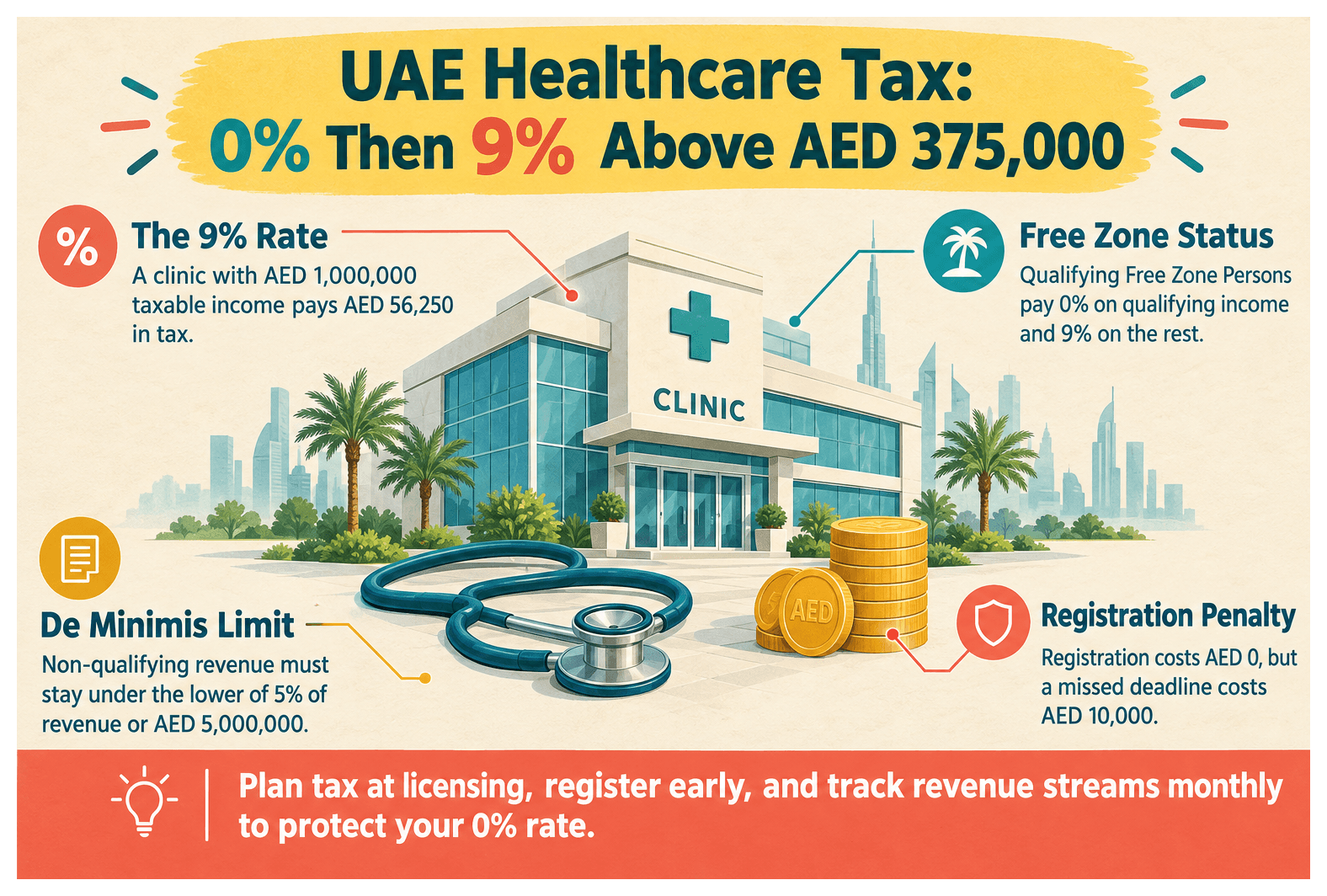
Under free zone corporate tax 2026 rules, a Qualifying Free Zone Person pays 0% on qualifying income and 9% on non-qualifying income. You need adequate substance, audited financial statements and non-qualifying revenue within the de minimis limit.
Qualifying Free Zone Person Status Explained
Take a Dubai South-licensed medical equipment trader selling to other free zone businesses. Its qualifying income can be taxed at 0%, provided it meets these conditions:
Adequate substance in the free zone.
Audited accounts every year.
Transfer pricing compliance.
Mainland entities pay 9% above AED 375,000. See tax benefits for Dubai free zone companies. Note this is a conditional 0%, never a blanket exemption.
The De Minimis Rule and What Happens If You Breach It
Non-qualifying revenue must not exceed the lower of 5% of total revenue or AED 5,000,000. A breach disqualifies the entity for that period and the following four years, a 5-year hit.
Picture a free zone lab earning AED 6,000,000 from mainland patients on AED 80,000,000 revenue. The cap is AED 4,000,000 (5%), so it loses the 0% rate. Track revenue by stream monthly.
Mainland Patient Revenue and Qualifying Activities
Services to mainland customers are generally non-qualifying.
Qualifying activities come from Ministry of Finance decisions.
A consultancy serving free zone clients differs from one serving mainland hospitals.
How Exempt and Zero-Rated Medical Supplies Are Treated
Exempt and zero-rated medical supplies are VAT concepts, not corporate tax exemptions. Preventive and basic healthcare services and certain medicines are zero-rated for VAT. The income from them still forms part of taxable income unless another exemption applies.
Zero-Rated Healthcare and Medicines Versus Exempt Supplies
Zero-rated supplies carry 0% VAT and allow input VAT recovery.
Exempt supplies do not allow recovery.
Cosmetic treatments are standard-rated at 5%.
A pharmacy might sell qualifying medicines zero-rated while charging 5% on cosmetic items. Confirm classification against Federal Tax Authority guidance.
How VAT Treatment Interacts With Corporate Tax Income
Here's the trap. A clinic with fully zero-rated services still reports full profit for the 9% calculation. Keep separate ledgers by supply type. Exempt income under corporate tax is narrow, such as qualifying dividends. See corporate tax exemptions in the UAE.
Documentation Needed for Medical Supply Classification
Invoices showing supply type.
Product registration with the health authority, such as the Dubai Health Authority.
Records kept for at least 7 years.
A para pharmaceutical products trading license holder should keep product-level classification records.
Step-by-Step Registration and Filing for UAE Corporate Tax for Healthcare Companies
To register and file, create an EmaraTax account, submit your registration, receive your Tax Registration Number (TRN), keep audited records and file within nine months of year-end. Free zone entities must also prepare audited financial statements.
Step 1: Confirm Your Entity and Choose a Compliant Name
Confirm legal form and license activity. The license must match what you actually do.
Run the company name check before licensing a new health consultancy.
Step 2: Register on EmaraTax and Obtain Your TRN
Gather your trade license, Emirates ID and ownership documents.
Register before your deadline, which depends on license date. A clinic licensed in 2025 should not wait.
Pay AED 0 in government fees (as of January 2026). See corporate tax registration cost in the UAE.
Corporate Tax Costs and Timelines for a UAE Healthcare Company (Fees Dated)
Item | Amount in AED and Timing |
|---|---|
Federal Tax Authority registration fee | AED 0, as of January 2026 |
Late registration penalty | AED 10,000 |
Corporate tax on income up to AED 375,000 | 0% |
Corporate tax on income above AED 375,000 | 9% |
Return filing deadline | Within 9 months of year-end |
Step 3: Keep Records, Calculate Income and File the Return
Maintain accounting records and audited statements. Support is available through corporate tax filing services in Dubai.
File within 9 months. A 31 December year-end means a 30 September deadline.
How Much Does It Cost and How Long Does It Take
Corporate tax registration costs AED 0, but audit and filing support carry separate fees. Registration typically takes a few working days once documents are complete. Verify any quoted fee and its date before budgeting.
Government Fees and Typical Professional Costs in AED
Government registration is AED 0 as of January 2026. Audit and return preparation fees vary by firm size and are estimates only, so get written quotes. Use the cost calculator to size your free zone setup budget.
Timelines From Registration to First Filing
A company licensed in March should set its first period end early, then plan for the 9-month filing window. Book audit preparation well ahead of that date.
Regulations in the UAE That Shape Healthcare Company Tax
Healthcare company tax in the UAE rests on the federal Corporate Tax Law, Ministry of Finance decisions on qualifying activities, Federal Tax Authority guidance, transfer pricing rules and health authority licensing.
Federal Corporate Tax Law and Ministry of Finance Decisions
The core law is Federal Decree-Law No. 47 of 2022, supported by Cabinet and ministerial decisions on qualifying activities and substance (Ministry of Finance, 2023). A free zone lab should check its activity against those lists before assuming 0%.
Health Authority Licensing, Transfer Pricing and Related Parties
DHA and MOHAP licenses run alongside tax registration.
Related-party and owner transactions must follow the arm's length principle.
A hospital group charging management fees between entities needs documented pricing.
A medical manpower supply business license is a common related-party example.
Common Mistakes and What Should You Do Next
Common mistakes include missing the registration deadline, breaching the de minimis limit, treating VAT zero-rating as a tax exemption and skipping audited accounts. Next, check your name, estimate costs and register.
Five Costly Errors Healthcare Owners Make
Late registration: AED 10,000 penalty.
Mixing untracked mainland revenue into free zone books.
Confusing VAT zero-rating with exemption.
No audited statements.
Ignoring related-party pricing.
Your Next Steps With Dubai South Business Hub
Run the cost calculator.
Check your name with the name check tool.
Plan your free zone trade license and residency visa package.
Founders can start with setting up a health consultancy business in Dubai.
Final Thoughts on UAE Corporate Tax for Healthcare Companies
UAE corporate tax for healthcare companies comes down to 9% above AED 375,000, careful free zone qualification and clean records. Remember the AED 5,000,000 de minimis cap, and that VAT zero-rating is not a corporate tax exemption. Review dated fees each January. Owners who register early and track revenue streams stay compliant and keep more profit.
References
Frequently Asked Questions