
Topic Summary
What Is Customer Due Diligence in a UAE Free Zone and Why It Matters
Customer due diligence (CDD) is the set of checks a UAE free zone company runs to confirm who its customers are, who owns them, where their money comes from and what risk they pose. It's a core anti-money laundering control, applied before and during any relationship.
Why You Must Conduct Customer Due Diligence in a UAE Free Zone
Why You Must Conduct Customer Due Diligence in a UAE Free Zone
Documents and Information to Collect From Every Customer
For individuals, collect a passport or Emirates ID, proof of address and the purpose of the relationship. For companies, collect the trade license, incorporation documents, ownership structure, UBO details and signatory IDs.
Process to Conduct Customer Due Diligence in a UAE Free Zone
To conduct customer due diligence in a UAE free zone, verify the customer and owners, screen them, rate the risk, choose standard or enhanced checks, decide, and record everything.
Enhanced Due Diligence for High-Risk Customers
Enhanced due diligence is deeper checking for high-risk customers. It adds source of wealth verification, senior approval and closer monitoring.
Ongoing Monitoring and Record Keeping
Customer due diligence doesn't end at onboarding. Monitor transactions against the customer's profile, refresh files on a risk-based schedule, report suspicion and keep records for at least five years ( Ministry of Finance ).
Common Mistakes and a Practical Example
The most common customer due diligence mistakes are unverified documents, ignored beneficial owners, skipped screening, stale files and scattered inboxes. One checklist and one central file fix most of them.
The UAE remains on the FATF regular follow-up list in 2026 [1], and the AML framework covers 40+ categories of designated non-financial businesses and professions [2]. Banks review corporate files every 12 to 18 months, and records must be kept for at least 5 years. This guide shows Dubai South founders how to conduct customer due diligence in a UAE free zone, step by step.
What Is Customer Due Diligence in a UAE Free Zone and Why It Matters
Customer due diligence (CDD) is the set of checks a UAE free zone company runs to confirm who its customers are, who owns them, where their money comes from and what risk they pose. It's a core anti-money laundering control, applied before and during any relationship.
Core Definition and Legal Basis
CDD means identifying the customer, verifying identity from reliable documents, identifying the beneficial owner and understanding the purpose of the relationship. It rests on Federal Decree-Law No. 20 of 2018 and Cabinet Decision No. 10 of 2019 (UAE Cabinet, 2019). Free zone status changes your licensing, not your AML duties.
Who Must Apply CDD
Real estate, precious metals, corporate services and audit businesses are directly obliged. A consultancy outside that list still gets customer-check requests from its bank. Check your activity against the DNFBP list, and read our guide on anti money laundering duties for Dubai businesses.
Why You Must Conduct Customer Due Diligence in a UAE Free Zone
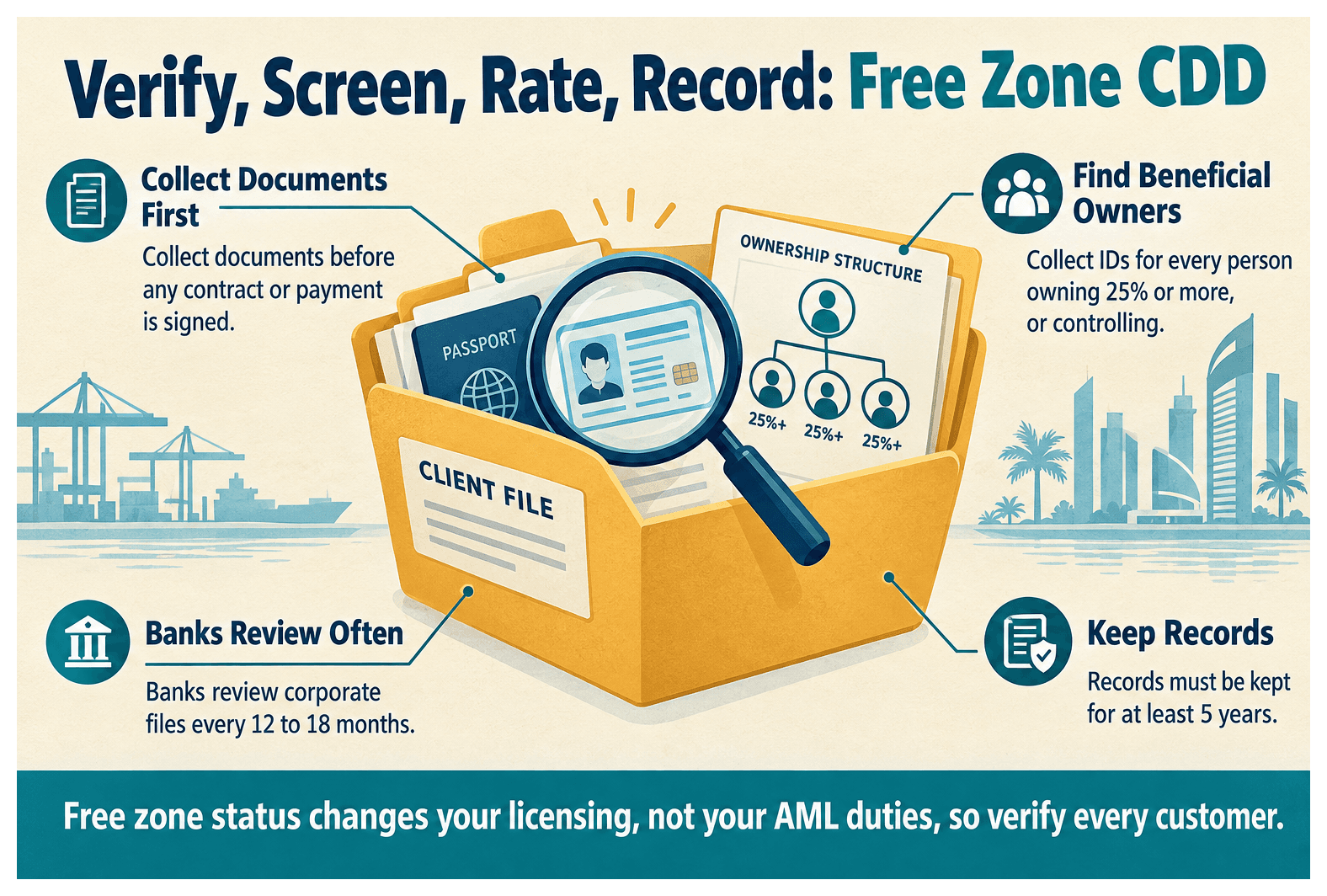
You must conduct customer due diligence in a UAE free zone because regulators fine weak controls, banks close accounts that lack evidence of customer checks, and unverified customers bring fraud and sanctions risk.
Regulatory and Financial Risk
Administrative fines apply for AML failures.
Dealing with listed persons creates sanctions exposure.
FATF follow-up status raises enforcement attention.
Banking Consequences for Dubai South Companies
Picture a founder whose account review stalled because customer contracts had no ownership verification attached. Missing records mean freezes or closure. See preparing your Dubai company for a bank review, and the Central Bank of the UAE for supervisory guidance.
Documents and Information to Collect From Every Customer
For individuals, collect a passport or Emirates ID, proof of address and the purpose of the relationship. For companies, collect the trade license, incorporation documents, ownership structure, UBO details and signatory IDs.
Individual Customers
Passport or Emirates ID, plus visa page if relevant.
Recent proof of address, such as a home-country utility bill.
Occupation, source of funds, expected volumes.
Corporate Customers and Ultimate Beneficial Owners
License, articles, shareholder register, board resolution.
IDs for every person owning 25% or more, or controlling the entity.
Traced layers if an offshore holding company sits on top.
Our guide to the ultimate beneficial owner in the UAE explains the rules in detail.
Process to Conduct Customer Due Diligence in a UAE Free Zone
To conduct customer due diligence in a UAE free zone, verify the customer and owners, screen them, rate the risk, choose standard or enhanced checks, decide, and record everything.
Step 1: Identify and Verify the Customer
Collect documents before any contract or payment.
Check the license number against the issuing authority's records.
Confirm the signatory's authority.
Our checklist on checking if a Dubai company is legitimate helps here.
Step 2: Screen for Sanctions and Politically Exposed Persons
Screen the customer, owners and signatories against the UAE local terrorist list and UN lists.
Check PEP status and adverse media.
Save dated results. A name match resolved by date of birth still needs a note.
Step 3: Assign a Risk Rating and Decide
Score by customer type, geography, product and channel.
Send high-risk cases, such as a cash-heavy buyer from a high-risk country, to management.
Write down the rationale.
Standard vs Enhanced Due Diligence Requirements
Feature | Standard Due Diligence | Enhanced Due Diligence |
|---|---|---|
Typical customer type | Local trading company with clear ownership | PEP, high-risk country or layered structure |
Identity and UBO verification | License, register and IDs of owners at 25% or more | Same, plus independent registry extracts and full chain tracing |
Source of funds evidence | Declaration and expected volumes | Audited accounts, bank statements, sale deeds |
Approval level | Compliance officer | Senior management sign-off |
Review frequency | Every 2 to 3 years | Annually |
Enhanced Due Diligence for High-Risk Customers
Enhanced due diligence is deeper checking for high-risk customers. It adds source of wealth verification, senior approval and closer monitoring.
Triggers That Call for Enhanced Checks
PEPs, relatives and close associates.
Countries flagged by FATF or UAE authorities.
Complex ownership with no commercial reason.
Large, unexplained transactions.
Verifying Source of Funds and Wealth
Ask for audited accounts, bank statements or sale agreements. A buyer funding an order from a property sale should show the deed and the bank transfer. Record why you accepted or refused the explanation. The World Bank publishes useful guidance on beneficial ownership.
Ongoing Monitoring and Record Keeping
Customer due diligence doesn't end at onboarding. Monitor transactions against the customer's profile, refresh files on a risk-based schedule, report suspicion and keep records for at least five years (Ministry of Finance).
Periodic Reviews and Trigger Events
High risk annually, medium every two years, low every three.
Review on ownership change, license renewal or odd activity.
Request the new shareholder register immediately.
Retention and Suspicious Activity Reporting
Keep identification, screening, transaction and decision records. Escalate suspicion, such as sudden round-sum payments, to your compliance officer, who files through the FIU goAML platform. Never tip off the customer.
Common Mistakes and a Practical Example
The most common customer due diligence mistakes are unverified documents, ignored beneficial owners, skipped screening, stale files and scattered inboxes. One checklist and one central file fix most of them.
Frequent Errors New Businesses Make
Accepting an emailed license copy that had expired.
Stopping at the first shareholding layer.
Screening once and never again.
Worked Example From Dubai South
A trading start-up onboards a buyer in three working days. Ownership traces to two individuals, screening is clean and the rating is medium. The file holds the license, register, two IDs, screening report and approval note, ready for the bank. Apply the same logic to vendor due diligence for UAE companies.
Tools and Internal Controls for Small Teams
Small free zone teams can run customer due diligence with a written AML policy, a named compliance officer, a checklist, a screening tool and a secure file.
Policy, Compliance Officer and Checklist
One-page policy approved by the owner.
Operations manager as compliance officer, plus a deputy.
One checklist with sign-off fields.
Screening Tools and Secure Filing
Pick a screening service covering UN and local lists. Store one folder per customer with access controls. Dubai South Business Hub companies can combine this with their license and shareholder records for one tidy compliance file.
Your Next Step
To conduct customer due diligence in a UAE free zone, verify customers and owners, screen them, rate the risk, escalate high-risk cases and keep records for five years. A checklist and a named officer protect your license and your bank account. Set up your Dubai South Business Hub free zone company with a compliance-ready structure, and speak with the team about licensing and residency visa packages today.
References
Frequently Asked Questions