
Topic Summary
What Is Dubai Customs MIRSAL Registration and Why Do Importers Need It?
Dubai Customs MIRSAL registration is the process of getting your company approved to use Mirsal 2, the Dubai Customs electronic system for import declarations. Without an active account linked to your client code, you can't file a Mirsal 2 import declaration or clear goods through Dubai's ports and free zones.
Who Can Apply for a Mirsal 2 Account for Importers?
Who Can Apply for a Mirsal 2 Account for Importers?
What Documents Do You Need Before Starting Dubai Customs MIRSAL Registration?
You need a valid trade license, a client code, the owner's passport and Emirates ID, a signed authorisation letter and an establishment contract. Requirements may vary by company type, so confirm the current checklist with Dubai Customs before you submit your Dubai Customs import registration.
How Do You Complete Dubai Customs MIRSAL Registration Step by Step?
Get your trade license, obtain a client code, register on the portal, submit documents, wait for approval and set up your Mirsal 2 login. Then file declarations yourself or link a clearing agent. Each step depends on the one before it.
How Much Does Dubai Customs MIRSAL Registration Cost and How Long Does It Take?
Cost and timeline depend on your license type, document readiness and current processing. Don't rely on a fixed figure, because fees and requirements may vary, so check the official source before applying. Complete, consistent documents are the biggest factor in speed.
What Mistakes and Penalties Should Importers Avoid After Registration?
The common mistakes are wrong HS codes, mismatched declarations, unauthorised users and late filings. They can cause delays, storage charges and fines. Check penalty rules with Dubai Customs rather than assuming amounts, and review each declaration before Mirsal 2 customs clearance.
Final Thoughts
Dubai Customs MIRSAL registration rests on a valid license, a client code and clean documents, followed by portal registration and login activation. Confirm your license covers your goods, gather the checklist and apply for your code. Need a license first? Speak to Dubai South Business Hub about a free zone trade license.
You need a valid trade license and a customs client code, then you apply for Mirsal 2 access through Dubai Customs. Dubai Customs MIRSAL registration is the gateway to every import declaration you'll file.
Mirsal 2 handles more than 17 million declarations a year (Dubai Trade, 2026). This guide is for entrepreneurs, logistics operators and cold chain investors who want to complete Dubai Customs MIRSAL registration without rejected applications. Rules in the UAE change often. Always verify the latest requirements with the official authority before taking action.
What Is Dubai Customs MIRSAL Registration and Why Do Importers Need It?
Dubai Customs MIRSAL registration is the process of getting your company approved to use Mirsal 2, the Dubai Customs electronic system for import declarations. Without an active account linked to your client code, you can't file a Mirsal 2 import declaration or clear goods through Dubai's ports and free zones.
What Mirsal 2 Does for Importers
Dubai Customs Mirsal is the electronic declaration system. A declaration is the formal filing describing your goods, value and origin. It covers import, export, re-export and transit, and connects importers, clearing agents and customs officers in one workflow.
Picture a cold chain operator importing frozen seafood. The declaration goes in before the shipment reaches Jebel Ali Port, so the cargo doesn't sit warming in a yard.
Mirsal 2 Versus the Dubai Trade Portal
The Dubai Trade portal handles logistics services and pre-clearance steps, and over 98% of declarations are processed digitally. Mirsal 2 handles the customs declaration itself. Most new importers register on both, since shipping lines and port services run through Dubai Trade. See our guide to Dubai Trade Portal registration for importers and exporters.
Who Can Apply for a Mirsal 2 Account for Importers?
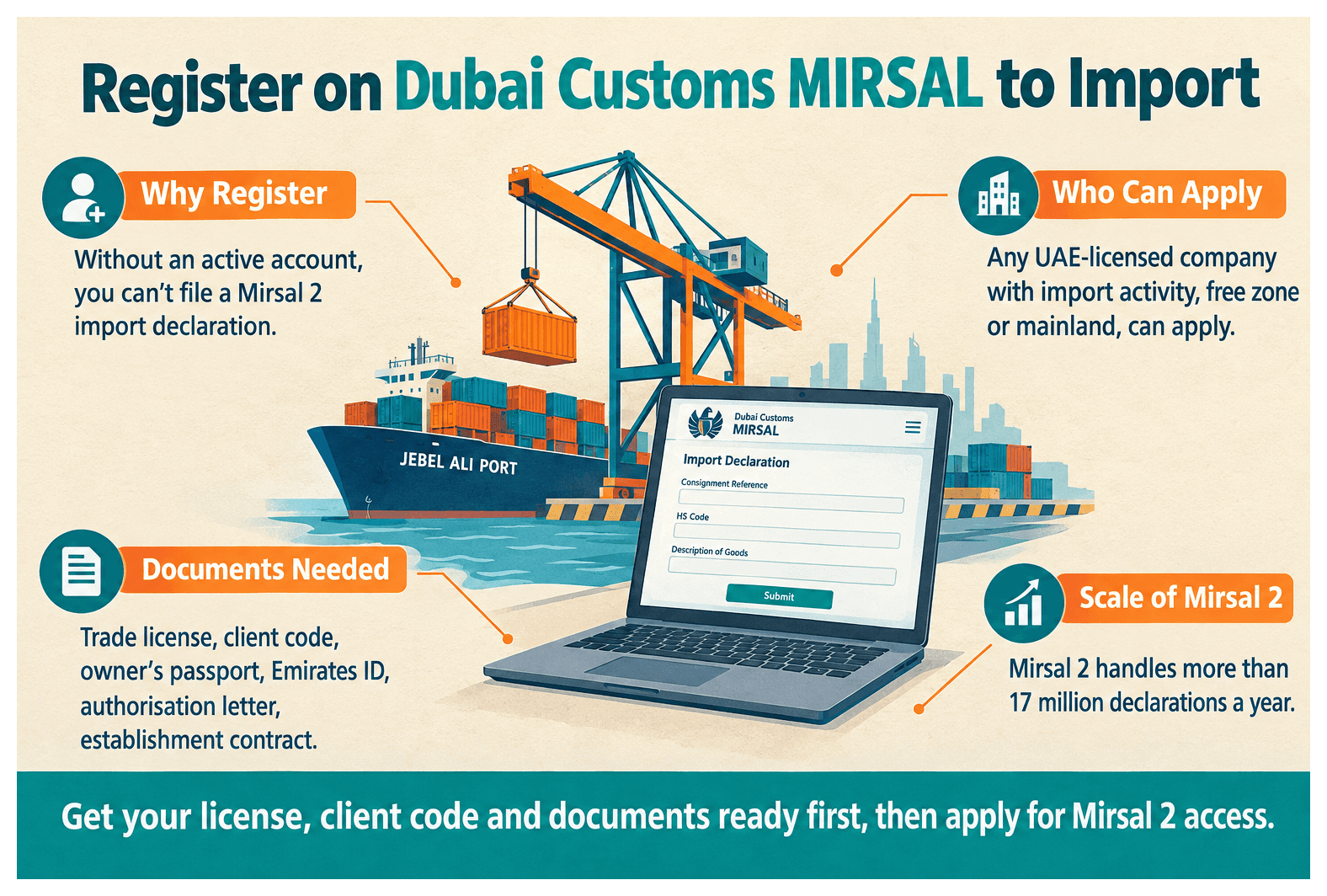
Any UAE-licensed company whose trade activity covers importing can apply. Free zone and mainland companies both qualify, provided they hold a valid license, a Dubai Customs client code and an authorised signatory. Individuals without a license can't register as importers.
Eligible Business Types and Activities
Trading, food trading, cold storage and logistics licenses with import activity qualify.
License activity must match the goods you import.
Cold chain firms should confirm food and temperature-controlled wording.
A consultancy license won't work for frozen food imports.
Which License Do You Need Before Applying
A Dubai South Business Hub Free Zone trade license is one route to a customs-eligible company. An investor setting up a cold chain trading firm starts there, then applies for the customs code. Read which license you need to import goods into Dubai. Fees and requirements may vary, so check the official source before applying.
What Documents Do You Need Before Starting Dubai Customs MIRSAL Registration?
You need a valid trade license, a client code, the owner's passport and Emirates ID, a signed authorisation letter and an establishment contract. Requirements may vary by company type, so confirm the current checklist with Dubai Customs before you submit your Dubai Customs import registration.
Documents Checklist for Importers
Trade license showing import activity.
Passport and Emirates ID of the signatory.
Establishment contract or memorandum of association.
Ejari or free zone tenancy document.
Authorisation letter for the account manager.
Self-Filing vs Using a Clearing Agent on Mirsal 2
Feature | File Declarations Yourself | Use a Clearing Agent |
|---|---|---|
Control over declarations | You review every HS code and value before submission. | The agent drafts and submits, you approve. |
Required in-house expertise | Trained staff who know classification and duty rules. | Minimal, the agent supplies the knowledge. |
Speed for first shipments | Slower while your team learns the system. | Faster, since agents file daily. |
Cost structure | Staff and training cost, no per-shipment agent fee. | Per-shipment service fees. |
Best suited for | High, regular shipment volumes. | New importers and occasional shipments. |
What Is a Customs Client Code
A customs client code is the unique ID Dubai Customs assigns to your company. The Federal Customs Authority (FCA) sets federal policy, while Dubai Customs runs the emirate-level process. A company with a license but no code gets stuck at sign-up. Compare options in customs client code for a Dubai company and the Dubai customs import code guide.
Practical tip: Company name, license number and signatory name must match on every document. A trading name spelled differently on the license and the authorisation letter is a classic reason for rejection.
How Do You Complete Dubai Customs MIRSAL Registration Step by Step?
Get your trade license, obtain a client code, register on the portal, submit documents, wait for approval and set up your Mirsal 2 login. Then file declarations yourself or link a clearing agent. Each step depends on the one before it.
Step 1: Secure Your Trade License
Confirm the activity covers your goods.
Use a free zone or mainland license.
A cold chain founder checks that food trading and cold storage appear.
Step 2: Obtain Your Customs Client Code
Apply to Dubai Customs with license and ID documents.
Wait for the code, often sent by email, before moving on.
Step 3: Register on the Dubai Customs Portal and Submit Documents
Create the account and upload your checklist.
Name authorised users, such as an operations manager with a signed letter.
Pay any fee. Fees and requirements may vary, so check the official source before applying.
Step 4: Activate Mirsal 2 Login and File Your First Declaration
Set credentials, test access and check user roles. File a small pilot shipment first. Read Mirsal 2 declarations for Dubai importers before you do.
How Much Does Dubai Customs MIRSAL Registration Cost and How Long Does It Take?
Cost and timeline depend on your license type, document readiness and current processing. Don't rely on a fixed figure, because fees and requirements may vary, so check the official source before applying. Complete, consistent documents are the biggest factor in speed.
Cost Components to Budget For
Trade license fees.
Customs client code fees.
Possible deposits or guarantees.
Clearing agent fees, charged per shipment.
Timeline Factors That Slow Approval
Incomplete uploads, name mismatches and a missing client code cause most delays. One resubmission lost days because the signatory's Emirates ID had expired. Check Dubai Trade Portal account timelines too, and confirm any official fee with the UAE Ministry of Finance.
What Mistakes and Penalties Should Importers Avoid After Registration?
The common mistakes are wrong HS codes, mismatched declarations, unauthorised users and late filings. They can cause delays, storage charges and fines. Check penalty rules with Dubai Customs rather than assuming amounts, and review each declaration before Mirsal 2 customs clearance.
Common mistake: An HS code is the Harmonised System number classifying your goods. A chilled food importer who picks the wrong one risks wrong duty and an inspection hold. Product compliance (MoIAT, Dubai Municipality for food) applies separately.
Account Security and Authorised Users
Protect your Mirsal 2 login.
Remove ex-employees immediately.
Assign roles by task.
Keep declaration records for audit.
Connecting Customs With VAT and Compliance
Import VAT runs through the Federal Tax Authority (FTA). Your finance team should match declaration values to VAT returns. Review import business in Dubai operating costs for the wider picture.
Final Thoughts
Dubai Customs MIRSAL registration rests on a valid license, a client code and clean documents, followed by portal registration and login activation. Confirm your license covers your goods, gather the checklist and apply for your code. Need a license first? Speak to Dubai South Business Hub about a free zone trade license.
Rules in the UAE change often. Always verify the latest requirements with the official authority before taking action.
References
Frequently Asked Questions