Topic Summary
What Is Tax Implications of Owning a Dubai Company as a Ethiopian National and Why It Matters
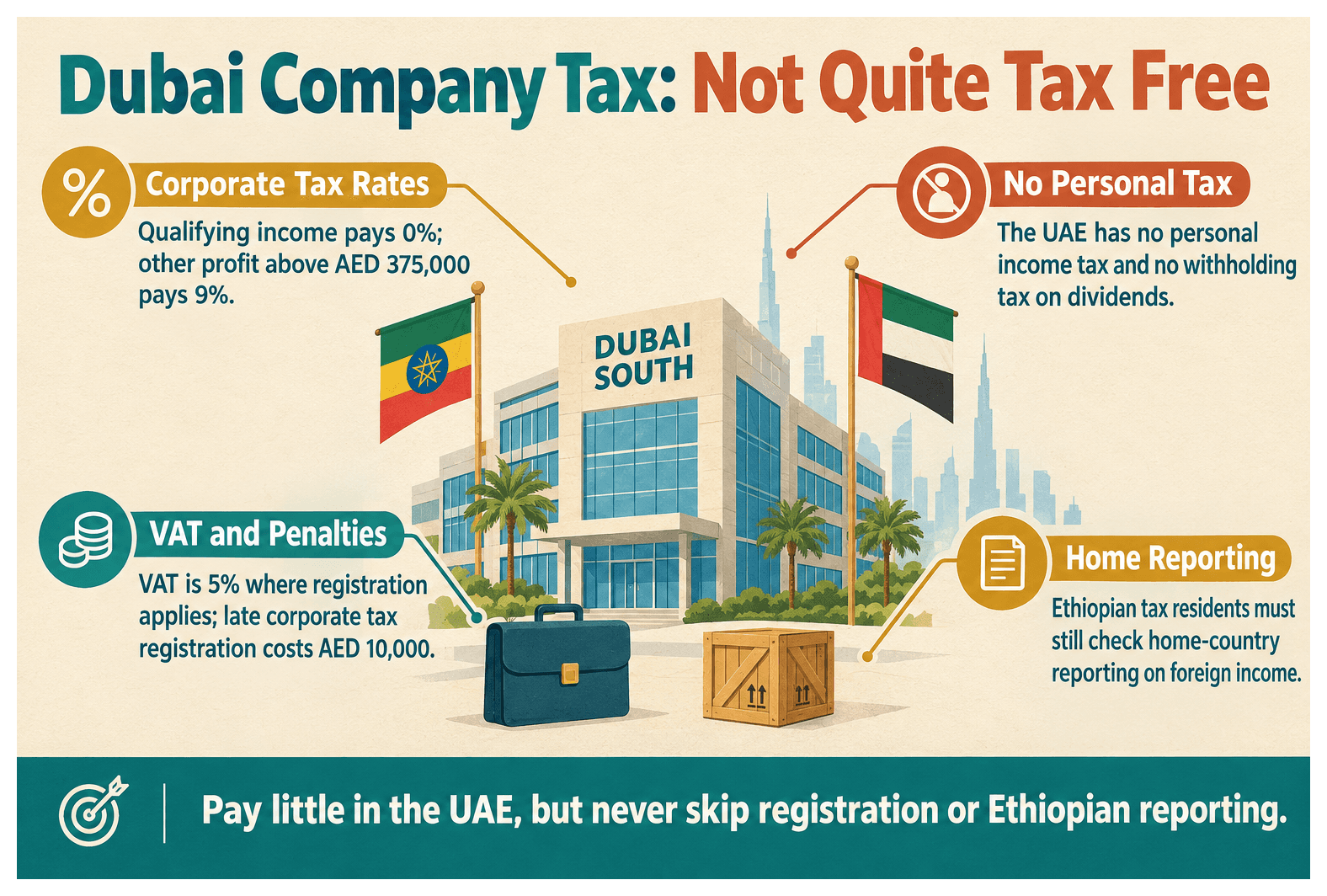
The tax implications of owning a Dubai company as an Ethiopian national cover UAE corporate tax, VAT and personal tax status, plus Ethiopian reporting duties. A Dubai South company can pay 0% on qualifying income and 9% above AED 375,000 on other profits, with no UAE personal income tax.
Forex Scarcity at Home and Dubai Sourcing: Why Tax Structure Matters
Forex Scarcity at Home and Dubai Sourcing: Why Tax Structure Matters
Regulations in the UAE on Corporate Tax and VAT for Ethiopian Owners
UAE regulations require eligible companies to register for corporate tax and file annually. They also require VAT registration at 5% once taxable supplies pass AED 375,000 over 12 months. Free zone companies must keep audited financials and substance records to protect the qualifying 0% rate for any dubai company ethiopian national owner.
Conditions Must You Meet to Keep the Exemption
To keep the 0% rate, a company must maintain adequate substance in the free zone, earn qualifying income and stay within the de minimis limit on non-qualifying revenue. It must also keep audited accounts and follow transfer pricing rules. Failing a condition can trigger 9% on income above AED 375,000 ( Ministry of Finance , 2026).
Step-by-Step Process to Stay Tax Compliant as an Ethiopian Owner
Stay compliant in six steps: form a free zone company, register for corporate tax, assess VAT, keep books, file annual returns, and check Ethiopian reporting. Following this order helps ethiopian nationals financial uae planners avoid penalties and protect the 0% rate.
Cost and Timeline of Tax Compliance for Ethiopian Founders
Tax compliance for a Dubai South company mainly costs the annual license from AED 12,500 (Dubai South Business Hub, 2026), plus accounting, audit and VAT filings. Corporate tax registration usually takes days, and returns are due within nine months of year-end.
Common Mistakes Ethiopian Founders Make With Dubai Company Tax
Common Mistakes include missing registration, ignoring VAT thresholds, mixing personal and company funds, weak substance and neglecting Ethiopian reporting. Each can trigger penalties from AED 10,000 or loss of the 0% rate, so build compliance in from month one.
Ethiopian nationals who own a Dubai South free zone company generally pay 0% corporate tax on qualifying income, 9% on non-qualifying income above AED 375,000, and 5% VAT where registration applies, with no UAE personal income tax. Ethiopian tax residents must still check home-country reporting on foreign income.
This guide is for founders planning ethiopian nationals financial uae structures. You'll learn what the UAE taxes, what Ethiopia may still expect, and how to keep a Dubai company compliant. The UAE has no personal income tax and no withholding tax on dividends (Federal Tax Authority, 2026). Late corporate tax registration costs AED 10,000, and Dubai's non-oil trade tops AED 2.2 trillion a year (Dubai Chamber, 2024). Never read any of this as "100% tax free."
What Is Tax Implications of Owning a Dubai Company as a Ethiopian National and Why It Matters
Forex Scarcity at Home and Dubai Sourcing: Why Tax Structure Matters
Regulations in the UAE on Corporate Tax and VAT for Ethiopian Owners
Conditions Must You Meet to Keep the Exemption
Step-by-Step Process to Stay Tax Compliant as an Ethiopian Owner
Cost and Timeline of Tax Compliance for Ethiopian Founders
Common Mistakes Ethiopian Founders Make With Dubai Company Tax
Should You Do Next to Start Re-Exporting From Dubai South
References
What Is Tax Implications of Owning a Dubai Company as a Ethiopian National and Why It Matters
The tax implications of owning a Dubai company as an Ethiopian national cover UAE corporate tax, VAT and personal tax status, plus Ethiopian reporting duties. A Dubai South company can pay 0% on qualifying income and 9% above AED 375,000 on other profits, with no UAE personal income tax.
UAE Corporate Tax at a Glance
Federal Decree-Law No. 47 of 2022 sets the 9% rate. Picture an Ethiopian founder whose Dubai South trading company earns AED 600,000 in mixed income. Qualifying income stays at 0%. Non-qualifying income is taxed at 9% only on the portion above AED 375,000, and only if the company keeps its status. Rates quoted here are current as of 2026.
Why Ownership Structure Shapes Your Tax Position
A free zone entity and a personal holding are taxed very differently. Your residency is tied to a license-linked visa, which affects where you're treated as resident. Over 70% of applications come from founders outside the UAE (Dubai South Business Hub, 2026), so remote formation from Addis Ababa is routine. Start with what Ethiopian founders need to know before setting up in Dubai.
Forex Scarcity at Home and Dubai Sourcing: Why Tax Structure Matters
Forex scarcity in Ethiopia makes it hard to pay overseas suppliers, so many founders source goods through a Dubai company that holds hard currency. Supplier payments, margins and retained profits in Dubai determine what's taxable in the UAE and what you must report in Ethiopia. That's the core of uae business from ethiopia planning.
How Birr Shortages Push Founders Toward Dubai Sourcing
An Addis Ababa electronics importer can't always get USD for stock. Buying through a Dubai entity with an AED or USD corporate account solves part of that. Dubai's non-oil trade runs above AED 2.2 trillion a year (Dubai Chamber, 2024), which is why it works as a sourcing and re-export hub. See opening a UAE corporate bank account for the banking side.
Taxable Margin on Dubai-Sourced Goods
Say your Dubai company buys at AED 100,000 and invoices an Ethiopian buyer at AED 120,000. That AED 20,000 margin is profit booked in the UAE, so pricing must be arm's-length, meaning what unrelated parties would agree. Check the import and export license requirements before your first shipment.
Regulations in the UAE on Corporate Tax and VAT for Ethiopian Owners
UAE regulations require eligible companies to register for corporate tax and file annually. They also require VAT registration at 5% once taxable supplies pass AED 375,000 over 12 months. Free zone companies must keep audited financials and substance records to protect the qualifying 0% rate for any dubai company ethiopian national owner.
Corporate Tax Registration and Filing
Register through the Federal Tax Authority portal.
File one annual return per financial year.
Qualifying free zone persons need audited accounts.
Late registration carries a AED 10,000 penalty (FTA, 2026).
VAT Registration Thresholds
Registration is mandatory at AED 375,000 and voluntary from AED 187,500. The standard rate is 5%. A re-exporter shipping goods to Ethiopia can often zero-rate qualifying exports, but you still have to register and file.
No Personal Income Tax on Dividends and Salaries
The UAE levies 0% personal income tax and no withholding tax on dividends. A founder drawing AED 20,000 monthly from their own company pays nothing on it in the UAE. Ethiopian rules may still reach tax residents, so don't skip Step 4 below. The Dubai South setup guide covers formation.
Conditions Must You Meet to Keep the Exemption
To keep the 0% rate, a company must maintain adequate substance in the free zone, earn qualifying income and stay within the de minimis limit on non-qualifying revenue. It must also keep audited accounts and follow transfer pricing rules. Failing a condition can trigger 9% on income above AED 375,000 (Ministry of Finance, 2026).
Qualifying Income and Substance
Sales to other free zone companies are usually qualifying.
Heavy mainland sales can breach the de minimis limit.
You need real staff, premises and spending in the zone.
Your licensed activity must match what you actually do. Run a name check early.
Consequences of Losing Qualifying Status
Imagine a founder who sells mostly to mainland customers without planning. Tax moves to 9% above AED 375,000, and disqualification can last several years. You must also keep records for seven years. Plan your customer mix before you invoice, not after.
Step-by-Step Process to Stay Tax Compliant as an Ethiopian Owner
Stay compliant in six steps: form a free zone company, register for corporate tax, assess VAT, keep books, file annual returns, and check Ethiopian reporting. Following this order helps ethiopian nationals financial uae planners avoid penalties and protect the 0% rate.
Step 1: Form Your Free Zone Company and Secure the Visa
Licenses start from AED 12,500 per year (Dubai South Business Hub, 2026), and you can form remotely from Ethiopia. Your investor visa is linked to the license. See the UAE investor visa guide.
Step 2: Register for Corporate Tax and Assess VAT
Register on the FTA portal within the deadline, because a late filing costs AED 10,000. Then check your trailing 12-month supplies against AED 375,000.
Step 3: Keep Books and File Annual Returns
Use accounting software, reconcile quarterly and keep audited statements. Hold records for seven years. Returns are due within nine months of year-end.
Step 4: Check Ethiopian Reporting Duties
If you split time between Addis Ababa and Dubai, day-count residency tests matter. Confirm your status with a qualified Ethiopian adviser, and ask about foreign income and asset disclosure.
Ongoing Tax and Compliance Costs for a Dubai South Company (AED, quoted 2026)
Feature | Item | Typical AED Figure |
|---|---|---|
Annual free zone license | Dubai South trade license | From AED 12,500 per year |
Corporate tax rate | Qualifying vs other income | 0% qualifying, 9% above AED 375,000 |
VAT rate and threshold | Mandatory registration | 5% from AED 375,000 |
Late VAT registration penalty | FTA administrative fine | AED 10,000 |
Bookkeeping and audit | Accountant and auditor | Adviser quote required |
Cost and Timeline of Tax Compliance for Ethiopian Founders
Tax compliance for a Dubai South company mainly costs the annual license from AED 12,500 (Dubai South Business Hub, 2026), plus accounting, audit and VAT filings. Corporate tax registration usually takes days, and returns are due within nine months of year-end.
Typical Compliance Calendar
Month 1: form the company, then register for corporate tax.
Quarterly: bookkeeping and any VAT returns.
Year-end: audit by qualified auditors.
Within nine months: file the annual return.
Budget your first year with the cost calculator.
Common Mistakes Ethiopian Founders Make With Dubai Company Tax
Common Mistakes include missing registration, ignoring VAT thresholds, mixing personal and company funds, weak substance and neglecting Ethiopian reporting. Each can trigger penalties from AED 10,000 or loss of the 0% rate, so build compliance in from month one.
Registration and Filing Errors
Registering late, for example a AED 10,000 VAT penalty.
Missing the annual return deadline.
Structuring and Reporting Errors
Paying household costs from the corporate account.
Leaving foreign income unreported at home.
Making unplanned mainland sales that breach qualifying limits.
Should You Do Next to Start Re-Exporting From Dubai South
Confirm your business activity, check your company name, estimate costs and speak with a Dubai South adviser. Then form the company, open a corporate account and register for tax, so re-exporting for uae business from ethiopia begins compliant from the first shipment.
Immediate Actions
Run the name check.
Budget a license from AED 12,500 in the cost calculator.
Speak to a consultant before you invoice.
Important Considerations
Ethiopian nationals financial uae planning works best when UAE and Ethiopian advice are aligned.
Keep supplier invoices and shipping records for every Dubai-sourced consignment.
Final Thoughts
Ethiopian nationals financial uae planning centres on 0% qualifying income, 9% above AED 375,000, 5% VAT and careful Ethiopian reporting. Dubai sourcing can ease forex scarcity at home when structured properly. Use the cost calculator and name check, then speak to Dubai South Business Hub to form your company.
References
Frequently Asked Questions