
Topic Summary
What Is a Suspicious Activity Report and Why It Matters in Dubai South
A suspicious activity report is a confidential notification sent to the UAE Financial Intelligence Unit (FIU) when you suspect, or have reasonable grounds to suspect, that funds relate to money laundering, terrorist financing or a predicate crime. In the UAE, it's filed through the goAML platform.
When to File a Suspicious Activity Report: The Triggers
When to File a Suspicious Activity Report: The Triggers
Where Reports Go and Who Reviews Them
Reports go to the UAE FIU, which sits within the Central Bank of the UAE. Analysts assess each filing and may pass it to law enforcement or supervisors. You'll typically get an acknowledgement, not a case outcome.
How to File: Steps to Submit a Report
To file, register on goAML, escalate to your compliance officer, gather documents, assess grounds, submit a clear narrative and keep records confidential. Never tip off the customer.
Mistakes and Penalties to Avoid When Filing
The costliest errors are tipping off, filing late, thin narratives and not reporting at all. Penalties can include administrative fines, license action and criminal liability for individuals.
Building a Reporting Process for Your Dubai South Company
Appoint a compliance officer, register on goAML, run risk-based due diligence, train staff and keep clear records. A properly licensed free zone entity makes onboarding smoother.
Putting It Into Practice
A suspicious activity report and when to file one comes down to one rule: report once you've reasonable grounds, stay confidential and document everything. Clear escalation protects your license and banking relationships.
In 2026, the UAE keeps tightening anti-money-laundering enforcement, and silence about a red flag can cost a business as much as the offence itself. This guide explains a suspicious activity report and when to file one, so Dubai South founders can spot triggers, file correctly and avoid penalties.
What Is a Suspicious Activity Report and Why It Matters in Dubai South
A suspicious activity report is a confidential notification sent to the UAE Financial Intelligence Unit (FIU) when you suspect, or have reasonable grounds to suspect, that funds relate to money laundering, terrorist financing or a predicate crime. In the UAE, it's filed through the goAML platform.
Definition and Legal Basis
It's a report based on suspicion, not proof. In UAE practice, suspicious transaction reports (STRs) and suspicious activity reports (SARs) travel through the same goAML channel. The duty sits in the federal AML/CFT framework, including Federal Decree-Law No. 20 of 2018 and its executive regulations (Ministry of Finance, 2018).
Reporting isn't an accusation. You hand the assessment to the FIU. Picture a trading company whose new customer pays invoices from three unrelated third-party accounts. It files a report and never confronts the customer.
Who Must Report
Banks, exchange houses and other financial institutions.
Designated non-financial businesses and professions (DNFBPs): real estate, precious metals, corporate service providers.
Free zone companies in those categories. Location gives no exemption.
Any business whose bank reviews its accounts, so a reporting habit helps everyone.
Say a Dubai South real estate brokerage handles a cash-heavy purchase where the buyer's profile doesn't fit the funds. It must report. A Dubai South Business Hub license doesn't change that duty. For the wider picture, read our guide to anti money laundering duties for Dubai businesses.
Red Flags and Recommended Reporting Action
Feature | Red Flag | Recommended Action |
|---|---|---|
Customer refuses to provide ownership information | Hidden beneficial owner blocks proper due diligence | Pause onboarding, escalate to the compliance officer, consider filing |
Payment from unrelated third party | Payer has no visible link to the customer or contract | Request an explanation and documents, file if none is credible |
Transaction inconsistent with licensed activity | Funds don't match what the license allows | Compare to the activity code, record the mismatch, file if unexplained |
Overpayment with refund to different account | Classic layering pattern to clean funds | Don't refund, escalate immediately and file |
Attempted cash transaction withdrawn after due diligence request | Customer avoids scrutiny once asked for source of funds | File anyway, because attempted transactions are reportable |
When to File a Suspicious Activity Report: The Triggers
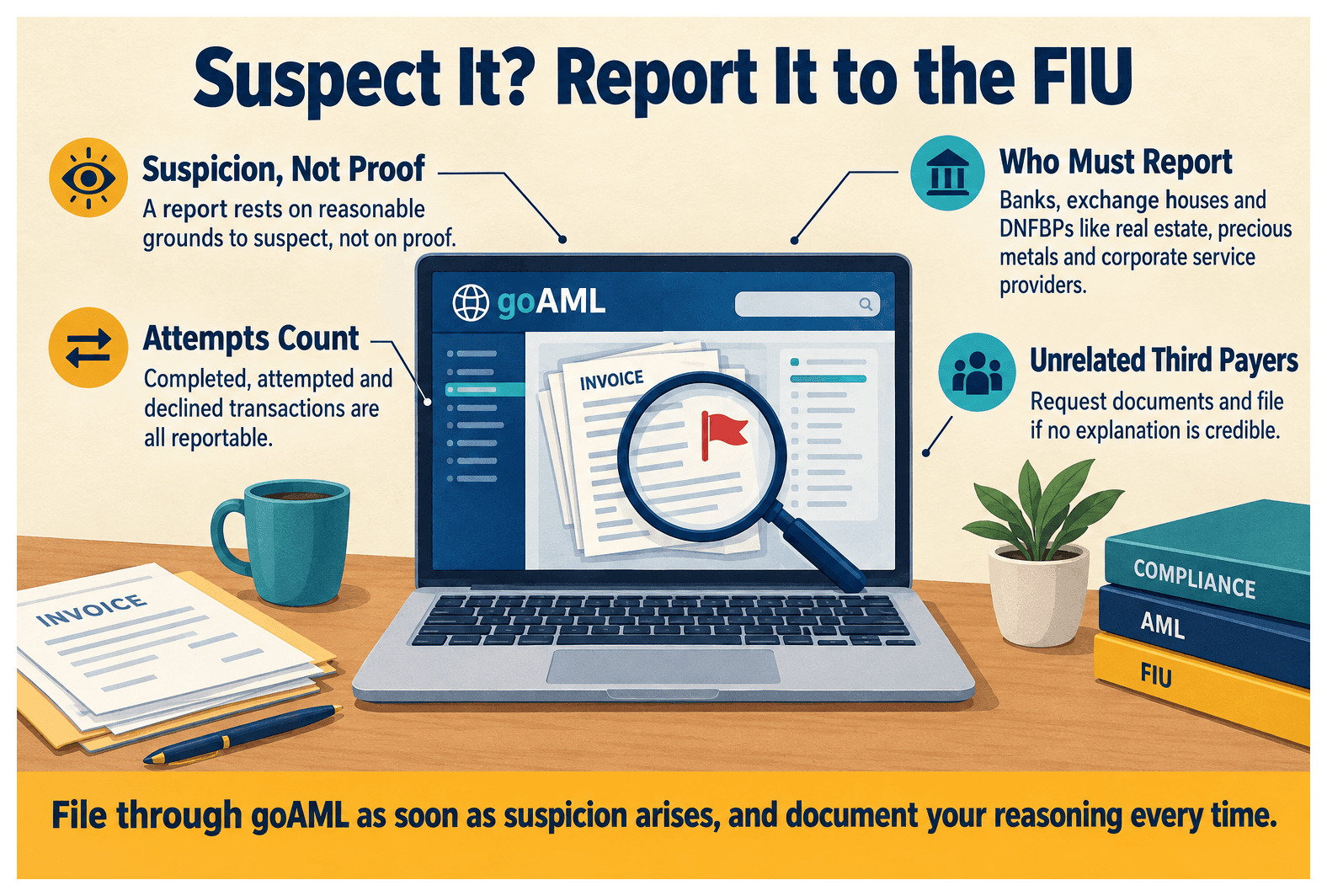
File as soon as you have reasonable grounds to suspect a link to money laundering or terrorist financing. This covers completed, attempted and declined transactions. Don't wait for proof or for the customer to explain.
The Reasonable Grounds Test
Judge suspicion on facts, context and what's normal for that customer. Delay creates exposure. Suppose a client wants to settle a large invoice in cash, then withdraws the order when you ask for source-of-funds papers. The attempt is still reportable. Document your reasoning either way.
Common Red Flags for Entrepreneurs
Reluctance to share beneficial owner details.
Activity that doesn't match the license.
Large payments from unrelated parties or high-risk jurisdictions.
Overpayment, then a refund request to another account.
Layered ownership with no commercial reason. See nominee structures in the UAE.
Picture a new consultancy receiving AED 900,000 from an overseas payer that isn't its client, followed by a refund request to a different bank. Patterns like this often appear alongside multiple currency corporate bank accounts in the UAE.
When You Do Not Need to File
Unusual but explained activity needs a file note, not a report. A seasonal sales spike backed by contracts and invoices is one example. If internal review finds no reasonable grounds, record the rationale. A customer complaint isn't suspicion.
Where Reports Go and Who Reviews Them
Reports go to the UAE FIU, which sits within the Central Bank of the UAE. Analysts assess each filing and may pass it to law enforcement or supervisors. You'll typically get an acknowledgement, not a case outcome.
The UAE Financial Intelligence Unit and goAML
goAML is the single electronic channel. You must register before filing, and supervisors expect that early, not after an incident. Register during onboarding so your compliance officer can file the same day a concern arises.
What Happens After You Submit
Expect an acknowledgement and possible requests for more information.
You've no right to learn the outcome.
Keep the customer under enhanced monitoring.
How to File: Steps to Submit a Report
To file, register on goAML, escalate to your compliance officer, gather documents, assess grounds, submit a clear narrative and keep records confidential. Never tip off the customer.
Step 1: Escalate Internally and Preserve Evidence
Pass the concern to the MLRO (Money Laundering Reporting Officer) within 24 hours.
Preserve invoices, KYC files and messages.
Limit access to those who need it.
Step 2: Assess and Write a Clear Narrative
Cover who, what, when, where, how much and why.
Attach documents and name all parties.
Stay factual, no speculation.
Step 3: Submit Through goAML and Record the Decision
Pick the correct report type and submit promptly.
Save the acknowledgement and decision log.
Retain records for at least five years under the federal framework. See records a Dubai South company must keep.
Mistakes and Penalties to Avoid When Filing
The costliest errors are tipping off, filing late, thin narratives and not reporting at all. Penalties can include administrative fines, license action and criminal liability for individuals.
Tipping Off and Confidentiality Breaches
Never tell a customer a report is filed or under consideration. A salesperson saying "compliance is reviewing your payment" reveals the concern. Script neutral wording for front-line staff.
Late, Vague, or Missing Reports
Waiting for proof defeats the purpose.
Vague narratives invite supervisory questions.
Good-faith reporting is protected from civil liability.
A firm ignoring structuring patterns for months faces scrutiny at its next bank review.
Building a Reporting Process for Your Dubai South Company
Appoint a compliance officer, register on goAML, run risk-based due diligence, train staff and keep clear records. A properly licensed free zone entity makes onboarding smoother.
Policies, Training, and Roles
Write an AML policy matched to your activity.
Name a compliance officer and a deputy.
Run annual red flag training.
Use a one-page escalation form.
Setting Up on Solid Ground With a Free Zone License
A precise activity code makes unusual transactions easier to spot, and clean shareholder records speed up bank due diligence. Dubai South Business Hub offers company formation, trade licenses and residency visa packages. Learn what a free zone establishment is and when to use one. AML duties stay federal, whatever your jurisdiction.
Putting It Into Practice
A suspicious activity report and when to file one comes down to one rule: report once you've reasonable grounds, stay confidential and document everything. Clear escalation protects your license and banking relationships.
Speak with Dubai South Business Hub about company formation, a free zone trade license and residency visa packages, and put your compliance structure in place from day one.
References
Frequently Asked Questions