
Topic Summary
What Is AML Compliance for a UAE Free Zone Company and Why It Matters
AML compliance for a UAE free zone company is the set of controls a business must run to prevent money laundering and terrorist financing. It covers risk assessment, customer due diligence, UBO records, monitoring, sanctions screening and goAML reporting under federal law, which applies in free zones as it does onshore.
Who Regulates AML Compliance for a UAE Free Zone Company
Who Regulates AML Compliance for a UAE Free Zone Company
KYC and Beneficial Ownership Requirements for Free Zone Entities
KYC requires you to verify who your customers are, who owns and controls them, and why they transact. You must also keep a register of your own Ultimate Beneficial Owners, meaning individuals holding 25% or more of ownership or control, and update changes within the legal timeframe.
Process to Set Up an AML Compliance Programme in Your Free Zone Company
Appoint a compliance officer, run a business-wide risk assessment, write policies, register on goAML, apply KYC and screening to every customer, train staff, and keep records for at least five years. Review the programme annually and after any material change.
Reporting Suspicious Activity Through goAML
goAML is the FIU's reporting platform. Supervised companies file STRs and SARs without delay once suspicion arises. Tipping off the customer is a criminal offence, so internal escalation must stay confidential. See our goAML registration guide.
Common Gaps and Penalties in AML Compliance for a UAE Free Zone Company
Common gaps include missing risk assessments, outdated UBO registers, no goAML registration, weak source-of-funds evidence and untrained staff. Consequences include fines, license action, frozen banking and criminal liability for individuals in serious breaches.
Keeping Your Free Zone Company Audit-Ready Year After Year
Review your risk assessment annually, refresh KYC files by risk, update the UBO register after ownership changes, log training, and store records for quick retrieval. Treat AML as an operating discipline, not a one-time licensing task.
The UAE's AML framework covers over 40 categories of designated non-financial businesses and professions (Ministry of Finance, 2024), and free zones are not exempt. This guide helps compliance officers and owners understand AML compliance for a UAE free zone company and build a working programme.
What Is AML Compliance for a UAE Free Zone Company and Why It Matters
AML compliance for a UAE free zone company is the set of controls a business must run to prevent money laundering and terrorist financing. It covers risk assessment, customer due diligence, UBO records, monitoring, sanctions screening and goAML reporting under federal law, which applies in free zones as it does onshore.
Plain-Language Definition for Owners and Compliance Officers
AML means policies, procedures and records that detect and deter illicit funds. KYC (know your customer) is one component, not the whole programme. Picture a Dubai South trading company receiving a large first payment from an unverified buyer. Your AML controls decide what you check before accepting that order.
Key AML Obligations for a UAE Free Zone Company
Obligation | What It Requires |
|---|---|
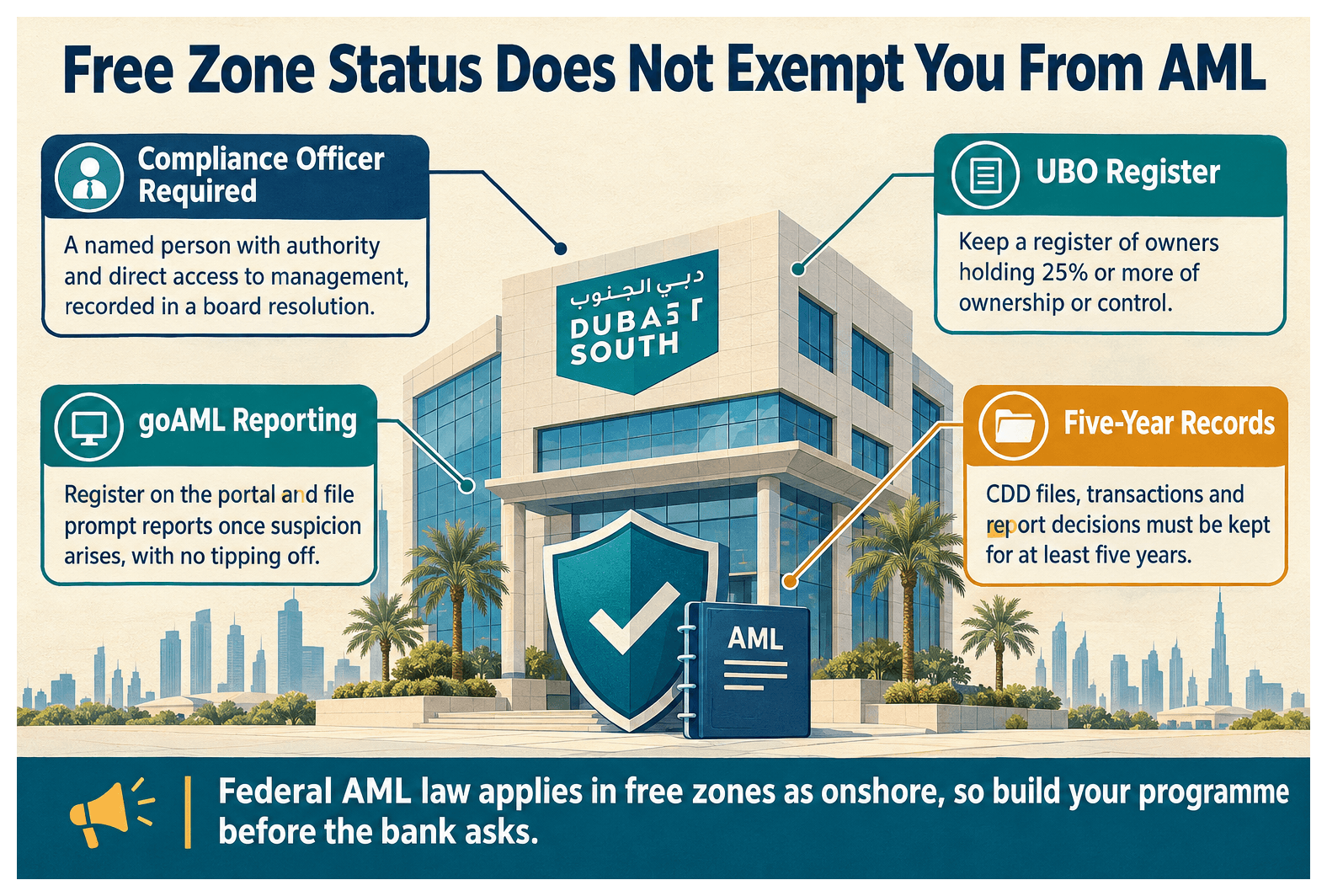
Compliance officer appointment | A named person with authority and direct access to management, recorded in a board resolution |
Business risk assessment | Written review of customer, geography, product and channel risk, refreshed annually |
Customer due diligence and UBO register | Verified identities, ownership charts and a register of owners holding 25% or more |
goAML registration and STR filing | Portal registration and prompt reports once suspicion arises, with no tipping off |
Record retention for five years | CDD files, transactions and report decisions kept for at least five years |
Why Free Zone Status Does Not Reduce Your Obligations
Federal Decree-Law No. 20 of 2018 and its implementing regulation apply nationwide. Only DIFC and ADGM run separate financial regimes, and Dubai South is not one of them. A free zone consultancy once assumed tax incentives exempted it, then learned it was a DNFBP when its bank asked for a compliance policy. Read more on anti money laundering duties for Dubai businesses.
Who Regulates AML Compliance for a UAE Free Zone Company
Several bodies share oversight. The Central Bank of the UAE supervises banks and licensed financial institutions, the Ministry of Economy supervises most DNFBPs, and the UAE Financial Intelligence Unit receives reports through goAML. The Executive Office for Control and Non-Proliferation oversees targeted financial sanctions.
The Role of CBUAE and the UAE FIU
The Central Bank of the UAE is the lead financial-sector supervisor. Its FIU analyses STRs and SARs. Banks pass KYC expectations down to you, so expect requests for source-of-funds evidence and a UBO register before account opening.
Ministry of Economy, Free Zone Authorities and Sector Supervisors
The Ministry of Economy supervises real estate agents, precious metals dealers and corporate service providers.
Free zone authorities enforce licensing and UBO filings.
Cabinet Decision No. 10 of 2019 sets implementing duties.
Dealers report cash transactions of AED 55,000 or more.
KYC and Beneficial Ownership Requirements for Free Zone Entities
KYC requires you to verify who your customers are, who owns and controls them, and why they transact. You must also keep a register of your own Ultimate Beneficial Owners, meaning individuals holding 25% or more of ownership or control, and update changes within the legal timeframe.
Customer Due Diligence and Risk Rating
Collect IDs, trade licenses and ownership charts.
Rate customers low, medium or high risk.
Apply enhanced checks to high-risk cases.
Screen against UN and local sanctions lists before onboarding.
A logistics firm, for example, rates a customer from a high-risk jurisdiction as high risk and gets senior approval before trading.
UBO Registers and Nominee Risks
Cabinet Decision No. 58 of 2020 requires every UAE company to register its UBOs. Our guide to UBO registration in the UAE covers the filing. Informal share transfers are a classic trap: a founder gives shares to a relative, the register goes stale, and the bank opens a review. Also read about nominee structures in the UAE.
Process to Set Up an AML Compliance Programme in Your Free Zone Company
Appoint a compliance officer, run a business-wide risk assessment, write policies, register on goAML, apply KYC and screening to every customer, train staff, and keep records for at least five years. Review the programme annually and after any material change.
Step 1: Appoint a Compliance Officer and Assess Risk
Name an officer with management access.
Record the appointment in a board resolution.
Document risks by customer, geography, product and channel.
Step 2: Write Policies and Register on goAML
Draft a policy covering KYC, monitoring, escalation and sanctions.
Register on goAML before your first high-value deal.
Step 3: Train Staff, Monitor Transactions and Keep Records
Train staff at onboarding and yearly.
Keep CDD and transaction files five years.
Sample files quarterly to catch gaps, such as a missing source-of-funds declaration.
Reporting Suspicious Activity Through goAML
goAML is the FIU's reporting platform. Supervised companies file STRs and SARs without delay once suspicion arises. Tipping off the customer is a criminal offence, so internal escalation must stay confidential. See our goAML registration guide.
When to File an STR or SAR
File when you have reasonable grounds for suspicion.
No minimum value applies.
Attempted transactions count.
Document every decision, filed or not.
Over 100,000 STRs have been processed through goAML in recent years (Central Bank of the UAE, 2024). A customer splitting payments below a threshold, then asking for a third-party refund, is a textbook trigger.
Avoiding Tipping Off and Managing Internal Escalation
Limit knowledge to the compliance officer and necessary management. Give sales staff a neutral script, such as a request for extra documents, with no mention of any review.
Common Gaps and Penalties in AML Compliance for a UAE Free Zone Company
Common gaps include missing risk assessments, outdated UBO registers, no goAML registration, weak source-of-funds evidence and untrained staff. Consequences include fines, license action, frozen banking and criminal liability for individuals in serious breaches.
Frequent Findings During Inspections and Bank Reviews
An unsigned template policy that doesn't match operations.
Files without controlling-person details.
No evidence of sanctions screening.
Banks act as de facto gatekeepers. One rejected an application because the applicant couldn't explain its customers or funding. See why UAE banks reject corporate account applications.
Fines, License Risk and Personal Liability
Federal Decree-Law No. 20 of 2018 and its amendments set administrative and criminal penalties. A license renewal can stall when records can't be produced on request. Check current ranges with the Ministry of Finance.
Keeping Your Free Zone Company Audit-Ready Year After Year
Review your risk assessment annually, refresh KYC files by risk, update the UBO register after ownership changes, log training, and store records for quick retrieval. Treat AML as an operating discipline, not a one-time licensing task.
Annual Review Cycle and Record Management
Calendar risk, policy and training dates.
Keep a central register of reports and decisions.
Hold policy, minutes, training logs and UBO register in one folder.
When to Bring in Specialist Advice
Call a specialist for multi-layer holdings, high-risk jurisdictions or cash-heavy activity. One founder with a layered structure commissioned an independent review before applying for a bank account.
Next Steps
AML compliance for a UAE free zone company rests on federal law, bank expectations and a practical programme: a named officer, documented risks, KYC and UBO records, goAML registration and routine reviews. Speak with the Dubai South Business Hub team about company formation, licensing and residency packages, then put your AML policy and goAML registration in place before trading begins.
References
Frequently Asked Questions