
Topic Summary
What Is the Economic Substance Test and Who Still Needs to File and Why It Matters
The test was a UAE requirement under Cabinet Resolution No. 31 of 2019 that made companies with relevant activities show a real presence in the country. It checked direction, management, staff, premises and expenditure. Reporting has ended for periods from 2023, but earlier periods can still matter.
Who Still Needs to File Under the Economic Substance Test for Earlier Periods
Who Still Needs to File Under the Economic Substance Test for Earlier Periods
How Substance Rules Now Work for Qualifying Free Zone Persons
Under Federal Decree-Law No. 47 of 2022, a Qualifying Free Zone Person must keep adequate substance in the free zone to hold the 0% rate on qualifying income. That means sufficient staff, premises and expenditure. It's a corporate tax condition, not a separate filing.
Steps to Confirm the Economic Substance Test and Who Still Needs to File
List your financial periods, compare them with 1 January 2023, identify relevant activities, check records, file missing reports, then document substance for corporate tax. Do it once a year.
Penalties and Records Dubai South Companies Should Keep
The old regime penalised missed notifications and reports, with fines escalating for repeat failures. Exposure now sits with unfiled earlier periods and corporate tax conditions. Keep records for at least seven years.
Practical Compliance Checklist for Dubai South Business Hub Companies
Dubai South companies should confirm historic filing status, register for corporate tax, keep audited accounts, hold a valid license and visas, and evidence real activity.
Where This Leaves You
The economic substance test and who still needs to file comes down to timing. Reporting ended for periods from 1 January 2023, but unfiled earlier periods can carry exposure, and substance now lives inside QFZP conditions. Review your periods, tidy any gaps, and speak with the Dubai South Business Hub team about licensing, residency visas and compliance.
The economic substance test and who still needs to file is a question that trips up founders in 2026. The UAE taxes income above AED 375,000 at 9% (Ministry of Finance, 2023), and many owners assume the old filings vanished without strings. This guide is for Dubai South founders who want to know what the test was, whether old periods still bite, and what to do now.
What Is the Economic Substance Test and Who Still Needs to File and Why It Matters
The test was a UAE requirement under Cabinet Resolution No. 31 of 2019 that made companies with relevant activities show a real presence in the country. It checked direction, management, staff, premises and expenditure. Reporting has ended for periods from 2023, but earlier periods can still matter.
What the Test Originally Checked
Cabinet Resolution No. 57 of 2020 amended the rules, and the Ministry of Finance oversaw them. They covered banking, insurance, holding company business, headquarters, distribution and service centre, shipping and intellectual property, among others.
Picture a holding company with a trade license but no staff, no office and no decisions made in the UAE. It would fail the adequacy test. A license alone never proved substance.
Why the Rules Still Matter Today
Cabinet Decision No. 98 of 2024 ended the regime for financial periods starting on or after 1 January 2023. It didn't wipe out duties for earlier periods.
Consider a buyer of a dormant free zone company who finds a missing notification for a 2021 financial year. That gap belongs to the buyer now. For background, see economic substance for Dubai free zone companies.
Who Still Needs to File Under the Economic Substance Test for Earlier Periods
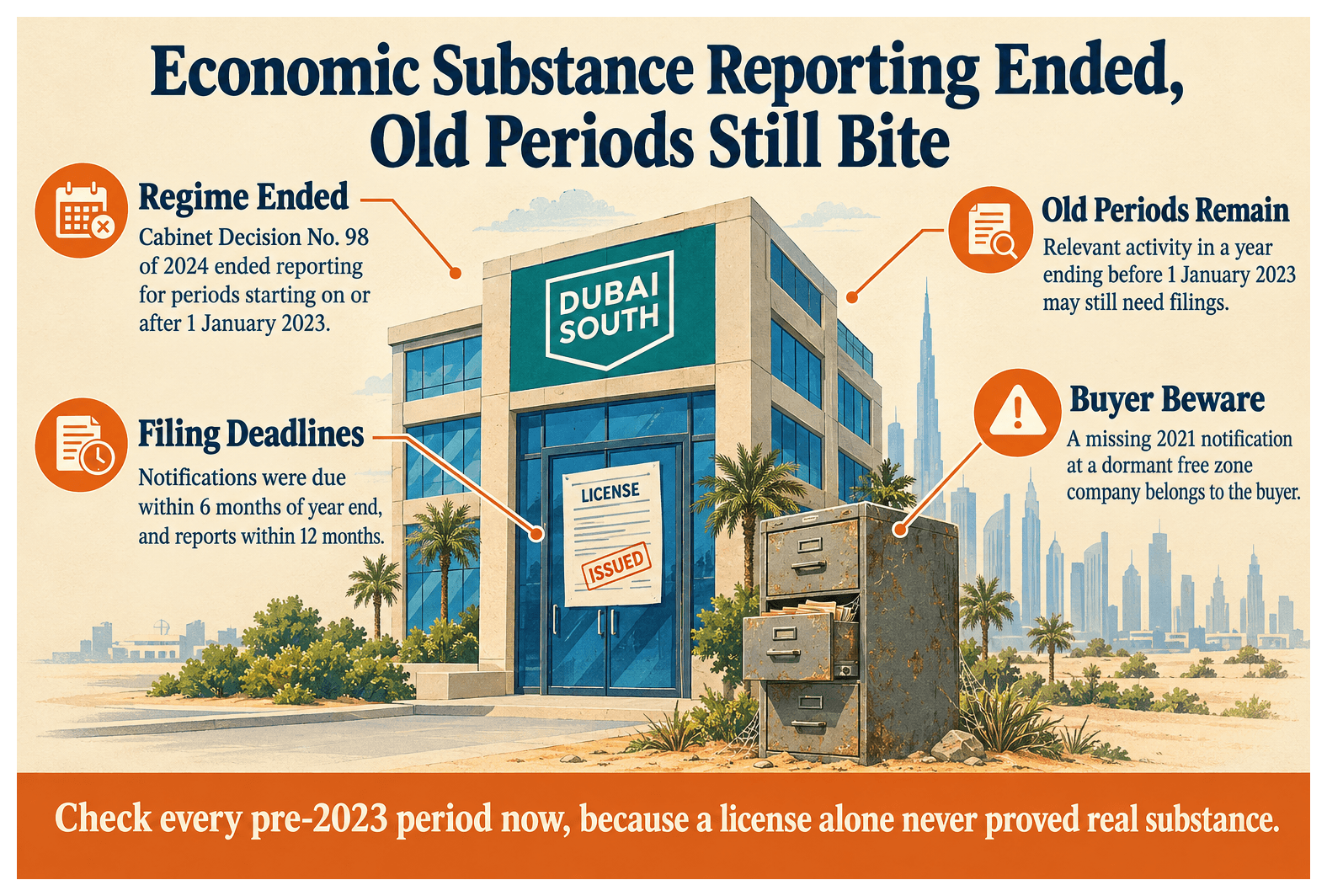
Companies that carried out a relevant activity in a financial period ending before 1 January 2023 may still need to file notifications or reports for that period if they never did. Companies with only periods starting on or after that date no longer file economic substance reports.
Entities With Unfiled Historical Obligations
Licensees with a relevant activity in a pre-2023 year and a missed notification or report.
Companies that filed late or filed incorrectly.
Liquidated companies whose records must stay accessible.
Notifications were due within 6 months of year end, and reports within 12 months. A Dubai South distribution business with a December 2021 year end that never submitted its report is still exposed.
Old Economic Substance Regime vs Current Substance Expectations
Feature | Old Economic Substance Regime (Before 2023 Periods) | Current QFZP Substance Under Corporate Tax |
|---|---|---|
Legal basis | Cabinet Resolution No. 31 of 2019, amended by No. 57 of 2020 | Federal Decree-Law No. 47 of 2022 |
Who it applied to | Licensees carrying out relevant activities | Free zone companies seeking Qualifying Free Zone Person status |
Filing requirement | Notification and annual report | Corporate tax return with audited financial statements |
Supervising authority | Ministry of Finance | Federal Tax Authority |
Consequence of failure | Administrative penalties for missed filings or weak substance | Loss of QFZP status and the 9% rate above AED 375,000 |
Who No Longer Needs to File
If your obligations relate only to periods starting on or after 1 January 2023, there's no filing. The same applies if you never carried out a relevant activity, though you should confirm that in writing. A consulting start-up licensed in 2023 has no economic substance filing but must still register for corporate tax.
How to Check Your Own Position
Compare your license date and year end against the cut-off. Then reconcile license activities with the list of relevant activities, and confirm records with the Ministry of Finance portal or an adviser.
How Substance Rules Now Work for Qualifying Free Zone Persons
Under Federal Decree-Law No. 47 of 2022, a Qualifying Free Zone Person must keep adequate substance in the free zone to hold the 0% rate on qualifying income. That means sufficient staff, premises and expenditure. It's a corporate tax condition, not a separate filing.
Substance as a Condition for the 0% Rate
Substance sits beside qualifying income, transfer pricing compliance, audited statements and the de minimis rule. Fail one and you can lose Qualifying Free Zone Person status, moving to 9% above AED 375,000. The regime isn't tax free. A Dubai South trading company with qualifying income but no real staff or premises is the classic risk.
Where Corporate Tax Filing Replaces the Old Reports
Evidence now supports your return with the Federal Tax Authority.
Audited statements are a QFZP condition.
Keep lease, contracts and payroll ready.
A flexible desk-based license with a residency visa package from Dubai South Business Hub helps put staff and premises on the ground. See the Dubai South corporate tax requirements.
Steps to Confirm the Economic Substance Test and Who Still Needs to File
List your financial periods, compare them with 1 January 2023, identify relevant activities, check records, file missing reports, then document substance for corporate tax. Do it once a year.
Step 1: List Every Financial Period Since Incorporation
Pull license date and year ends.
Mark periods before and after the cut-off.
A 2020 company with a 31 December year end shows three pre-2023 periods.
Step 2: Match Your Activities to Relevant Activities
Check against the nine relevant activities.
Record income per activity.
A distribution license with invoiced sales is a flag.
Step 3: Verify Filing Records and Fix Gaps
Search for acknowledgements.
Hire an adviser to submit missing items.
Find receipts before any share sale.
Step 4: Document Current Substance for Corporate Tax
Gather lease, visas and payroll.
Align with QFZP conditions and the annual audit.
Bind it into one file ready for your return.
Penalties and Records Dubai South Companies Should Keep
The old regime penalised missed notifications and reports, with fines escalating for repeat failures. Exposure now sits with unfiled earlier periods and corporate tax conditions. Keep records for at least seven years.
What Non-Compliance Can Cost
I'd avoid quoting any penalty figure without checking official sources. The bigger risk today is losing QFZP status. A company that can't evidence staff and premises pays 9% on taxable income above AED 375,000. Our corporate tax filing services guide covers the process.
Records to Keep on File
Lease or flexi-desk agreement.
Employment contracts, payroll and visas.
Board minutes showing where decisions were made.
Old notifications, reports and acknowledgements.
Practical Compliance Checklist for Dubai South Business Hub Companies
Dubai South companies should confirm historic filing status, register for corporate tax, keep audited accounts, hold a valid license and visas, and evidence real activity.
Setting Up Compliance From Day One
Choose license activities you'll actually perform.
Pair the license with residency visas.
Register for corporate tax on time.
Common Mistakes to Avoid
Assuming the repeal erased historic duties.
Treating a license as proof of substance.
Ignoring the audit requirement.
Where This Leaves You
The economic substance test and who still needs to file comes down to timing. Reporting ended for periods from 1 January 2023, but unfiled earlier periods can carry exposure, and substance now lives inside QFZP conditions. Review your periods, tidy any gaps, and speak with the Dubai South Business Hub team about licensing, residency visas and compliance.
References
Frequently Asked Questions