Topic Summary
What Is the UAE Reverse Charge Mechanism for B2B Services and Why It Matters
The UAE reverse charge mechanism for B2B services shifts VAT reporting from the supplier to the customer. When a VAT-registered UAE business buys taxable services from a non-resident supplier, it declares the 5% output VAT itself and, if eligible, recovers the same amount as input tax on the same VAT201 return.
When the UAE Reverse Charge Mechanism for B2B Services Applies
When the UAE Reverse Charge Mechanism for B2B Services Applies
How to Apply the UAE Reverse Charge Mechanism for B2B Services in Six Stages
Confirm your registration, check the supplier's residency, verify the place of supply, calculate 5%, report it in the right VAT201 boxes, and keep documents for five years. Each stage keeps your return audit-ready.
Cash Flow and Input Tax Effects of the Reverse Charge
For fully taxable businesses, the reverse charge is cash-neutral because output VAT and recoverable input VAT cancel out on the same return. With exempt supplies or partial recovery, some self-accounted VAT becomes a real cost.
Invoices, Records, and Common Mistakes With the Reverse Charge
The most common errors are missing the self-accounting entirely, using the wrong VAT201 box, applying the wrong exchange rate, and losing supplier documents. A monthly review of overseas purchases is your simplest safeguard.
Practical Guidance for Dubai South Free Zone Companies
A VAT-registered Dubai South Business Hub company must apply the reverse charge on imported taxable services like any mainland business. A free zone license doesn't remove VAT duties.
Next Steps for Your Dubai South Company
The UAE reverse charge mechanism for B2B services is a reporting duty, not an extra cost, for most fully taxable businesses. Identify overseas purchases, self-account 5%, report in the right boxes, and keep records for five years. Talk to the Dubai South Business Hub team about your free zone setup and tax compliance routine.
More than 350,000 UAE businesses are VAT-registered (Federal Tax Authority, 2025) [1]. Many buy services from overseas suppliers who never charge UAE VAT. This guide explains the UAE reverse charge mechanism for B2B services, so you know when to self-account, how to report it, and what to keep on file.
What Is the UAE Reverse Charge Mechanism for B2B Services and Why It Matters
The UAE reverse charge mechanism for B2B services shifts VAT reporting from the supplier to the customer. When a VAT-registered UAE business buys taxable services from a non-resident supplier, it declares the 5% output VAT itself and, if eligible, recovers the same amount as input tax on the same VAT201 return.
Plain-Language Definition of the Mechanism
You, the recipient, account for the VAT instead of the supplier. The legal basis sits in Article 48 of Federal Decree-Law No. 8 of 2017, and the Federal Tax Authority administers it. Say a Dubai South consultancy pays AED 40,000 to a UK software vendor. It self-accounts AED 2,000 at the 5% rate.
Why the FTA Uses the Mechanism
Overseas suppliers usually aren't UAE-registered. Without self-accounting, a marketing agency buying overseas ad services would pay no UAE VAT at all, even though the service is consumed here. The mechanism closes that gap and stays neutral for fully taxable businesses.
Reverse Charge Treatment by Scenario
Feature | Scenario | Treatment |
|---|---|---|
Overseas supplier, taxable service, UAE-registered recipient | UK vendor invoices AED 40,000 for software | Reverse charge applies: AED 2,000 self-accounted |
UAE-registered supplier charging 5% VAT | Local agency invoices with a TRN and VAT | No reverse charge; claim the VAT as input tax |
Zero-rated or exempt service | Qualifying exempt financial service from abroad | No reverse charge VAT due |
Fully taxable recipient | Trading company with only taxable sales | Output and input VAT net to zero |
Partially exempt recipient | Business with taxable and exempt income | Part of the VAT becomes a cost |
B2B Versus B2C Treatment
The mechanism targets VAT-registered business recipients. An individual buying the same cloud tool is handled through the supplier's own obligations, which our guide to VAT on digital services in the UAE covers. Mandatory registration starts at AED 375,000 of taxable turnover.
When the UAE Reverse Charge Mechanism for B2B Services Applies
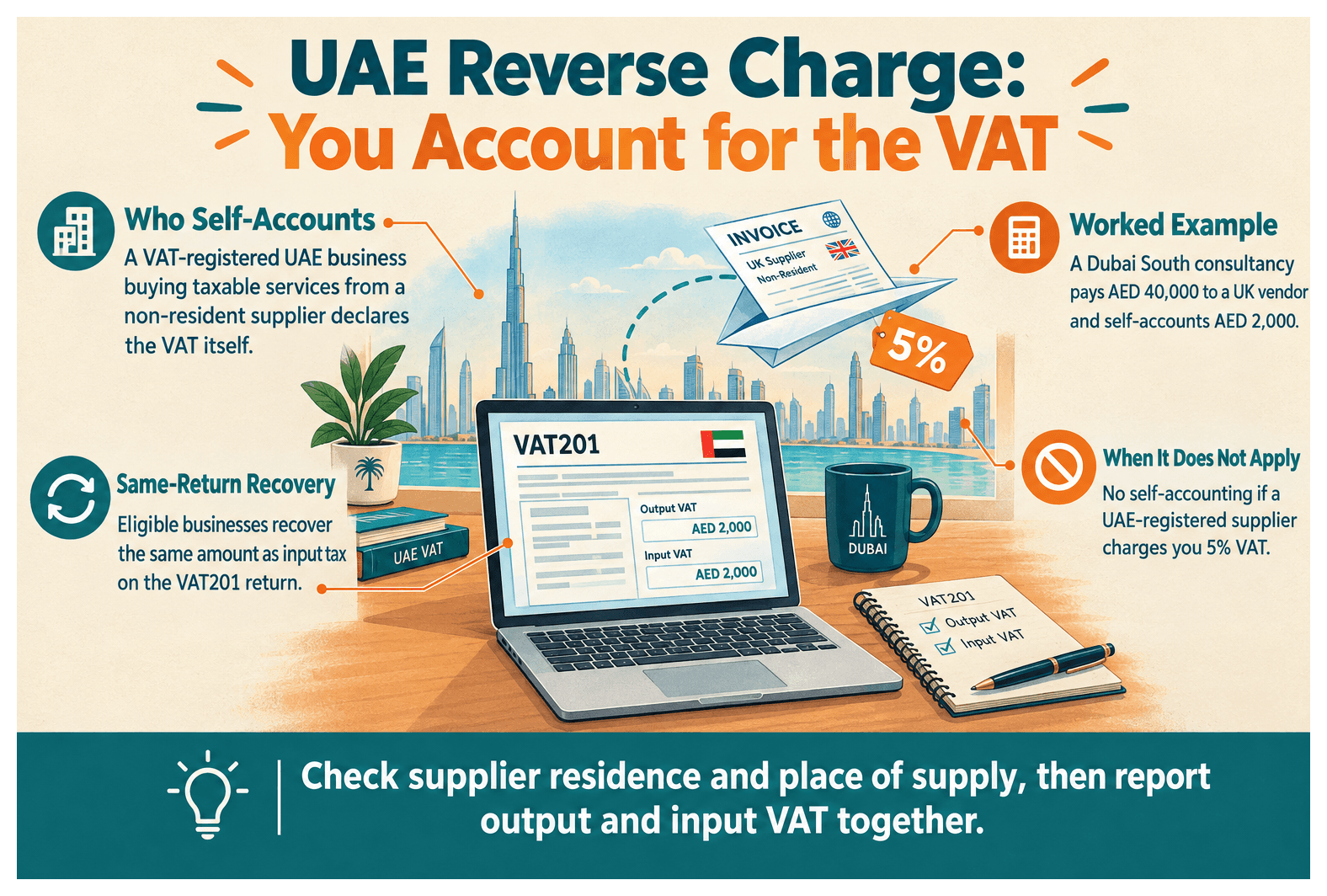
The reverse charge applies when a VAT-registered UAE business receives taxable services from a supplier outside the UAE, and the place of supply is the UAE. It doesn't apply when the supplier is UAE-registered and charges VAT, or when the service is zero-rated, exempt, or outside UAE VAT scope.
Conditions That Trigger Self-Accounting
The supplier is non-resident with no UAE registration.
You're VAT-registered in the UAE.
The place of supply falls in the UAE under the Decree-Law.
Picture a Dubai South logistics firm paying a Singapore platform for consulting services. All three conditions are met.
Services Commonly Caught by the Rule
Software subscriptions and cloud hosting.
Legal, consulting, and design work from overseas providers.
Advertising and platform fees.
The Statista B2B e-commerce forecast tops USD 5 billion (2025), so overseas spend keeps rising.
Situations Where It Does Not Apply
If a UAE-registered supplier invoices you with 5% VAT, no self-accounting is needed. Zero-rated and exempt services fall outside it too. A few domestic reverse charge categories exist, but they're narrow. Check the Ministry of Finance for the legislation.
How to Apply the UAE Reverse Charge Mechanism for B2B Services in Six Stages
Confirm your registration, check the supplier's residency, verify the place of supply, calculate 5%, report it in the right VAT201 boxes, and keep documents for five years. Each stage keeps your return audit-ready.
Stage 1: Confirm Your Registration and the Supplier's Status
Check your TRN (Tax Registration Number) is active on EmaraTax.
Look for any UAE TRN on a German vendor's invoice.
Know the thresholds: AED 375,000 mandatory, AED 187,500 voluntary.
Not registered yet? Read about VAT registration for service businesses.
Stage 2: Verify the Place of Supply and Calculate the VAT
Confirm the service is taxable and supplied in the UAE.
Convert the invoice to AED. The dirham is pegged at 3.6725 to the USD (Central Bank of the UAE).
Example: USD 10,000 becomes AED 36,725, so VAT is AED 1,836.25.
Stage 3: Report on the VAT201 and Keep Records
Declare the amount as reverse charge output tax, then claim input tax if eligible.
File within 28 days of the period end, as explained in VAT return filing for Dubai companies.
Keep the invoice, contract, payment proof, and workings for five years.
Cash Flow and Input Tax Effects of the Reverse Charge
For fully taxable businesses, the reverse charge is cash-neutral because output VAT and recoverable input VAT cancel out on the same return. With exempt supplies or partial recovery, some self-accounted VAT becomes a real cost.
Why Fully Taxable Businesses Pay Nothing Extra
AED 2,000 self-accounted and AED 2,000 recovered nets to AED 0. No cash leaves your account, only a reporting entry. Normal input tax conditions still apply.
When Input Tax Recovery Is Restricted
Exempt supplies limit recovery.
Some blocked categories, like certain entertainment costs, aren't recoverable.
Mixed-income firms recover only a proportion, so budget for the rest.
Invoices, Records, and Common Mistakes With the Reverse Charge
The most common errors are missing the self-accounting entirely, using the wrong VAT201 box, applying the wrong exchange rate, and losing supplier documents. A monthly review of overseas purchases is your simplest safeguard.
What Documents You Need
The supplier invoice, even with no UAE VAT shown.
The contract and proof of payment.
Your own calculation sheet.
See tax invoice requirements in the UAE for what your own invoices need.
Frequent Errors and How to Avoid Them
Treating overseas invoices as VAT-free.
Mixing zero-rated exports with imported services.
Filing late or in the wrong box.
Found six months of unreported software fees? File a voluntary disclosure with the FTA before it finds them.
Preparing for E-Invoicing
Tag each overseas purchase with a reverse charge code in your accounting software. Clean data now eases the phased e-invoicing rollout later.
Practical Guidance for Dubai South Free Zone Companies
A VAT-registered Dubai South Business Hub company must apply the reverse charge on imported taxable services like any mainland business. A free zone license doesn't remove VAT duties.
Free Zone License Does Not Cancel VAT Duties
VAT is federal and depends on registration status, not license type. Designated zone rules are a narrow, goods-focused exception. Missing registration after crossing AED 375,000 costs AED 10,000 in penalties.
Setting Up Your Compliance Routine From Day One
Add a reverse charge tag to your chart of accounts.
Review overseas payments monthly.
Check with your accountant before each filing.
Reconcile sales and purchases, including getting paid by international clients.
Next Steps for Your Dubai South Company
The UAE reverse charge mechanism for B2B services is a reporting duty, not an extra cost, for most fully taxable businesses. Identify overseas purchases, self-account 5%, report in the right boxes, and keep records for five years. Talk to the Dubai South Business Hub team about your free zone setup and tax compliance routine.
References
Frequently Asked Questions