
Topic Summary
What Is a Politically Exposed Person and What Are Your Obligations in the UAE?
A politically exposed person (PEP) holds, or has held, a prominent public function, such as a minister, judge, military leader or state-company executive, plus family members and close associates. In the UAE, PEPs are higher-risk and require enhanced due diligence, senior approval and ongoing monitoring.
Who Counts as a PEP Under UAE and International Standards
Who Counts as a PEP Under UAE and International Standards
Your Legal Obligations When a PEP Is Involved
Who is a politically exposed person and what are your obligations in the UAE once one appears? You must identify the PEP, apply enhanced due diligence PEP measures, get senior approval, establish source of wealth and funds, monitor continuously, keep records five years, and report suspicion to the Financial Intelligence Unit (FIU).
Step-by-Step Process to Handle a PEP Relationship
Identify the PEP, assess risk, collect documents, verify wealth, obtain approval, monitor and document. This is how PEP obligations Dubai South companies face become routine.
How PEP Status Connects to UBO Disclosure
Every UAE company must register individuals owning or controlling 25% or more, and those people are then screened. Under UAE anti-money laundering PEP rules, a PEP hidden behind nominees breaches both disclosure and AML expectations.
Practical Impact on Entrepreneurs Setting Up in Dubai South
PEP status affects formation, banking, visas and renewals. Declare links early, prepare wealth documents first, and expect longer reviews. Concealment risks rejection, delay and penalties.
Your Next Step
Knowing who is a politically exposed person and what are your obligations in the UAE comes down to three habits: screen every owner, apply enhanced due diligence with documented approval, and keep UBO records current. Speak with the Dubai South Business Hub team to structure your company formation, license and residency visa package with clean ownership records and a PEP process from day one.
Banks commonly review higher-risk corporate files every 12 to 18 months, and the UAE remains on the FATF regular follow-up list in 2026 [3]. So who is a politically exposed person and what are your obligations in the UAE? This guide helps Dubai South founders spot PEPs in their ownership chain and act before an account or renewal stalls. It rests on Federal Decree-Law No. 20 of 2018 [1] and its 25% ownership test for beneficial owners [2].
What Is a Politically Exposed Person and What Are Your Obligations in the UAE?
A politically exposed person (PEP) holds, or has held, a prominent public function, such as a minister, judge, military leader or state-company executive, plus family members and close associates. In the UAE, PEPs are higher-risk and require enhanced due diligence, senior approval and ongoing monitoring.
Here's the thing: PEP is a risk category, not an accusation. FATF Recommendation 12 sets the global standard [3]. A founder whose uncle is a deputy minister abroad is a PEP associate, even with no public role.
Why the fuss? Public office gives access to state funds and contracts, and layered companies can hide corrupt proceeds. Picture a shell company collecting consultancy fees from a state contractor tied to an official's relative. Regulators treat that as a core anti money laundering duty for Dubai businesses.
It hits Dubai South founders directly. Shareholders, directors and UBOs are all screened, and an undeclared link can freeze onboarding. Imagine a new company whose account is held because one shareholder is a former regional governor.
Who Counts as a PEP Under UAE and International Standards
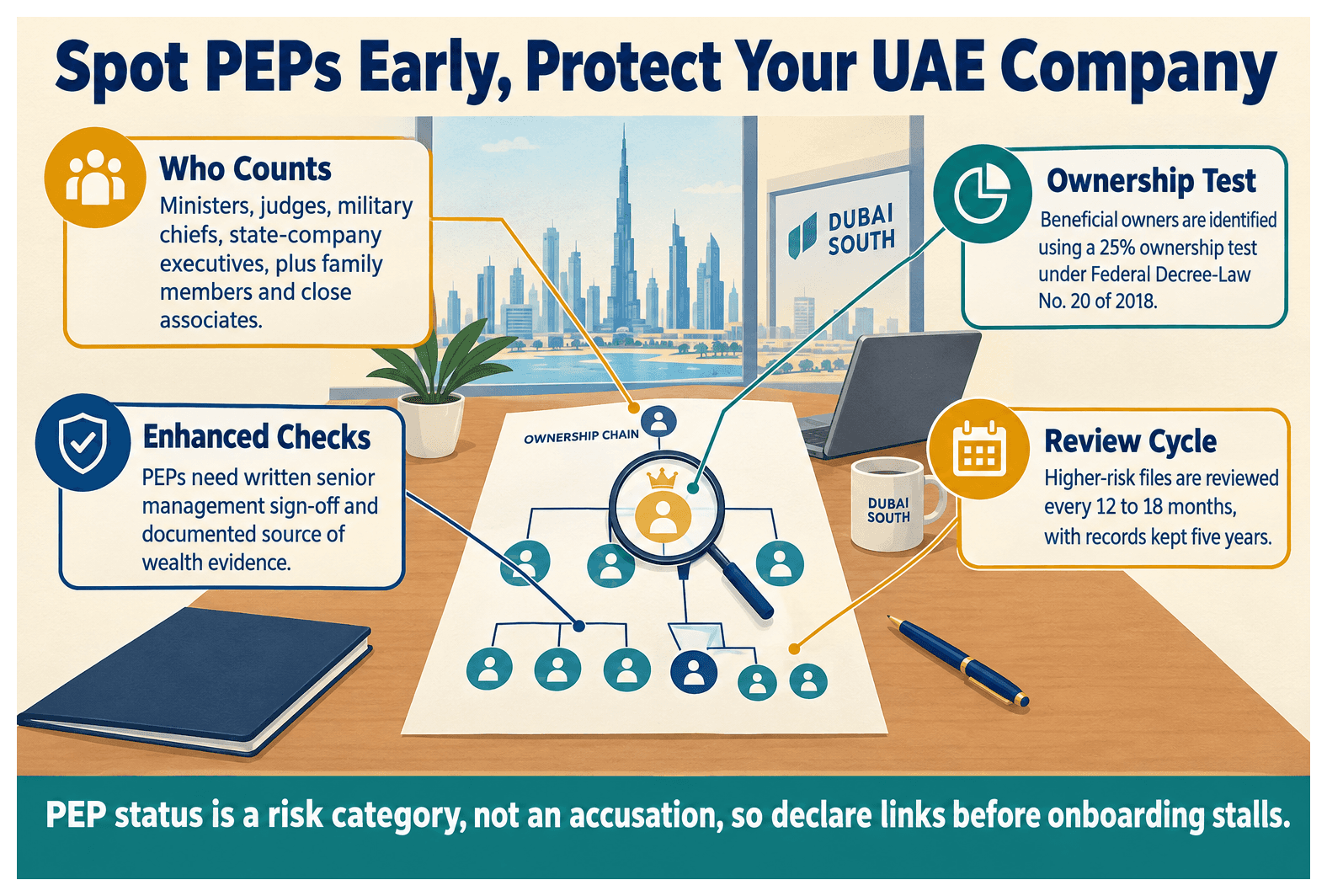
PEPs include heads of state, ministers, senior officials, judges, military chiefs, state-company executives and senior party officials, plus immediate family and known close associates. FATF treats foreign, domestic and international-organisation PEPs as three types. PEP screening UAE teams apply to all three.
Foreign PEPs always trigger enhanced measures.
Domestic and international-organisation PEPs are assessed by risk.
Senior roles at the UN or development banks count.
Standard Due Diligence Versus Enhanced Due Diligence for PEPs
Feature | Standard Due Diligence | Enhanced Due Diligence for PEPs |
|---|---|---|
Approval level required | Compliance officer or onboarding staff | Written senior management sign-off |
Source of wealth verification | Usually not required | Documented, independent evidence of wealth and funds |
Monitoring frequency | Routine, periodic checks | Closer transaction scrutiny, with extra checks on trigger events |
Documentation depth | ID, address and ownership chart | Adds audited accounts, sale contracts, tax records, decision log |
Review cycle | Longer, risk-based cycle | Every 12 to 18 months, or sooner |
Family, Associates and Duration
Spouses, parents, children and siblings are typically covered. So are joint owners, like a co-shareholder who co-owns overseas property with a former senator. Association alone can trigger enhanced checks.
There's no fixed expiry. Seniority, influence and time since leaving office drive the call (World Bank guidance on PEPs). If you downgrade risk, write down why, and keep records at least five years.
Your Legal Obligations When a PEP Is Involved
Who is a politically exposed person and what are your obligations in the UAE once one appears? You must identify the PEP, apply enhanced due diligence PEP measures, get senior approval, establish source of wealth and funds, monitor continuously, keep records five years, and report suspicion to the Financial Intelligence Unit (FIU).
Screen shareholders, directors, UBOs and key customers, using databases plus self-declaration forms. Rescreen at renewal and on trigger events. The Central Bank of the UAE expects this throughout the relationship.
For wealth evidence, collect audited accounts, sale agreements and tax records. Evidence should be traceable and independent.
If grounds for suspicion exist, file a suspicious transaction report through goAML, the FIU's portal. Never tip off the customer. Unexplained large transfers from an offshore entity linked to a PEP associate are a classic trigger. The UAE Cabinet framework, including Cabinet Decision No. 10 of 2019, backs these duties.
Step-by-Step Process to Handle a PEP Relationship
Identify the PEP, assess risk, collect documents, verify wealth, obtain approval, monitor and document. This is how PEP obligations Dubai South companies face become routine.
Identify and classify. Screen, collect a signed PEP declaration, and record family links.
Gather documents. Passport, Emirates ID if resident, address proof, and an ownership chart to the UBO. Source of wealth verification UAE banks accept includes a business sale contract plus bank statements.
Approve, monitor, document. Get written sign-off, set review dates, and keep a log for five years.
Escalate or exit. If a customer won't explain a spike in third-party payments, file an STR or end the relationship.
Your UBO registration in the UAE feeds step two directly.
How PEP Status Connects to UBO Disclosure
Every UAE company must register individuals owning or controlling 25% or more, and those people are then screened. Under UAE anti-money laundering PEP rules, a PEP hidden behind nominees breaches both disclosure and AML expectations.
Say a founder adds an investor holding 30% who is a former official. Update the register promptly and flag the status internally. Read what UBO disclosure means in Dubai South for the detail.
Banks treat opaque chains as high risk. One account was rejected because ownership ended in an unexplained trust. Even legal nominee structures need full disclosure.
Practical Impact on Entrepreneurs Setting Up in Dubai South
PEP status affects formation, banking, visas and renewals. Declare links early, prepare wealth documents first, and expect longer reviews. Concealment risks rejection, delay and penalties.
One founder with a politically connected investor pre-assembled a wealth dossier and cleared bank review faster than expected. Compare that with why UAE banks reject corporate account applications.
Omitting family connections.
Submitting inconsistent ownership charts.
Offering unverifiable wealth explanations.
Declaring a UBO that differs from the shareholder register.
Build a simple policy: a two-page procedure, a one-page PEP declaration form, a named compliance contact, annual training, and five-year record retention.
Your Next Step
Knowing who is a politically exposed person and what are your obligations in the UAE comes down to three habits: screen every owner, apply enhanced due diligence with documented approval, and keep UBO records current. Speak with the Dubai South Business Hub team to structure your company formation, license and residency visa package with clean ownership records and a PEP process from day one.
References
Frequently Asked Questions