How to Invoice Australia Clients From Your Dubai Company Legally

Topic Summary
Name the Right Contracting Company
Use the UAE-licensed entity’s legal name as the supplier, and ensure its licensed activity covers the work. The same company should sign the agreement, issue the invoice, and receive payment.
Include Essential Invoice Details
State both parties’ legal names and addresses, invoice number, issue and due dates, currency, service description, delivery period, and payment terms. Keep the invoice consistent with the contract and supporting work records.
Assess UAE VAT for Each Supply
An Australian billing address does not automatically make a supply zero-rated or outside UAE VAT. Check the supply, place-of-supply rules, and registration position, and retain evidence for any special treatment.
Keep VAT and Corporate Tax Separate
UAE VAT and corporate tax are different regimes, and neither is automatically charged on every invoice. The excerpt states that corporate tax is 9% on taxable income above AED 375,000.
Separate Company Invoicing From Residency
A Dubai company’s invoices do not determine its founder’s personal Australian tax residency. Review personal tax obligations separately from the company’s invoicing arrangements.
Maintain Supporting Business Records
Retain the contract, correspondence, service or delivery evidence, and records supporting the invoice’s tax treatment. Consistent records help show what the UAE company supplied and how the invoice was prepared.
In 2026, more than 350,000 UAE businesses are VAT-registered, according to figures cited by the Federal Tax Authority (FTA, 2025). UAE VAT is 5% when applicable. The mandatory registration threshold is AED 375,000; voluntary registration starts at AED 187,500. A registration application is generally due within 30 days of becoming liable. UAE corporate tax is 9% on taxable income above AED 375,000. These figures describe different tax rules, not automatic charges on every invoice. This guide shows Australian founders how to invoice Australia clients Dubai company operations correctly, covering invoice format, currency, VAT, and payments.
What Does It Mean to Invoice Australia Clients From a Dubai Company?
Invoicing Australian clients means the UAE-licensed entity supplies the contracted goods or services and bills in its registered legal name. Match the invoice to the company’s license activity and records. An Australian customer’s address alone doesn’t settle UAE VAT or Australian tax treatment.
Identify the Contracting Company and Licensed Activity
Show the Dubai South Business Hub Free Zone (DSBH) company as supplier, and ensure its licensed activity covers the work. The same entity should sign the agreement, issue the invoice, and receive payment. For example, a Dubai consultancy contracts with a Sydney retailer for market research and invoices under its licensed UAE company name. See our guide to invoicing clients from a Dubai company.
Separate Invoicing From Your Personal Tax Residency
Registering a company doesn’t determine your personal Australian tax residency. An Australian founder may still have Australian obligations while the UAE company bills the client. Review your circumstances separately, including if you’re moving from Australia to Dubai.
Which Details Should an Australian Client Invoice Include?
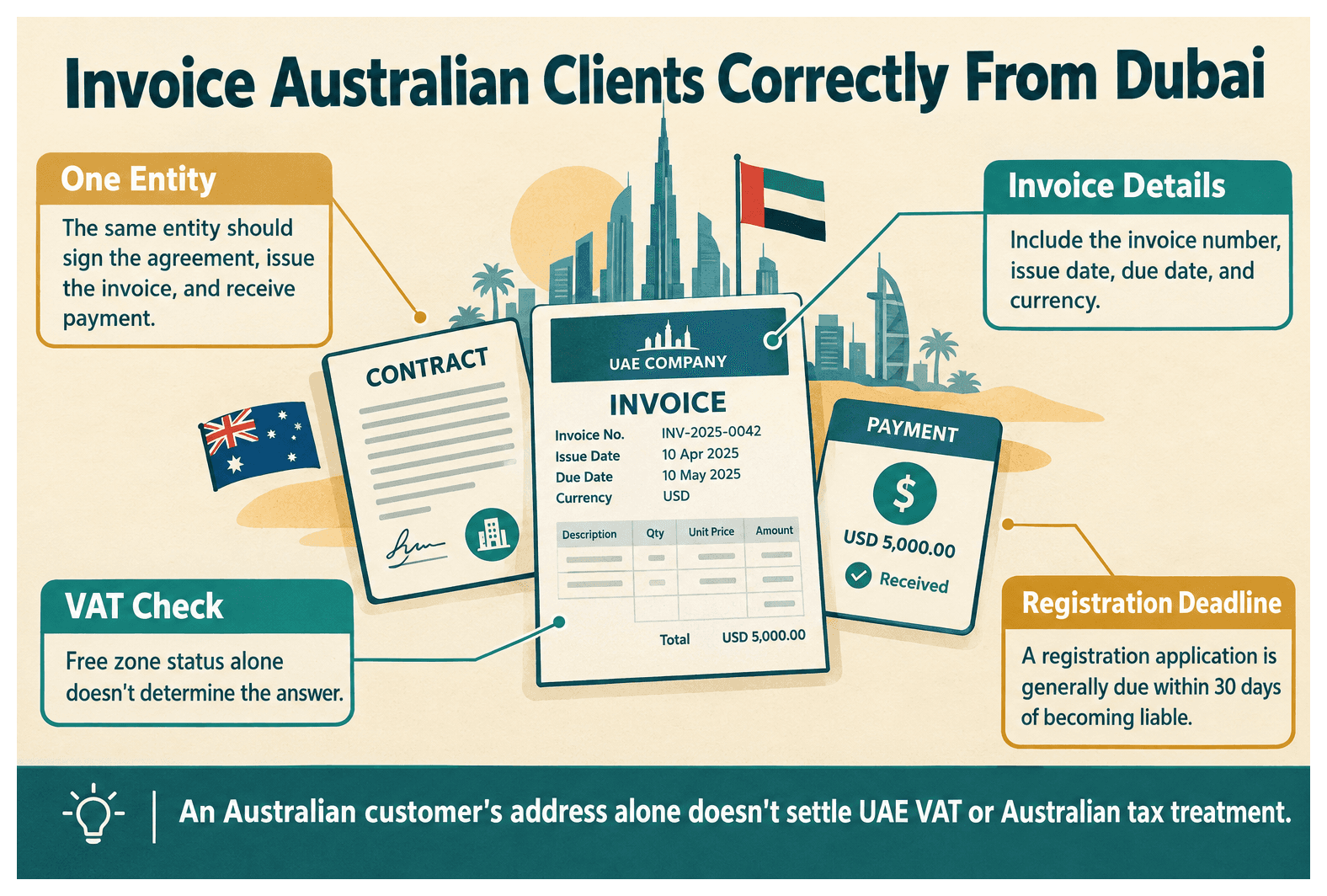
A clear australian clients uae invoice identifies both parties, describes the supply, and states amount, currency, date, payment terms, and applicable tax treatment. Keep numbering consistent and retain the contract and delivery evidence.
Use Complete Supplier, Customer, and Service Details
Enter the supplier’s legal name, address, and contact information.
Add the customer’s legal name and Australian billing address.
Include the invoice number, issue date, due date, and currency.
Describe the service and delivery period specifically.
A software implementation invoice should identify the project phase, not just say “consulting.” A uae company invoice australian customers receive should align with the signed agreement.
Keep Commercial Records Aligned
For a monthly design retainer, make the service period, agreed rate, and invoice description match the contract. File correspondence and proof of work with the invoice. The FTA publishes UAE tax information and guidance.
How Should You Handle UAE VAT on Australian Client Invoices?
UAE VAT depends on the supply and applicable place-of-supply rules. An Australian billing address doesn’t automatically make a service zero-rated or outside UAE VAT. Confirm the registration position, treatment, and invoice requirements for the actual transaction.
Check the Supply and VAT Registration Position
The FTA administers VAT. A UAE consultancy providing remote advice to an Australian business should check the service classification and place-of-supply conditions before deciding whether to charge VAT. Free zone status alone doesn’t determine the answer. Corporate tax follows a separate framework under Federal Decree-Law No. 47 of 2022.
Document Any Special VAT Treatment
Keep the customer contract, work records, and evidence supporting any special treatment. This is a useful practical distinction: the client’s location is evidence, not a complete tax analysis. For dubai free zone invoicing australia, get UAE tax advice if the service or customer’s use creates uncertainty.
What Are the Steps to Issue and Collect a Cross-Border Invoice?
Confirm the license and contract, prepare the invoice, determine VAT treatment, and agree currency and fees. Send it through the agreed channel, reconcile payment, and retain supporting records. These cross-border payment options depend on your bank and provider.
Confirm the Contract, Activity, and Currency
Match the contracted service to the DSBH license activity.
Agree AUD, AED, or another currency, plus who pays transfer charges.
Send, Reconcile, and File
Send the invoice to the customer’s agreed billing contact.
Reconcile the received amount, exchange rate, and deductions.
File the invoice, contract, and payment evidence together.
A Melbourne customer paying an AED invoice can agree in writing to cover intermediary bank fees. If paid in AUD, record conversion charges against the invoice.
Invoice Currency and Payment Route Considerations
Feature | AUD Invoice | AED Invoice |
|---|---|---|
Customer price clarity | Shows the Australian customer its AUD amount. | Requires customer to consider AUD conversion. |
Supplier conversion exposure | Supplier bears conversion exposure if converting to AED. | Amount is already stated in dirhams. |
Exchange-rate and transfer fees | Check conversion spread and intermediary charges. | Check the customer’s conversion and transfer charges. |
Account settlement currency | Confirm whether the account can receive AUD. | May suit an AED-settled account, subject to bank terms. |
Payment and reconciliation records | Record conversion rate and net AED received. | Match AED receipt and fees to the invoice reference. |
Which Payment Routes and Currency Choices Can You Use?
A company may receive funds through its corporate account or an eligible payment provider, subject to its terms and checks. AUD can give a Sydney customer price certainty; AED may fit the supplier’s accounting. Compare exchange spreads, transfer fees, settlement time, and records before agreeing. Read about getting paid by international clients.
Keep Payment Instructions Consistent
Use company-controlled account details matching the invoicing entity. Ask the bank or provider about currencies accepted, charges, and documentation. Have the customer include the invoice number as its transfer reference, then retain remittance advice and bank statements.
How Do Australian Tax Rules Apply to Your Dubai Company?
Australian consequences can depend on founder residency, company management and control, income, and treaty provisions. Australian Taxation Office (ATO) tax matters and Australian Securities and Investments Commission (ASIC) requirements are distinct. The UAE-Australia Double Tax Treaty may be relevant, but doesn’t automatically remove obligations.
Review Residency, Control, and Treaty Issues
An Australian founder directing Dubai operations from Australia should seek cross-border advice on residency and control. Review ownership, income, and reporting rather than assuming incorporation settles the position. Our Australian tax residency guide offers related context.
What Company and Residency Records Support Compliant Invoicing?
Keep the current license, contracts, invoices, tax records, correspondence, and payment evidence. Store them so the supply and receipt can be followed from agreement to bank statement.
Separate Licensing and Immigration Administration
Keep residency administration distinct from billing. The Federal Authority for Identity, Citizenship, Customs and Port Security (ICP) and General Directorate of Residency and Foreigners Affairs (GDRFA) handle relevant residency processes. Emirates ID is an identity document, not proof of invoice tax treatment. Federal Decree-Law No. 47 of 2022 governs the UAE corporate tax framework.
How Can You Set Up Your Dubai Company to Invoice Australia Clients?
Choose a DSBH license matching planned work, then establish contracting, billing, tax, and payment processes before your first sale. Australian founders should also review their personal and company reporting position.
Match the License and Operating Plan to Client Work
For recurring consulting, plan the licensed activity, contract template, billing currency, and recordkeeping together. Explore how to open a company in Dubai from Australia.
Use a Practical Pre-Invoice Checklist
Confirm supplier name, license activity, and customer details.
Check contract terms, currency, and payment account.
Review UAE VAT treatment and Australian advice needs.
Use the Business Activities and Cost Calculator to assess setting up or buying a license. Before you invoice Australia clients Dubai company records should clearly connect the license, contract, tax treatment, and payment.
References
how-to-invoice-australia-clients-from-your-dubai-company-legally