What France Tax Rules Apply When You Also Own a Dubai Company

Topic Summary
What Is France Tax Rules Dubai Company and Why It Matters
France tax rules for a Dubai company are the residency tests, controlled foreign company (CFC) provisions and reporting duties that apply when a French resident owns a UAE entity. The Direction Générale des Finances Publiques (DGFiP) can tax foreign profits if your home, centre of interests or main activity stays in France.
How French CFC Rules Treat a Dubai Free Zone Company
How French CFC Rules Treat a Dubai Free Zone Company
How the UAE-France Double Tax Treaty Shapes Your Position
The UAE-France Double Tax Treaty allocates taxing rights and relieves double taxation. Its tie-breaker rules look at permanent home, centre of vital interests, habitual abode and nationality. If you own an apartment in Nice and one in Dubai, proof beats intention.
UAE Obligations That Sit Beside France Tax Rules Dubai Company Owners Face
Your UAE company owes its own filings whatever France decides. Under Federal Decree-Law No. 47 of 2022, it must register with the Federal Tax Authority (FTA), file annually and keep records. VAT registration with the FTA applies above AED 375,000 of taxable supplies ( FTA , 2023).
Residency Proof That Supports Your French Tax Position
Residency proof supports a UAE residency claim, though France decides its own position. Useful evidence includes a visa from the General Directorate of Residency and Foreigners Affairs (GDRFA), an Emirates ID from the Federal Authority for Identity, Citizenship, Customs and Port Security (ICP), a lease and utility bills.
Step-by-Step Guide to Staying Compliant in France and the UAE
Confirm your French residency, review CFC exposure, build UAE substance, register with the FTA, declare the entity and accounts in France, and keep evidence. Review yearly with advisers in both countries.
Comparison of French and UAE Obligations at a Glance
French and UAE obligations run in parallel. France looks at you personally; the UAE looks at the company. A French founder can use the table as a pre-filing checklist, and the 9% rate is published by the Ministry of Finance . Verify figures before filing.
The UAE taxes company profits at 9% above AED 375,000 under Federal Decree-Law No. 47 of 2022 (Ministry of Finance, 2022). France still applies its own rules to you. This guide shows French founders how the france tax rules dubai company question works in practice.
What Is France Tax Rules Dubai Company and Why It Matters
France tax rules for a Dubai company are the residency tests, controlled foreign company (CFC) provisions and reporting duties that apply when a French resident owns a UAE entity. The Direction Générale des Finances Publiques (DGFiP) can tax foreign profits if your home, centre of interests or main activity stays in France.
How France Decides Where You Are Tax Resident
DGFiP looks at your home or main place of stay, principal professional activity and centre of economic interests. One test is enough. The 183-day rule isn't the French test. Picture a Lyon consultant with a family home in France who spends eight months a year there: DGFiP treats him as French resident, license or not. See does setting up in Dubai change your French tax position.
A license gives you a legal UAE entity, not a tax exit. Company residency and personal residency are separate questions. Our UAE company formation for French entrepreneurs guide covers the setup side.
How French CFC Rules Treat a Dubai Free Zone Company
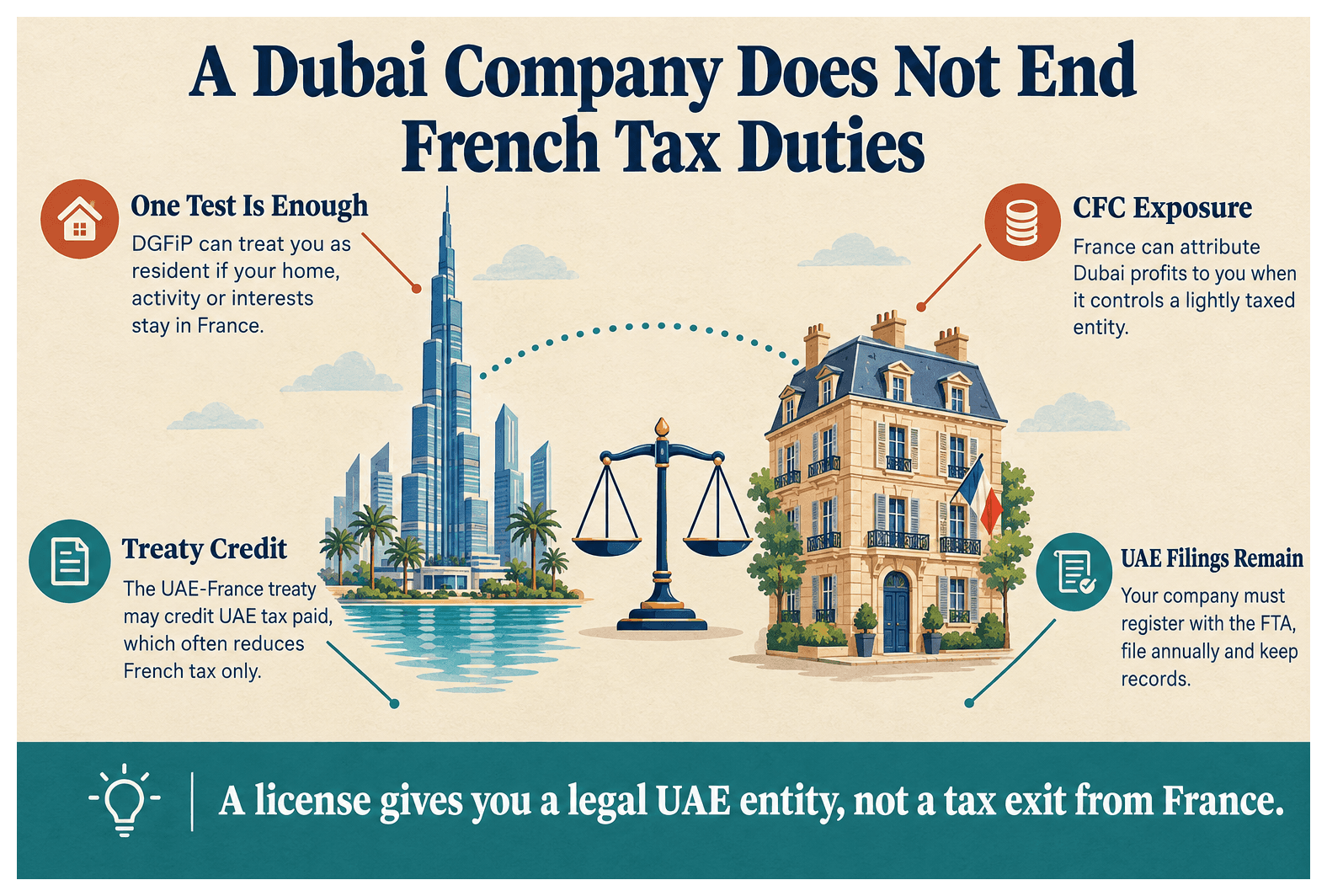
French CFC rules can attribute a Dubai company's profits to its French resident owner when France controls the entity and its tax burden is materially lower. Real substance and genuine commercial activity in the UAE can defeat that attribution.
A French founder holding 100% of a Dubai South Business Hub entity that invoices French clients is the classic exposure. French company law, including the Code de Commerce, frames control and shareholdings. Confirm current thresholds with a French adviser before you rely on them.
Rent a real office or flexi-desk.
Hold board meetings in the UAE.
Keep contracts, payroll and invoices in the entity's name.
Never describe the structure as tax free.
Compare the cost and reporting burden in Dubai company against a French SAS or SARL.
How the UAE-France Double Tax Treaty Shapes Your Position
The UAE-France Double Tax Treaty allocates taxing rights and relieves double taxation. Its tie-breaker rules look at permanent home, centre of vital interests, habitual abode and nationality. If you own an apartment in Nice and one in Dubai, proof beats intention.
The treaty may give credit for UAE tax paid, for example on a dividend to a French owner. Credit often reduces French tax without removing it. Keep corporate tax filings and payment receipts, and ask a French adviser to confirm the method. Budget details sit in what a Dubai company costs a French founder.
UAE Obligations That Sit Beside France Tax Rules Dubai Company Owners Face
Your UAE company owes its own filings whatever France decides. Under Federal Decree-Law No. 47 of 2022, it must register with the Federal Tax Authority (FTA), file annually and keep records. VAT registration with the FTA applies above AED 375,000 of taxable supplies (FTA, 2023).
Don't assume a free zone company pays 0%. Qualifying Free Zone Person rules need care. An e-commerce seller invoicing EU customers should reconcile UAE books with what France may ask for. See French e-commerce sellers opening a Dubai entity.
Residency Proof That Supports Your French Tax Position
Residency proof supports a UAE residency claim, though France decides its own position. Useful evidence includes a visa from the General Directorate of Residency and Foreigners Affairs (GDRFA), an Emirates ID from the Federal Authority for Identity, Citizenship, Customs and Port Security (ICP), a lease and utility bills.
License-linked residency visa.
Emirates ID.
12-month lease and bills.
Track days with a spreadsheet of entry and exit stamps matched to flight bookings. French authorities weigh family and schooling heavily, so keep a dated evidence file. The investor visa in Dubai for French nationals is one route.
Step-by-Step Guide to Staying Compliant in France and the UAE
Confirm your French residency, review CFC exposure, build UAE substance, register with the FTA, declare the entity and accounts in France, and keep evidence. Review yearly with advisers in both countries.
Apply the DGFiP criteria honestly and decide whether you're relocating.
Obtain your license, visa and Emirates ID, register with the FTA and open a bank account.
Declare the entity and foreign accounts in your French return, with apostilled documents ready (documents to set up a Dubai company from France).
Comparison of French and UAE Obligations at a Glance
French and UAE obligations run in parallel. France looks at you personally; the UAE looks at the company. A French founder can use the table as a pre-filing checklist, and the 9% rate is published by the Ministry of Finance. Verify figures before filing.
French and UAE Obligations Compared for Dubai Company Owners
Feature | France | UAE |
|---|---|---|
Authority involved | DGFiP | FTA, GDRFA, ICP |
Residency or tax-status test | Home, activity, economic interests | Visa, Emirates ID, presence |
Company-level tax | CFC attribution possible | 9% above AED 375,000 |
Reporting and declarations | Foreign entity and account declarations | Annual return, VAT, records |
Evidence to keep | Travel logs, family ties | Lease, payroll, invoices |
Common Mistakes to Avoid
Assuming a license equals tax exit.
Missing foreign account declarations.
Invoicing from a French home office with no substance.
Next Steps for French Founders
The france tax rules dubai company question comes down to where you truly live, how the entity is controlled and whether you report in both countries. Substance and documentation matter.
Use the Business Activities and Cost Calculator to choose activities and price your license, then read moving to Dubai from France.
References
what-france-tax-rules-apply-when-you-also-own-a-dubai-company