Topic Summary
What Is UAE Corporate Tax for E-Commerce Companies and Why It Matters
UAE corporate tax for e-commerce companies is a federal tax on annual taxable profit. The rate is 0% up to AED 375,000 and 9% above it. It applies to online sellers on the mainland and in free zones, with special treatment for qualifying free zone income. Recent updates are covered in our guide to UAE corporate tax changes 2026 .
How Marketplace Sales and Cross-Border Supply Are Taxed
How Marketplace Sales and Cross-Border Supply Are Taxed
Free Zone Corporate Tax 2026 for Online Sellers
Free zone corporate tax 2026 offers 0% on qualifying income for a Qualifying Free Zone Person (QFZP), and 9% on non-qualifying income. Online retail sales to consumers are generally not qualifying income. Plan for 9% above AED 375,000 rather than assume an exemption.
Conditions Must You Meet to Keep the Exemption
To keep 0% QFZP status, you need adequate substance in the free zone, qualifying income, audited financial statements and transfer pricing compliance. Non-qualifying revenue must stay within the lower of 5% of revenue or AED 5 million. These conditions decide uae corporate tax for e-commerce companies in free zones.
How Much Does It Cost and How Long Does It Take
Compliance costs depend on accounting fees, audit needs and licensing. Federal Tax Authority registration is free, while accountants and auditors charge variable fees. Use the cost calculator for current setup quotes.
Regulations in the UAE That Shape E-Commerce Company Tax
Federal Decree-Law No. 47 of 2022 sets the corporate tax regime. Cabinet and Ministry of Finance decisions cover free zones and small business relief. Transfer pricing rules add documentation duties for uae corporate tax for e-commerce companies.
Common Mistakes and What Should You Do Next to Start Re-Exporting From Dubai South
Common Mistakes include skipping registration at 0% liability, assuming free zone status means no tax, ignoring de minimis limits and mixing personal and business payouts. Next, check your company name, estimate costs, pick a licensed structure and register with the Federal Tax Authority.
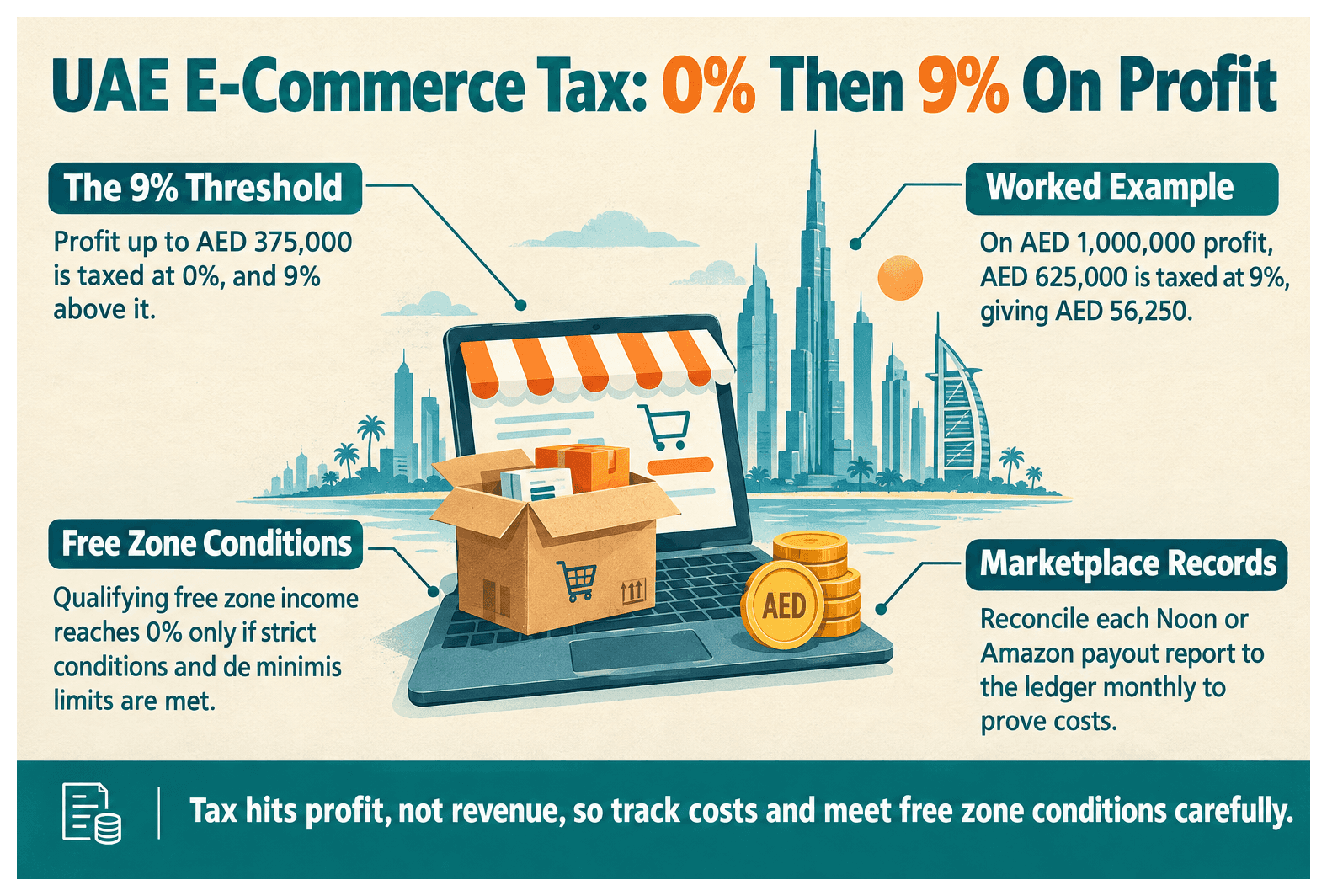
UAE corporate tax for e-commerce companies is 9% on taxable profit above AED 375,000, and 0% below it. Qualifying free zone companies can reach 0% on qualifying income only if they meet strict conditions, including the de minimis limits.
UAE e-commerce revenue is projected to pass USD 9 billion in 2026 [1]. This guide is for owners and finance leads who need to plan tax, records and structure with confidence. No setup is 100% tax free, so we'll show you where the real exposure sits.
What Is UAE Corporate Tax for E-Commerce Companies and Why It Matters
UAE corporate tax for e-commerce companies is a federal tax on annual taxable profit. The rate is 0% up to AED 375,000 and 9% above it. It applies to online sellers on the mainland and in free zones, with special treatment for qualifying free zone income. Recent updates are covered in our guide to UAE corporate tax changes 2026.
The 9% Rate and the AED 375,000 Threshold
Tax hits profit, not revenue. That's why ad spend, fulfilment and platform fees matter so much.
Take a store with AED 1,000,000 in taxable profit. The first AED 375,000 is taxed at 0%. The remaining AED 625,000 is taxed at 9%, which gives AED 56,250 (Federal Tax Authority, 2026) [2].
Who Falls Inside the Tax Net
Mainland LLCs (Limited Liability Companies) and free zone companies.
Sole establishments holding commercial licenses.
Financial years starting on or after 1 June 2023.
Registration with the Federal Tax Authority, even at 0% liability.
Picture a Dubai online retailer selling electronics through its own website. It's inside the net the day its licensed year begins.
How Marketplace Sales and Cross-Border Supply Are Taxed
Marketplace sales and cross-border supply are taxed by where the company is resident and where income arises. Revenue from Amazon, Noon or your own store counts as business income. Overseas customers don't remove corporate tax, and VAT treatment differs from corporate tax treatment. That's the core of e-commerce company tax uae.
Marketplace Sales: Noon, Amazon and Your Own Store
Every channel rolls into one profit figure. Say a seller earns AED 2 million across Noon and a Shopify store. Commissions and fulfilment fees are deductible if invoices support them. Reconcile each payout report to the ledger monthly, or you'll struggle to prove costs later. If you're comparing sales channels, see top e-commerce platforms in the UAE compared.
Corporate Tax Treatment: Mainland vs Qualifying Free Zone E-Commerce Company
Feature | Mainland Company | Free Zone Company (QFZP) |
|---|---|---|
Rate on profit up to AED 375,000 | 0% | 0% on qualifying income; the 0% band still applies to non-qualifying profit if eligible |
Rate on profit above AED 375,000 | 9% | 0% qualifying income, 9% non-qualifying income |
Treatment of B2C online sales | Taxable business income | Generally non-qualifying income |
De minimis rule (lower of 5% or AED 5 million) | Not applicable | Non-qualifying revenue must stay under the cap |
Audited accounts requirement | Depends on revenue and legal form | Required for QFZP status |
Cross-Border Supply to GCC and Overseas Buyers
A UAE resident company taxes overseas sales as UAE income.
Shipping to Saudi Arabia and the UK may raise permanent establishment questions.
Foreign tax credit relief can offset tax paid abroad.
VAT and customs sit in separate analyses.
Transfer Pricing and Related Parties
Related-party deals must follow the arm's length principle. If your UAE store buys stock from a related overseas entity, document the price. Intra-group fees and shared warehouse costs need written support too. Our e-commerce warehousing and storage license guide covers the storage side.
Free Zone Corporate Tax 2026 for Online Sellers
Free zone corporate tax 2026 offers 0% on qualifying income for a Qualifying Free Zone Person (QFZP), and 9% on non-qualifying income. Online retail sales to consumers are generally not qualifying income. Plan for 9% above AED 375,000 rather than assume an exemption.
Qualifying vs Non-Qualifying Income
Qualifying income covers specific activities, such as certain transactions with other free zone persons. Consider a Dubai South Business Hub Free Zone trading company selling to individuals through its website. Those consumer sales are typically non-qualifying. Fail the test and 0% status can be lost for five years (Ministry of Finance, 2026) [3].
Choosing Between Free Zone and Mainland
Compare tax outcome, customer base and licensing, not an assumed rate gap. Dubai South Business Hub Free Zone offers trade licenses with residency visa packages tied to the license. Our free zone vs mainland for an e-commerce business comparison goes deeper, and the e-commerce license Dubai page covers licensing.
Conditions Must You Meet to Keep the Exemption
To keep 0% QFZP status, you need adequate substance in the free zone, qualifying income, audited financial statements and transfer pricing compliance. Non-qualifying revenue must stay within the lower of 5% of revenue or AED 5 million. These conditions decide uae corporate tax for e-commerce companies in free zones.
Step 1: Confirm Adequate Substance
Staff, premises and decision-making sit in the free zone.
Core income-generating activities happen in the UAE.
Example: a visa-holding operations manager at the licensed premises.
Step 2: Test Income Against the De Minimis Rule
Cap = the lower of 5% of revenue or AED 5 million.
AED 10 million revenue gives a cap of AED 500,000.
Exceed either limit and 0% status goes for that period.
Step 3: Maintain Audited Accounts and Records
Audited statements are required for QFZP status.
Keep transfer pricing files and invoices for seven years.
Reconcile marketplace payouts to the ledger quarterly.
Step 4: Review Status Each Financial Year
Re-test qualifying income at year-end.
Plan changes before the year closes.
Some sellers move B2C volume into a separate mainland entity.
How Much Does It Cost and How Long Does It Take
Compliance costs depend on accounting fees, audit needs and licensing. Federal Tax Authority registration is free, while accountants and auditors charge variable fees. Use the cost calculator for current setup quotes.
Compliance Cost Table in AED
Item | Amount (as of 2026) |
|---|---|
FTA registration | AED 0 |
Late registration penalty | AED 10,000 |
Late filing penalty | AED 500 per month for 12 months, then AED 1,000 |
License and visa package | Quote via calculator |
Verify each figure against the Federal Tax Authority before budgeting. Our business setup cost for e-commerce guide helps with the rest.
Timelines From Registration to Filing
Register through the EmaraTax portal before your deadline. File within nine months of year-end. A 31 December year-end company files by 30 September. Start bookkeeping on day one.
Regulations in the UAE That Shape E-Commerce Company Tax
Federal Decree-Law No. 47 of 2022 sets the corporate tax regime. Cabinet and Ministry of Finance decisions cover free zones and small business relief. Transfer pricing rules add documentation duties for uae corporate tax for e-commerce companies.
Corporate Tax Law and Ministerial Decisions
A finance lead should map each revenue stream to a qualifying or non-qualifying category. Ministry of Finance decisions define which activities qualify.
VAT Alongside Corporate Tax
VAT is 5%, with its own registration and returns.
Exports can be zero-rated for VAT.
That same income is still reported for corporate tax.
Common Mistakes and What Should You Do Next to Start Re-Exporting From Dubai South
Common Mistakes include skipping registration at 0% liability, assuming free zone status means no tax, ignoring de minimis limits and mixing personal and business payouts. Next, check your company name, estimate costs, pick a licensed structure and register with the Federal Tax Authority.
Common Mistakes Finance Leads Make
Not registering under AED 375,000, then facing the AED 10,000 penalty.
Treating marketplace payouts as net profit.
Missing a de minimis breach after B2C sales exceed the cap.
Next Steps for Your Company
Run the company name check.
Price the setup, then choose the license and visa package that fit your sales model.
Appoint an accountant and register on EmaraTax.
For wider setup context, read e-commerce business setup in Dubai.
Final Thoughts on UAE Corporate Tax for E-Commerce Companies
UAE corporate tax for e-commerce companies comes down to 9% above AED 375,000, correct treatment of marketplace and cross-border income, and strict free zone conditions, including the de minimis rule. Plan structure and records early.
Check your company name, estimate your cost, and speak with the Dubai South Business Hub team about a trade license and visa package.
References
Statista, UAE e-commerce market outlook, 2026.
Federal Tax Authority, corporate tax guidance, 2026.
Ministry of Finance, corporate tax and free zone decisions, 2026.
Frequently Asked Questions