
Topic Summary
What Is UAE Corporate Tax for Food Companies and Why It Matters
UAE corporate tax for food companies is a federal tax under Federal Decree-Law No. 47 of 2022. It covers importers, wholesalers, bakeries, caterers and manufacturers for financial years starting on or after 1 June 2023. Food company tax in the UAE is charged on profit, not on sales.
Zero-Rated Staples Versus Standard-Rated Catering Explained
Zero-Rated Staples Versus Standard-Rated Catering Explained
Free Zone Corporate Tax 2026 and the De Minimis Rule for Food Companies
Free zone corporate tax 2026 gives a 0% rate on qualifying income, but only to a Qualifying Free Zone Person. You need adequate substance, qualifying income, compliance with the de minimis limit, and transfer pricing and audit compliance. Fail one condition and the standard 9% applies. It isn't "tax free" across the board.
Step-by-Step Registration and Filing for a UAE Food Company
Register for corporate tax on the Federal Tax Authority portal, keep audit-ready books, calculate taxable income, and file within nine months of year-end. Free zone companies must also document qualifying status. Late registration carries a flat AED 10,000 penalty.
How Much Does It Cost and How Long Does It Take
A combined general and food trading license at Dubai South Business Hub Free Zone starts at AED 12,500 per year as of January 2026. Corporate tax registration is free on the Federal Tax Authority portal. Filing support and audits cost extra.
Regulations in the UAE That Shape Food Company Tax
Federal Decree-Law No. 47 of 2022 sets corporate tax. Ministry of Finance decisions cover free zones, and the Federal Tax Authority sets procedures. Food importers must also meet registration and labelling rules, which affect cost of goods, write-offs and deductions.
Common Mistakes and Final Takeaways for Your Compliance Plan
The most common Mistakes are late registration, assuming free zone status means 0% on all income, ignoring the de minimis limit, mixing personal and business expenses, and misclassifying VAT. Monthly bookkeeping and mainland sales tracking fix most of them. That's the core of managing UAE corporate tax for food companies.
UAE corporate tax for food companies is 9% on taxable profit above AED 375,000, and 0% on profit up to that figure [1]. Qualifying free zone income can be taxed at 0%, but only if every condition is met.
In 2026, over 350,000 businesses are registered with the Federal Tax Authority [2]. The UAE imports more than 80% of its food [3], so importers, wholesalers and caterers all sit inside this regime. This guide is for owners and finance leads who need to file correctly.
What Is UAE Corporate Tax for Food Companies and Why It Matters
UAE corporate tax for food companies is a federal tax under Federal Decree-Law No. 47 of 2022. It covers importers, wholesalers, bakeries, caterers and manufacturers for financial years starting on or after 1 June 2023. Food company tax in the UAE is charged on profit, not on sales.
The 9% Rate and the AED 375,000 Threshold
The first AED 375,000 of taxable income is taxed at 0%. Everything above is taxed at 9%. The base is accounting profit adjusted for tax rules.
Take a Dubai bakery wholesaler with AED 1,200,000 taxable profit. It pays 9% on AED 825,000, which is AED 74,250. Mainland and free zone entities both fall under this rule unless a free zone company qualifies for 0%.
Which Food Businesses Are Taxable
Importers, distributors and wholesalers.
Retailers, caterers and cloud kitchens.
Food manufacturers and bakeries.
Individuals with business turnover above AED 1 million.
Picture a cloud kitchen on a mainland license. If it's a company, it's a taxable person from day one. Clean books matter before your first 2026 filing.
How Corporate Tax Differs From VAT for Food Sellers
Corporate tax hits profit. VAT, at 5%, hits the value of each supply. A restaurant supplier files quarterly VAT returns and one annual corporate tax return, each with its own registration. For recent updates, see UAE corporate tax changes.
Zero-Rated Staples Versus Standard-Rated Catering Explained
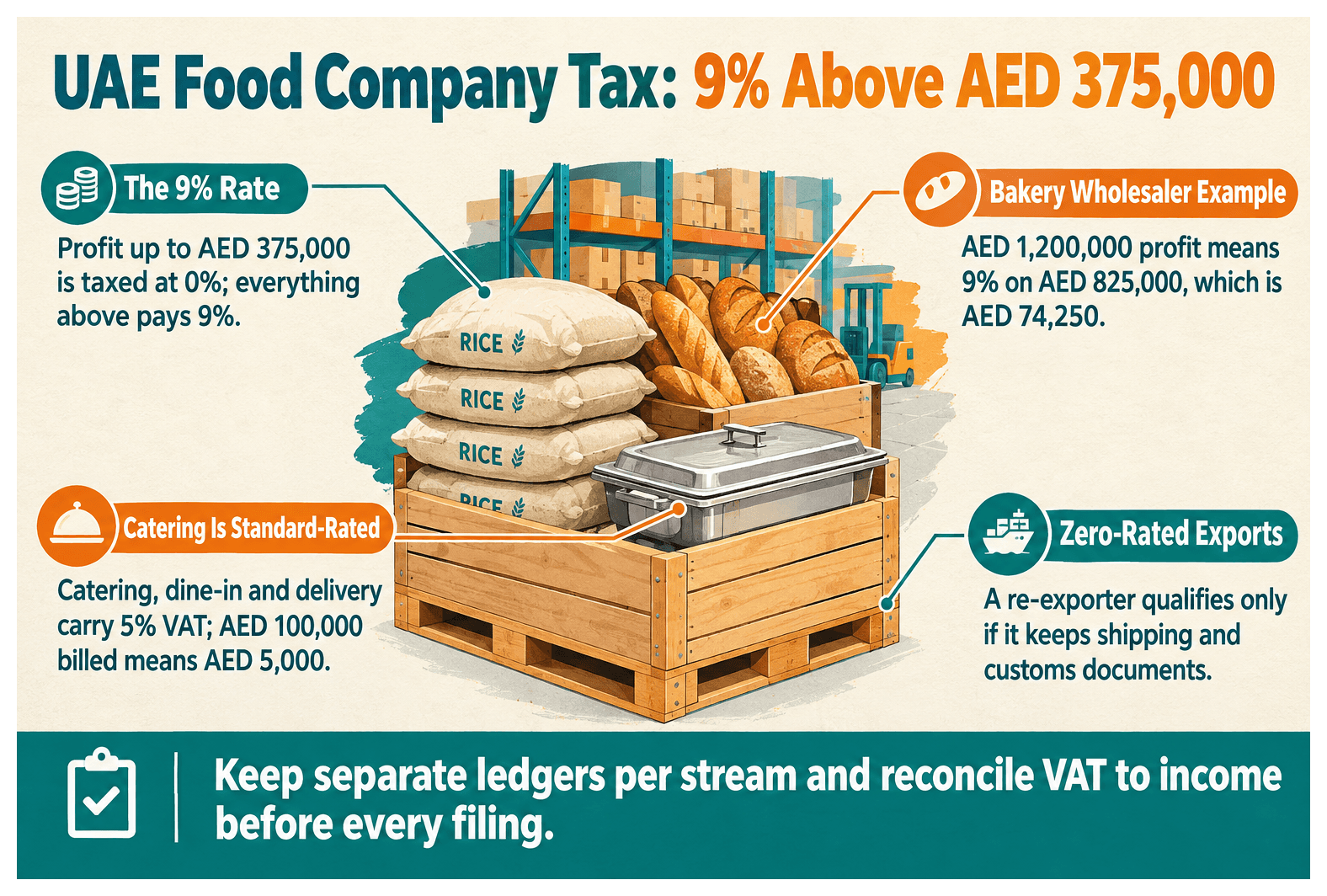
Most basic food sold inside the UAE is standard-rated at 5% VAT. Zero-rating covers qualifying exports and specific supplies. Catering and restaurant services are standard-rated. Either way, all food revenue counts toward taxable profit, so VAT classification changes cash flow and margins, not your corporate tax exemption.
Zero-Rated Supplies and Exported Foodstuffs
Zero-rated means 0% VAT with full input VAT recovery. A Dubai South trader re-exporting rice to East Africa qualifies only if it keeps shipping and customs documents. Check each product line against Federal Tax Authority guidance. Don't assume staples are zero-rated.
Standard-Rated Catering and Restaurant Services
Catering, dine-in and delivery carry 5% VAT.
Service and delivery charges usually join the taxable value.
A caterer billing AED 100,000 charges AED 5,000 VAT.
Mandatory VAT registration starts at AED 375,000 turnover.
Why VAT Treatment Still Affects Your Corporate Tax Return
A company selling wholesale staples and catering should keep separate ledgers per stream. Reconcile VAT returns to the income statement before filing. Mismatches invite questions. If you're building a trading arm, read about a foodstuff trading business in Dubai.
Free Zone Corporate Tax 2026 and the De Minimis Rule for Food Companies
Free zone corporate tax 2026 gives a 0% rate on qualifying income, but only to a Qualifying Free Zone Person. You need adequate substance, qualifying income, compliance with the de minimis limit, and transfer pricing and audit compliance. Fail one condition and the standard 9% applies. It isn't "tax free" across the board.
What Conditions Must You Meet to Keep the Exemption
Real substance in the free zone.
Qualifying income, with mainland sales generally non-qualifying.
Audited financial statements.
Transfer pricing compliance.
No election for the standard rate.
Think of a food ingredient trader at Dubai South Business Hub Free Zone selling mostly to free zone and overseas buyers. That profile fits. Qualifying income is taxed at 0%, and the rest at 9%.
The De Minimis Rule Explained With Numbers
Non-qualifying revenue must stay below the lower of 5% of total revenue or AED 5,000,000. With AED 20,000,000 revenue, 5% is AED 1,000,000. Mainland sales above that breach the limit. You then lose qualifying status for that period and the following four years, so track mainland sales monthly.
Selling to Mainland Customers From a Free Zone
Mainland revenue is a common trigger for 9% tax. A free zone food importer can route mainland orders through a licensed mainland distributor instead. See corporate tax for free zone companies with mainland clients before you plan.
Step-by-Step Registration and Filing for a UAE Food Company
Register for corporate tax on the Federal Tax Authority portal, keep audit-ready books, calculate taxable income, and file within nine months of year-end. Free zone companies must also document qualifying status. Late registration carries a flat AED 10,000 penalty.
Step 1: Confirm Your License and Check Your Company Name
Confirm the activity code on your food trading license.
Run the name check before formation.
Match the legal name to your tax records.
Step 2: Register on the Federal Tax Authority Portal
Create an EmaraTax account.
Submit license, ownership and financial year details.
Receive your Tax Registration Number.
A caterer that registers on time avoids the AED 10,000 penalty.
Estimated Costs and Timelines for a UAE Food Company (AED, as of January 2026)
Feature | Item | Cost or Timing |
|---|---|---|
Combined general and food trading license | Dubai South Business Hub Free Zone annual license | From AED 12,500 per year |
Corporate tax registration | Federal Tax Authority portal | No government fee |
Late registration penalty | Flat administrative penalty | AED 10,000 |
Return and payment deadline | Annual return and tax due | 9 months after year-end |
Record retention | Invoices, stock and ledgers | 7 years |
Step 3: Keep Records and Close the Books
Retain records for seven years.
Reconcile inventory, spoilage and supplier invoices.
Separate qualifying and non-qualifying revenue.
A bakery wholesaler should document stock write-offs for perishables item by item.
Step 4: File and Pay Within Nine Months
Prepare the return from closed books.
File and pay by the deadline. A December year-end means 30 September.
Consider professional help; see how to file a UAE corporate tax return.
How Much Does It Cost and How Long Does It Take
A combined general and food trading license at Dubai South Business Hub Free Zone starts at AED 12,500 per year as of January 2026. Corporate tax registration is free on the Federal Tax Authority portal. Filing support and audits cost extra.
License, Visa and Compliance Costs in AED
A two-partner food trader should budget for the license, a residency visa package and annual accounting. Read what a general food trading license costs in Dubai, then use the cost calculator for a tailored estimate. Fees quoted here are dated January 2026 and can change.
Timeline From License to First Tax Return
Say you're licensed in March with a December year-end. Your first return is due 30 September the following year. If you're a qualifying free zone company, schedule the audit early so it doesn't delay filing.
Regulations in the UAE That Shape Food Company Tax
Federal Decree-Law No. 47 of 2022 sets corporate tax. Ministry of Finance decisions cover free zones, and the Federal Tax Authority sets procedures. Food importers must also meet registration and labelling rules, which affect cost of goods, write-offs and deductions.
Deductible Costs for Food Businesses
Cost of goods, rent and wages.
Cold storage and packaging.
Refrigerated transport.
Entertainment, limited to 50%.
Fines and penalties are not deductible.
Import, Labelling and Compliance Costs
With over 80% of food imported [3], compliance shapes landed cost. A shipment held for labelling errors can mean storage charges or a write-off. Read food import registration and labelling in the UAE before you order.
Common Mistakes and Final Takeaways for Your Compliance Plan
The most common Mistakes are late registration, assuming free zone status means 0% on all income, ignoring the de minimis limit, mixing personal and business expenses, and misclassifying VAT. Monthly bookkeeping and mainland sales tracking fix most of them. That's the core of managing UAE corporate tax for food companies.
Mistakes That Trigger Penalties
Registering late (AED 10,000).
Missing filing deadlines.
Treating all free zone income as exempt.
Keeping poor inventory records.
A Simple Annual Compliance Calendar
Monthly: reconcile sales and mainland share.
Quarterly: file VAT returns.
Annually: audit, return and payment within nine months.
To recap: UAE corporate tax for food companies means 9% above AED 375,000 and 0% below. Qualifying free zone income gets 0% only when every condition and the de minimis rule are met. VAT classification affects cash flow, not exemption.
Ready to start? Use the cost calculator, check your company name, then speak with Dubai South Business Hub about a free zone trade license and residency visa package.
References
Ministry of Finance, Corporate Tax guidance, 2025.
Federal Tax Authority, registration data, 2026.
Dubai Chamber of Commerce, trade and food import data, 2024 (still accurate as of 2026).
Frequently Asked Questions


