
Topic Summary
What Is UAE Corporate Tax for Real Estate Companies and Why It Matters
UAE corporate tax for real estate companies is a 9% federal tax on taxable profit above AED 375,000, with 0% on profit up to that threshold. It applies to developers, brokers, landlords and property managers whose financial year began on or after 1 June 2023, under Federal Decree-Law No. 47 of 2022 [1].
Commercial Versus Residential Supply Regulations in the UAE for Property Businesses
Commercial Versus Residential Supply Regulations in the UAE for Property Businesses
Free Zone Corporate Tax 2026 and the De Minimis Rule for Real Estate Companies
Free zone corporate tax in 2026 lets a Qualifying Free Zone Person pay 0% on qualifying income and 9% on the rest. Under the de minimis rule, non-qualifying revenue must not exceed the lower of 5% of total revenue or AED 5 million, or the company loses the 0% rate [2]. It is never a blanket exemption.
Step-by-Step Registration and Filing for a UAE Real Estate Company
To register a UAE real estate company for corporate tax, create an EmaraTax account, submit your trade license details, receive your tax registration number, keep audited records, and file within 9 months of year end. Registration costs AED 0 as of January 2026 [1].
How Much Does It Cost and How Long Does It Take
Corporate tax registration with the Federal Tax Authority costs AED 0 as of January 2026 and typically completes within a few working days. Real costs come from licensing, accounting, audit and filing support. Late registration triggers a flat AED 10,000 penalty, so timing matters more than the fee.
Regulations in the UAE That Shape Real Estate Company Tax
Real estate company tax in the UAE is shaped by Federal Decree-Law No. 47 of 2022, Ministry of Finance cabinet decisions on qualifying free zone income, VAT law, and Dubai Land Department registration rules. Together they define taxable income, qualifying activities, records and penalties ( Ministry of Finance , 2023).
Common Mistakes and Final Takeaways for Your UAE Corporate Tax for Real Estate Companies Plan
The most common Mistakes are missing registration, treating residential income as qualifying free zone income, breaching the de minimis limit, mixing personal and company property, and weak records. Avoid them by registering on time, segregating income streams, monitoring the 5% and AED 5 million test, and keeping audited accounts.
UAE corporate tax for real estate companies is 9% on taxable profit above AED 375,000, and 0% on profit up to that figure [1]. Qualifying free zone income can be taxed at 0% only if the company meets every Qualifying Free Zone Person (QFZP) condition and stays within the de minimis limit of the lower of 5% of revenue or AED 5 million [2].
This guide is for owners and finance leads. You'll learn how the rules apply to a property business, how to register, what it costs, and which errors trigger the AED 10,000 late registration penalty [1].
What Is UAE Corporate Tax for Real Estate Companies and Why It Matters
UAE corporate tax for real estate companies is a 9% federal tax on taxable profit above AED 375,000, with 0% on profit up to that threshold. It applies to developers, brokers, landlords and property managers whose financial year began on or after 1 June 2023, under Federal Decree-Law No. 47 of 2022 [1].
How the 9% Rate and AED 375,000 Threshold Work
Tax falls on accounting profit adjusted for tax rules, not on revenue. Rental income, sales margins, commissions and management fees all feed into it.
Take a brokerage with AED 1,375,000 of taxable profit. The first AED 375,000 is taxed at 0%, and 9% applies to the remaining AED 1,000,000. The bill is AED 90,000. Simple, but only if your books are clean. For recent amendments, see UAE corporate tax changes.
Which Property Businesses Fall Inside the Regime
Developers, brokerages and property managers are in scope.
Landlords holding property through a licensed entity are in scope.
An individual renting one flat is generally outside scope, unless it's a licensed business activity.
Registration is required even where profit sits below AED 375,000.
Commercial Versus Residential Supply Regulations in the UAE for Property Businesses
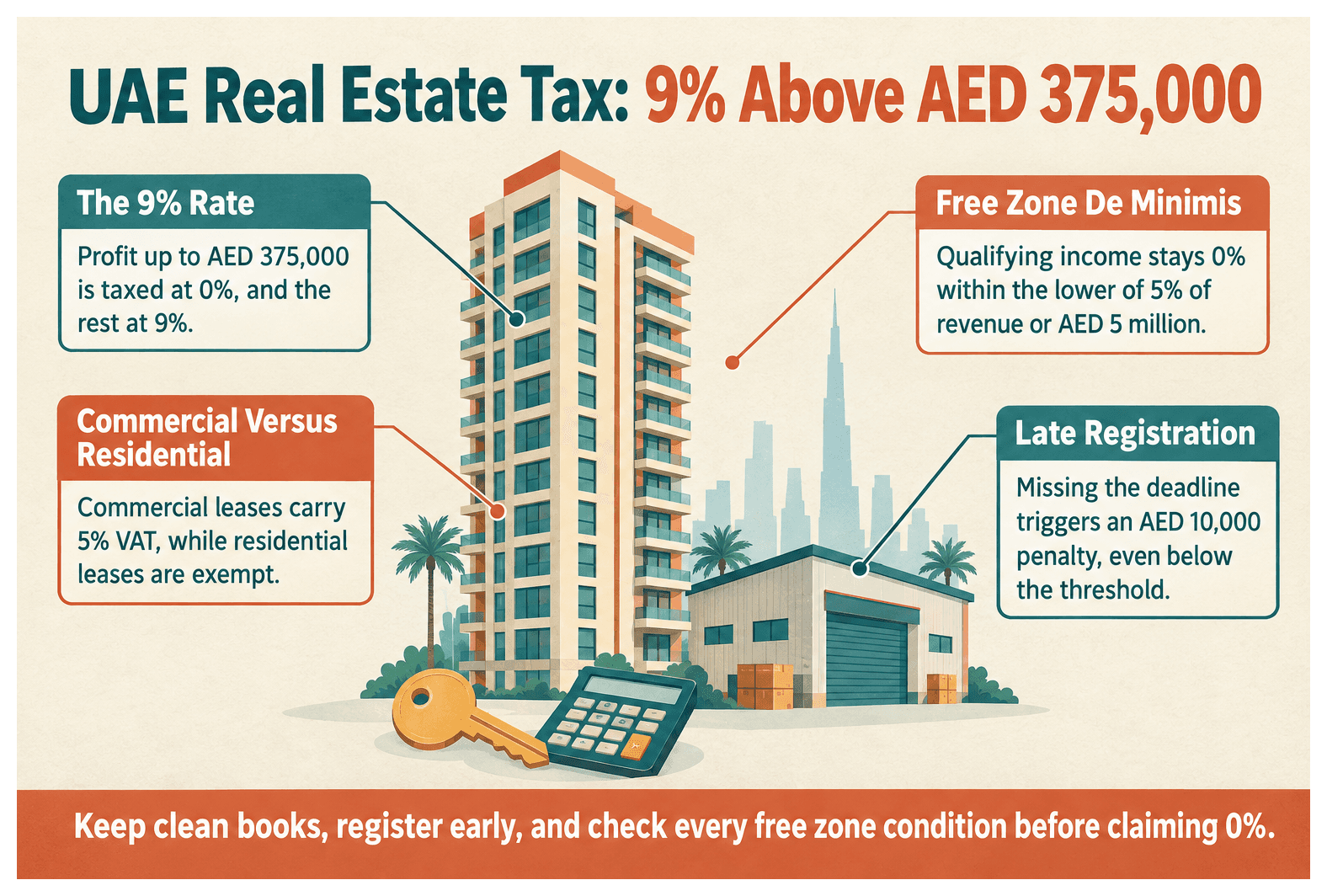
Corporate tax taxes profit from both commercial and residential property, but supply treatment differs elsewhere. For VAT, commercial sales and leases are standard-rated at 5%, while residential leases and most resales are exempt. For free zones, commercial transactions between free zone persons can qualify for 0%. This is where real estate company tax UAE planning gets practical.
Commercial Property Supply Treatment
Commercial sales and leases carry 5% VAT, and the profit sits fully inside the 9% regime above the threshold. Picture a landlord leasing a warehouse. If the tenant is another free zone company and the property is in a designated zone, the income may qualify for 0%. Lease the same warehouse to a mainland retailer and it's taxed at 9%.
Residential Property Supply Treatment
Residential leases and later resales are VAT exempt.
The first supply within 3 years of construction is zero-rated.
Residential income is generally not qualifying free zone income.
Exempt supplies limit input VAT recovery.
A developer selling new apartments (zero-rated) while leasing completed units (exempt) must track both. Dubai Land Department registration records help prove which is which (Dubai Land Department, 2025).
Mixed-Use Portfolios and Record Keeping
In a mixed-use tower with a retail podium and residential floors, segregate revenue by type in the ledger. Allocate shared costs on a documented basis. Keep records for 7 years.
Free Zone Corporate Tax 2026 and the De Minimis Rule for Real Estate Companies
Free zone corporate tax in 2026 lets a Qualifying Free Zone Person pay 0% on qualifying income and 9% on the rest. Under the de minimis rule, non-qualifying revenue must not exceed the lower of 5% of total revenue or AED 5 million, or the company loses the 0% rate [2]. It is never a blanket exemption.
What Counts as Qualifying Income for Property Firms
Commercial property transactions in a free zone with other free zone persons qualify.
Residential income and mainland immovable property are excluded.
Non-qualifying income is taxed at 9%.
Think of a Dubai South Business Hub licensed property company leasing commercial units to other free zone tenants. That income can qualify. Your licensed location and activity shape eligibility.
How the De Minimis Rule Is Tested
Say revenue is AED 40,000,000. Five percent is AED 2,000,000, which is lower than AED 5,000,000, so the cap is AED 2,000,000. Breach it and you lose QFZP status for that year and the next 4 years.
Other Conditions Must You Meet to Keep the Exemption
Maintain adequate substance in the free zone.
Comply with transfer pricing rules.
Prepare audited financial statements.
Don't elect the standard rate.
A free zone landlord that adds mainland tenants can breach the cap fast. Read about free zone companies with mainland clients before you sign.
Step-by-Step Registration and Filing for a UAE Real Estate Company
To register a UAE real estate company for corporate tax, create an EmaraTax account, submit your trade license details, receive your tax registration number, keep audited records, and file within 9 months of year end. Registration costs AED 0 as of January 2026 [1].
Step 1: Confirm Your License and Company Name
Secure a trade license with the correct property activity.
Check your company name before applying.
Residency visa packages are tied to the license.
Step 2: Register on EmaraTax
Create the account and submit the registration.
Late registration costs AED 10,000 (Federal Tax Authority, 2024).
Registration fee: AED 0 as of January 2026.
Step 3: Keep Records and Prepare Financials
Separate commercial and residential ledgers.
Reconcile rent rolls to the ledger.
Price related-party deals at arm's length.
Step 4: File the Return and Pay
Return and payment are due within 9 months of year end. A 31 December year end means a 30 September deadline. Consider corporate tax filing services in Dubai.
Commercial Versus Residential Property: Tax Treatment in the UAE (as of January 2026)
Feature | Commercial Property | Residential Property |
|---|---|---|
Corporate tax rate (9% above AED 375,000) | 9% above AED 375,000; 0% possible if qualifying free zone income | 9% above AED 375,000; no 0% route in practice |
VAT on sale and lease | Standard-rated at 5% | Leases and resales exempt; first supply within 3 years zero-rated |
Qualifying free zone income eligibility | Possible in a designated zone with other free zone persons | Generally excluded |
Input VAT recovery | Generally recoverable | Restricted on exempt supplies; recoverable on zero-rated |
Registration and filing fee (AED 0 registration as of January 2026) | AED 0 registration; audit needed if claiming QFZP | AED 0 registration; same AED 10,000 late penalty |
How Much Does It Cost and How Long Does It Take
Corporate tax registration with the Federal Tax Authority costs AED 0 as of January 2026 and typically completes within a few working days. Real costs come from licensing, accounting, audit and filing support. Late registration triggers a flat AED 10,000 penalty, so timing matters more than the fee.
Government Fees and Penalties
Registration fee: AED 0 (January 2026).
Late registration: AED 10,000.
A company that misses its deadline pays AED 10,000 for a form that costs nothing. See the corporate tax registration cost in the UAE.
Budgeting Your Total Compliance Spend
A start-up brokerage should estimate your setup costs for the license and visas first. Then add accounting. If you claim QFZP status, budget for an audit too.
Regulations in the UAE That Shape Real Estate Company Tax
Real estate company tax in the UAE is shaped by Federal Decree-Law No. 47 of 2022, Ministry of Finance cabinet decisions on qualifying free zone income, VAT law, and Dubai Land Department registration rules. Together they define taxable income, qualifying activities, records and penalties (Ministry of Finance, 2023).
Corporate Tax Law and Cabinet Decisions
Cabinet decisions list qualifying and excluded activities. A landlord should check its activity against them before claiming 0%. Our UAE corporate tax guide covers the basics.
Property Registration and Transaction Records
Dubai Land Department records support revenue evidence.
Reconcile sale registrations to booked revenue.
Align contracts, invoices and ledgers.
Common Mistakes and Final Takeaways for Your UAE Corporate Tax for Real Estate Companies Plan
The most common Mistakes are missing registration, treating residential income as qualifying free zone income, breaching the de minimis limit, mixing personal and company property, and weak records. Avoid them by registering on time, segregating income streams, monitoring the 5% and AED 5 million test, and keeping audited accounts.
Five Mistakes That Trigger Penalties
Late registration (AED 10,000).
Assuming all free zone income is 0%.
Ignoring the de minimis test.
Mixing residential and commercial income.
Missing the 9-month filing deadline.
One example: a free zone landlord signs a mainland residential lease and loses 0% status.
Final Takeaways and Next Move
UAE corporate tax for real estate companies comes down to three numbers: 9% above AED 375,000, 0% below it, and the de minimis cap. Planning a licensed property consultancy? Explore the real estate consultancies business license in Dubai, then speak to Dubai South Business Hub about a free zone license and visa package.
References
Frequently Asked Questions


