Setting Up a Food and Beverage Distribution Business in Dubai South: License, Cost and Steps

Topic Summary
What Is a Food and Beverage Distribution Business Dubai Entrepreneurs Can Launch
A food and beverage distribution business Dubai entrepreneurs run imports or sources food and drink products, stores them, and supplies retailers, wholesalers, hotels, restaurants and caterers. It earns on the margin between purchase and resale. It suits traders, not manufacturers.
Why Dubai South Suits a Food and Beverage Distribution Business Dubai
Why Dubai South Suits a Food and Beverage Distribution Business Dubai
Choosing the Right License for a Food and Beverage Distribution Business Dubai
Choose a Dubai South Business Hub free zone trade license whose activities match what you sell, such as foodstuff trading, beverage trading or wholesale. The wording limits what you can import, so list your categories first and confirm with the business launch team.
Approvals, Food Product Registration and Labelling Rules Before You Import
Beyond the license, an importer typically needs Dubai Municipality food product registration, import approvals via Montaji and related food import systems, compliant storage and correct labelling. Requirements change, so confirm with Dubai Municipality and Dubai Customs before shipping.
Cost Breakdown for a Food and Beverage Distribution Business Dubai
Costs for a food and beverage distribution business Dubai founders plan for fall into license, visas, flexi-desk or office, approvals, insurance and extras. Each varies with activities, headcount, space and range, so request a tailored quotation from the Dubai South Business Hub team.
Step-by-Step Setup Process and Typical Timeline
To set up, define your range, choose activities, apply, receive the license, arrange visas and office, register products, secure storage and place your first import. Timelines depend on document readiness and approvals, so confirm schedules with the business launch team.
Using Airport and Logistics Access for Imports, Re-Exports and Temperature Ranges
Dubai South's access lets a food and beverage distributor Dubai South based can air-freight perishables, bring containers through Jebel Ali Port and re-export regionally. Choose ambient, chilled or frozen ranges by storage capability, shelf life and demand.
The UAE food and beverage market is worth over USD 30 billion and grows roughly 6% a year [1]. Dubai's non-oil trade has passed AED 2.2 trillion, and food is among its busiest import categories [2]. A food and beverage distribution business Dubai South can host gets you into that flow. This guide is for importers and F&B founders who want to know the license, approvals, costs and steps. Confirm current rules with the relevant authorities before you commit.
What Is a Food and Beverage Distribution Business Dubai Entrepreneurs Can Launch
A food and beverage distribution business Dubai entrepreneurs run imports or sources food and drink products, stores them, and supplies retailers, wholesalers, hotels, restaurants and caterers. It earns on the margin between purchase and resale. It suits traders, not manufacturers.
What the Activity Covers
You source, import, warehouse, sell and deliver packaged products. Customers include supermarkets, HoReCa buyers (hotels, restaurants, catering), and online grocers. Picture a founder importing ambient pantry staples from Southeast Asia and supplying hotel kitchens and mid-size retailers. That's an F&B trading company UAE buyers can rely on. Distribution means you hold stock and deliver; a pure import-export operation often moves goods without local warehousing. See our guide to a foodstuff beverages trading business Dubai for the licensing angle.
Who This Business Model Suits
Importers wanting a UAE base for re-exports.
Brand owners who want to control distribution.
Founders with a defined product range.
A European specialty-food brand, for instance, can set up its own entity instead of relying on third-party agents.
Why Dubai South Suits a Food and Beverage Distribution Business Dubai
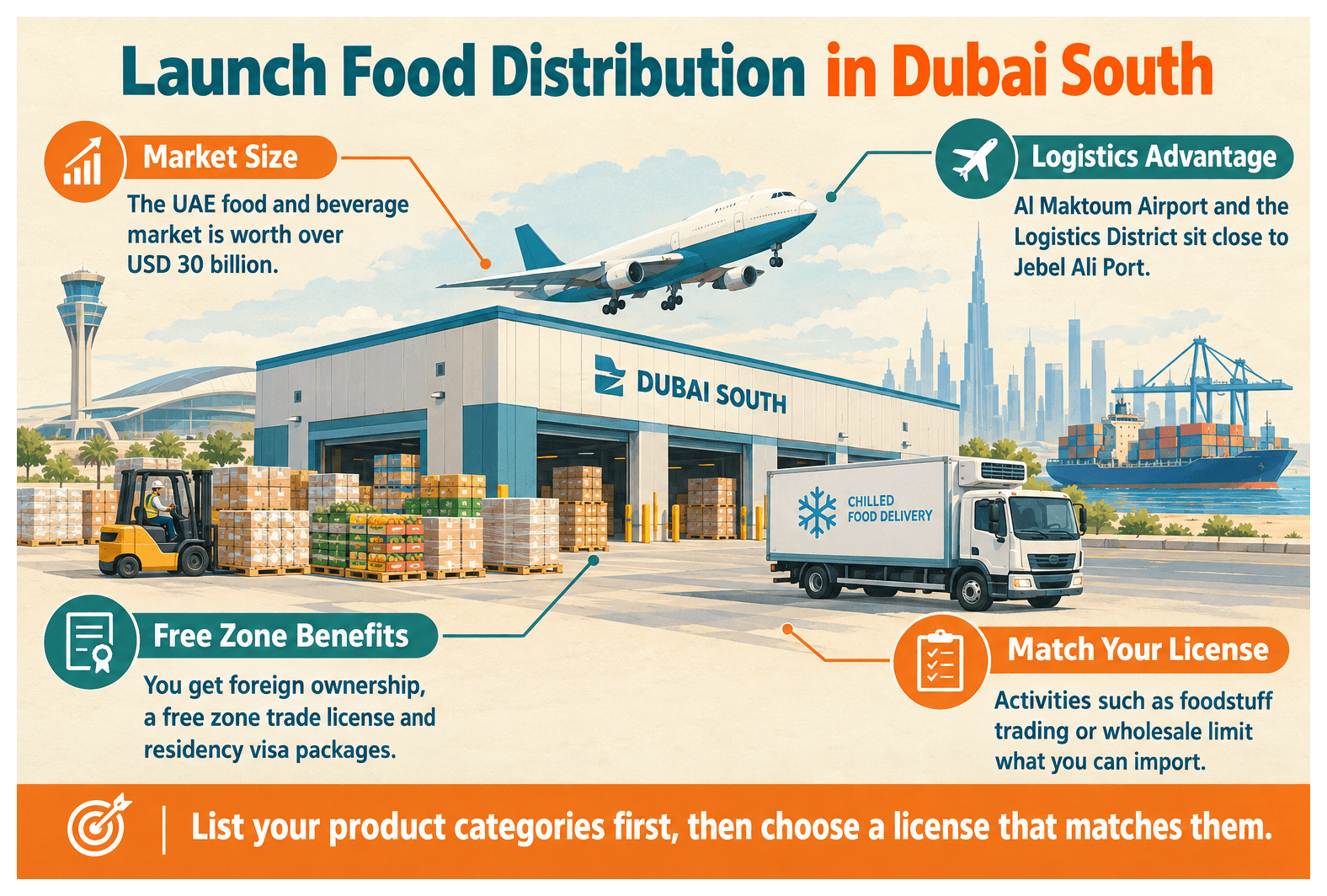
Dubai South suits a food and beverage distribution business because it combines Al Maktoum International Airport, the Logistics District, and close access to Jebel Ali Port and Expo City. That shortens the path from supplier to warehouse to customer.
Airport and Logistics District Advantages
Think of a chilled-dairy distributor receiving air-freighted pallets and moving them to a nearby temperature-controlled facility. Fewer handoffs mean less time out of temperature. Check flight and cargo capacity with Dubai Airports.
Sea Access and Regional Reach
Jebel Ali Port is close for containerised ambient and frozen cargo.
Expo City adds events and corporate catering demand.
Re-exports can serve GCC customers.
Free Zone Benefits for Distributors
You get foreign ownership, a free zone trade license and residency visa packages tied to the license. A solo founder can start on a flexi-desk while the product range is registered. Our guide to setting up a food trading business in Dubai South covers more.
Choosing the Right License for a Food and Beverage Distribution Business Dubai
Choose a Dubai South Business Hub free zone trade license whose activities match what you sell, such as foodstuff trading, beverage trading or wholesale. The wording limits what you can import, so list your categories first and confirm with the business launch team.
Matching Business Activity to Your Product Range
Foodstuff trading covers general packaged food.
Beverage trading covers drinks.
Wholesale suits bulk supply to other traders.
Juices, frozen poultry or snacks may need specific activities.
A snacks-and-soft-drinks distributor should select activities covering both. A precise list avoids amendments later. Compare the food and beverages wholesale trading license in Dubai option if you sell to other traders.
License Duration, Visas and Office Choices
Visa allocation depends on license and office type. A two-partner team might take a flexi-desk and two visas, then rent third-party warehouse space. Warehousing is arranged separately from the license.
Approvals, Food Product Registration and Labelling Rules Before You Import
Beyond the license, an importer typically needs Dubai Municipality food product registration, import approvals via Montaji and related food import systems, compliant storage and correct labelling. Requirements change, so confirm with Dubai Municipality and Dubai Customs before shipping.
Dubai Municipality Food Product Registration
Products are registered before import clearance, and registration is by product, so a bigger range means more effort. Prepare product details, ingredients and supplier information, then confirm the exact list with Dubai Municipality. One practical move: register a first batch of ambient SKUs before placing a bulk order. Our food trading approval guide expands on this.
Import Requirements Through Montaji and Food Import Systems
Use Montaji and the food import systems for shipment approvals.
Agree customs documents with your freight agent.
Confirm paperwork before the vessel departs.
Verify current steps with Dubai Municipality and Dubai Trade.
Compliant Storage and Labelling
Match storage to ambient, chilled or frozen goods.
Confirm label content, dates and language rules with authorities.
Fix labels at the supplier, not after arrival.
Relabelling errors delay stock release. Read more in starting a food import business in Dubai.
Cost Breakdown for a Food and Beverage Distribution Business Dubai
Costs for a food and beverage distribution business Dubai founders plan for fall into license, visas, flexi-desk or office, approvals, insurance and extras. Each varies with activities, headcount, space and range, so request a tailored quotation from the Dubai South Business Hub team.
What Drives Each Cost Component
Cost Components for a Food and Beverage Distribution Business Dubai
Cost Component | What Drives the Cost |
|---|---|
Free zone trade license | Number of activities selected and license term |
Visa allocation | Number of partners and staff needing residency |
Flexi-desk or office | Lean flexi-desk versus dedicated office for staff and meetings |
Approvals and product registration | Number of products and their category |
Insurance and set-up extras | Stock value, storage and transport arrangements |
For a license reference point, see general food trading license cost in Dubai.
Budgeting Beyond Setup
Working capital for stock and supplier payments.
Warehousing and cold-chain costs.
Freight, clearance and delivery.
Budget for your first three shipments, not just setup fees.
Step-by-Step Setup Process and Typical Timeline
To set up, define your range, choose activities, apply, receive the license, arrange visas and office, register products, secure storage and place your first import. Timelines depend on document readiness and approvals, so confirm schedules with the business launch team.
Step 1: Define Your Range and Choose Activities
List categories and temperature needs.
Map each SKU to a license activity.
Note which products need specific approvals.
Step 2: Apply for the License and Set Up Visas and Office
Submit passports and activity choices in one application.
Pick a flexi-desk or office.
Set visa allocation per partner.
Step 3: Complete Approvals, Storage and First Shipment
Register products with Dubai Municipality.
Arrange storage and confirm labelling.
Trial a small first shipment and note the timings authorities give you.
Related reading: foodstuff import export business Dubai.
Using Airport and Logistics Access for Imports, Re-Exports and Temperature Ranges
Dubai South's access lets a food and beverage distributor Dubai South based can air-freight perishables, bring containers through Jebel Ali Port and re-export regionally. Choose ambient, chilled or frozen ranges by storage capability, shelf life and demand.
Air and Sea Import Routes
Air suits high-value, short-shelf-life goods.
Sea suits bulk ambient and frozen cargo.
Fresh-chilled by air and canned goods by sea can serve one distributor.
Port operations are described by DP World.
Choosing Between Ambient, Chilled and Frozen Ranges
Ambient has the lowest storage complexity, so it's the easier start. Chilled and frozen need cold-chain investment and tighter handling. My advice: launch ambient, then add frozen once cold storage is secured.
Planning Re-Exports
Check destination-market import rules and keep documents consistent across shipments. A distributor supplying GCC customers from a Dubai stock base needs both.
Mistakes to Avoid When Launching Your Food and Beverage Distribution Business Dubai
Common mistakes include wrong license activities, importing before registration, underestimating storage and labelling compliance, thin working capital, and skipping confirmation with authorities. Plan range, approvals and logistics before shipment one.
Licensing and Approval Errors
Activities that don't cover every product.
Shipping before registration is confirmed, which can leave a shipment held.
Operational and Financial Oversights
Underestimating cold-chain and warehouse costs.
Running short of cash between supplier payment and customer collection.
Not verifying current requirements with official bodies.
Your Next Move
A food and beverage distribution business Dubai South supports rests on the right activities, registered products, compliant storage and realistic budgets. Speak to the Dubai South Business Hub business launch team to confirm license activities, visa needs and a tailored quotation.
References
Frequently Asked Questions