
Topic Summary
What Is Food Product Labelling in the UAE and Which Rules Apply?
Food product labelling in the UAE is the mandatory information printed on packaged food before sale. Rules follow Gulf Standardization Organization (GSO) standards adopted by the Ministry of Industry and Advanced Technology (MoIAT), with local enforcement by bodies such as Dubai Municipality. Fees and requirements may vary, so check the official source.
What Must Appear on a Food Label in the UAE?
What Must Appear on a Food Label in the UAE?
How Do Arabic Labelling, Shelf Life and Halal Rules Apply?
Arabic labelling food UAE rules require key information in Arabic, printed on the pack or added as an approved sticker where permitted. Shelf life labelling UAE rules require clear production and expiry dates. Halal labelling requirements UAE apply to products such as meat and poultry, backed by recognised certification.
What Are the Imported Food Label Requirements in the UAE?
Imported food label requirements UAE rules mean the product carries compliant information before customs clearance. Importers usually register the product, submit artwork through Dubai Municipality or the relevant authority, and declare goods through Mirsal 2 with Dubai Customs. Requirements may vary, so check the official source.
How Do You Get Your Food Labels Approved Step by Step?
To get labels approved, confirm the product category, prepare compliant artwork, gather documents, register the product, then submit the declaration through Mirsal 2. Fix comments and print only after approval. Dubai Municipality food labelling checks and timelines vary, so verify officially.
What Label Mistakes and Penalties Should You Avoid?
Common mistakes include missing Arabic text, altered dates, absent allergen warnings, unsupported claims and mismatched halal documents. Consequences can include holds, relabelling costs, rejection or fines. Penalty amounts change, so confirm current figures with the relevant authority.
What Should You Do Next to Stay Label-Compliant?
Audit one product label against the checklist, fix gaps with your supplier, and secure the right trade license before importing. Food product labelling requirements UAE inspectors apply are easier to meet when your setup is ready first.
Food product labelling requirements UAE regulators enforce cover product name, ingredients, allergens, net quantity, origin, batch code, dates, storage conditions and Arabic text. Imported goods must carry compliant labels before they clear customs.
The UAE imports more than 80% of its food (UAE Government Portal, 2025), and Dubai's non-oil trade has passed AED 2.2 trillion (Dubai Chamber of Commerce, 2024). If you're planning a cold chain or food trading company, this guide covers UAE food label regulations and how to get labels approved.
What Is Food Product Labelling in the UAE and Which Rules Apply?
Food product labelling in the UAE is the mandatory information printed on packaged food before sale. Rules follow Gulf Standardization Organization (GSO) standards adopted by the Ministry of Industry and Advanced Technology (MoIAT), with local enforcement by bodies such as Dubai Municipality. Fees and requirements may vary, so check the official source.
Which Authorities Set and Enforce Label Rules?
MoIAT sets the federal baseline. Dubai Municipality enforces it through inspections and food import clearance, while the Federal Customs Authority and Dubai Customs check consignments at entry points. An importer in Dubai quickly learns that one product must satisfy both federal standards and local checks.
Which Products Do the Rules Cover?
Prepackaged food means food sealed in packaging before it reaches the consumer. Frozen poultry in a branded carton falls under the rules. Loose produce sold from a crate usually follows different documentation, so verify with the authority. For the registration side, see this guide to food import registration and labelling in the UAE.
What Must Appear on a Food Label in the UAE?
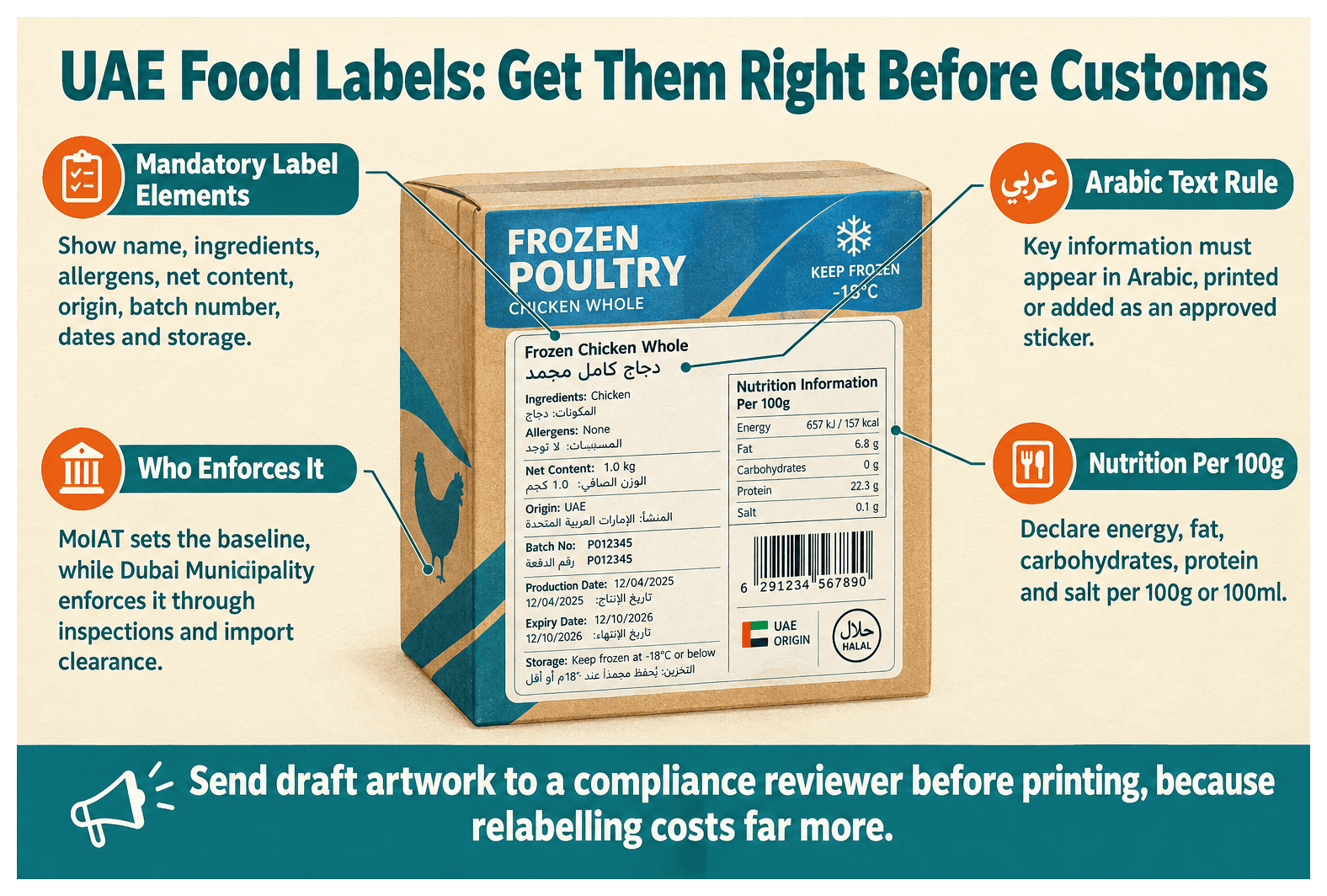
A UAE food label generally shows the product name, ingredients, net quantity, producer, country of origin, batch number, dates, storage conditions and allergens, plus nutrition details where required. Most of it must appear in Arabic. Confirm exact wording against current standards before printing.
Mandatory Label Elements Checklist
Product name and ingredient list
Allergen declaration
Net content and country of origin
Manufacturer and importer name and address
Batch number (the code that traces a production run)
Production and expiry dates
Storage and use instructions
Picture a frozen shipment held because the batch code and storage temperature were missing. That's a common, avoidable delay.
How Do UAE Nutrition Labelling Rules Work?
UAE nutrition labelling rules typically expect energy, fat, carbohydrates, protein and salt or sodium per 100g or 100ml. Claims like "low fat" or "high protein" must meet defined criteria. A snack that fails the protein threshold can't carry the claim. Thresholds may change, so verify with MoIAT.
Practical tip: Send draft artwork to a compliance reviewer before the print run. Relabelling a container costs far more than a pre-check.
How Do Arabic Labelling, Shelf Life and Halal Rules Apply?
Arabic labelling food UAE rules require key information in Arabic, printed on the pack or added as an approved sticker where permitted. Shelf life labelling UAE rules require clear production and expiry dates. Halal labelling requirements UAE apply to products such as meat and poultry, backed by recognised certification.
Arabic Text and Bilingual Labels
Arabic must be accurate and legible, not a rough translation. Bilingual Arabic-English labels are common for imports. Containers have been flagged at port for missing Arabic text. Stickers must be durable and never cover original mandatory information. More detail is in this guide to Arabic labelling approvals and scope.
Production Dates, Expiry Dates and Remaining Shelf Life
Shelf life is the period a product stays safe and good quality under stated storage. Never alter or over-sticker dates. Remaining shelf life at arrival may be assessed at clearance, so chilled goods with too little left can be refused. Confirm the current rule.
Halal Marking and Certification
Use certificates from approved halal bodies.
Don't use misleading halal marks.
Match certificate details to shipment batches.
What Are the Imported Food Label Requirements in the UAE?
Imported food label requirements UAE rules mean the product carries compliant information before customs clearance. Importers usually register the product, submit artwork through Dubai Municipality or the relevant authority, and declare goods through Mirsal 2 with Dubai Customs. Requirements may vary, so check the official source.
Who Is Responsible: Importer or Exporter?
The UAE importer carries compliance responsibility. Brief your overseas supplier on label specs before production, and supply the Arabic text before the pack run. Starting out? Read about starting a food import business in Dubai.
Packaging Material and Food Contact Rules
Food packaging regulations UAE also cover food contact materials, meaning any material touching the food. A tray supplier unable to show compliance can stall a shipment. Keep test reports ready and review food contact packaging approvals.
A Dubai South Business Hub Free Zone trade license can support food trading and importing, subject to activity approvals.
How Do You Get Your Food Labels Approved Step by Step?
To get labels approved, confirm the product category, prepare compliant artwork, gather documents, register the product, then submit the declaration through Mirsal 2. Fix comments and print only after approval. Dubai Municipality food labelling checks and timelines vary, so verify officially.
Confirm category and standard. Baby food needs stricter label content than ordinary snacks.
Prepare artwork and documents. Proofread the Arabic translation.
Register, submit and clear. Answer inspection comments quickly.
Documents checklist for a first-time importer:
Label artwork and ingredient list
Certificate of origin and commercial invoice
Halal and health or analysis certificates where relevant
Trade license
Common Label Issues, Likely Outcomes and Fixes
Feature | Label Issue | Likely Outcome and Fix |
|---|---|---|
Missing or inaccurate Arabic text | Arabic absent or poorly translated | Hold until corrected. Supply proofread Arabic and relabel. |
Unclear or altered production and expiry dates | Smudged, over-stickered or unclear dates | Possible rejection. Reprint clear original dates. |
Missing allergen information | No allergen warning on the pack | Shipment hold. Add the declaration before resubmitting. |
Unsupported nutrition or health claims | Claim fails defined criteria | Comments from inspectors. Remove the claim or reformulate. |
Halal certificate not matching shipment | Batch or product details differ from certificate | Clearance delay. Obtain a corrected certificate. |
What Label Mistakes and Penalties Should You Avoid?
Common mistakes include missing Arabic text, altered dates, absent allergen warnings, unsupported claims and mismatched halal documents. Consequences can include holds, relabelling costs, rejection or fines. Penalty amounts change, so confirm current figures with the relevant authority.
Common Mistake: Relying on Stickers Without Approval
Stickers can cover original information or peel off. In cold storage, condensation and freezing loosen cheap adhesive, and a sticker may fall off frozen cartons within days. Use freezer-grade labels and get them approved first.
What Should You Do Next to Stay Label-Compliant?
Audit one product label against the checklist, fix gaps with your supplier, and secure the right trade license before importing. Food product labelling requirements UAE inspectors apply are easier to meet when your setup is ready first.
Set Up the Right License for Food Trading
A free zone trade license with a food activity, plus residency visa packages tied to it, gives you a base. See the food and beverages wholesale trading license. A cold chain startup should pair it with label audits before its first shipment.
Build a Repeatable Label Review Routine
Keep a master checklist.
Archive approved artwork.
Review quarterly, before new SKUs.
Recheck when recipes or rules change.
Final Word
Food product labelling requirements UAE importers face centre on accurate Arabic, clear dates, allergen and nutrition data, halal documents and approval before clearance. Audit one product label this week, then speak with Dubai South Business Hub about a free zone trade license. Rules in the UAE change often. Always verify the latest requirements with the official authority before taking action.
References
Frequently Asked Questions