Topic Summary
What Is a UAE VAT Inspection and Why Does the FTA Run One
A UAE VAT inspection is a formal review by the Federal Tax Authority of a registered business's VAT returns, invoices and accounting records. The FTA runs it to confirm that output tax, input tax recovery and filings match the law. Selection can be risk-based, random, or triggered by refund claims and return discrepancies.
Which VAT Records in the UAE Must You Keep Ready
Which VAT Records in the UAE Must You Keep Ready
What Is the Right Way to Prepare Before the FTA Arrives
Prepare for a UAE VAT inspection by running an internal review of returns, reconciling ledgers, correcting errors through voluntary disclosure, and briefing staff. Name one contact, gather records by period, and confirm TRN details. Early preparation shortens the visit and reduces the penalty exposure from avoidable Mistakes.
Step-by-Step Guide to Handle a UAE VAT Inspection
To handle a UAE VAT inspection, acknowledge the FTA notice, appoint a lead, collect requested records, brief the inspectors, answer queries in writing, review the findings, and challenge errors through reconsideration if needed. Meeting each deadline and keeping a log of every exchange protects your position.
Which Penalties and Costs Apply to a UAE VAT Inspection
Penalties after a UAE VAT inspection depend on the finding: fixed AED fines for record-keeping or filing failures, plus percentage penalties on unpaid tax. Late registration costs AED 10,000, and missing records start at AED 10,000. Always confirm the current FTA penalty schedule and date before quoting figures to management.
How Does a Free Zone Company Prepare for an FTA Audit in the UAE
A free zone company prepares for an FTA audit in the UAE the same way as a mainland one: it must hold a valid TRN, file returns on time, and keep full records. Free zone status doesn't remove VAT duties, and designated zone goods rules need extra customs and stock documents.
Should You Do Next to Start Handling a UAE VAT Inspection With Confidence
Next, audit your VAT records, reconcile each return, correct errors by voluntary disclosure, and assign an inspection lead. Consider a registered tax agent and keep an indexed digital file. Doing this before any FTA notice arrives is the cheapest way to manage a UAE VAT inspection.
More than 350,000 businesses are VAT-registered in the UAE, and the Federal Tax Authority (FTA) has audited more than 40,000 since January 2018 [1]. You handle a UAE VAT inspection by answering the FTA notice inside the stated deadline and producing complete records. You also name one person to run the process. This guide is for compliance officers and managers who want to prepare records, follow the steps, limit penalties and fix gaps. For the wider process, read our tax audit in the UAE guide.
What Is a UAE VAT Inspection and Why Does the FTA Run One
A UAE VAT inspection is a formal review by the Federal Tax Authority of a registered business's VAT returns, invoices and accounting records. The FTA runs it to confirm that output tax, input tax recovery and filings match the law. Selection can be risk-based, random, or triggered by refund claims and return discrepancies.
What an FTA Audit in the UAE Actually Covers
An FTA audit UAE review covers returns, tax invoices, credit notes, import documents and refund claims. It can be a desk audit (documents sent electronically) or an on-site visit. The FTA's powers come from the VAT law and the Tax Procedures Law. Picture a trading company that claims a large input tax refund. It receives a document request covering its last four returns.
What Triggers a UAE VAT Inspection
Refund claims and unusual input tax ratios.
Late or inconsistent returns.
Sales that fall sharply while expenses rise.
Random selection and sector reviews.
Late registration alone costs AED 10,000 (FTA penalty schedule, as of 2026) [1].
Notice Types and Response Deadlines
You'll usually receive a notification of audit with a request for documents. Acknowledge it in writing and note the deadline. If you need more time, ask for an extension in writing. The FTA can review returns filed in the past five years, so log the notice date and assign a reply owner the same day.
Which VAT Records in the UAE Must You Keep Ready
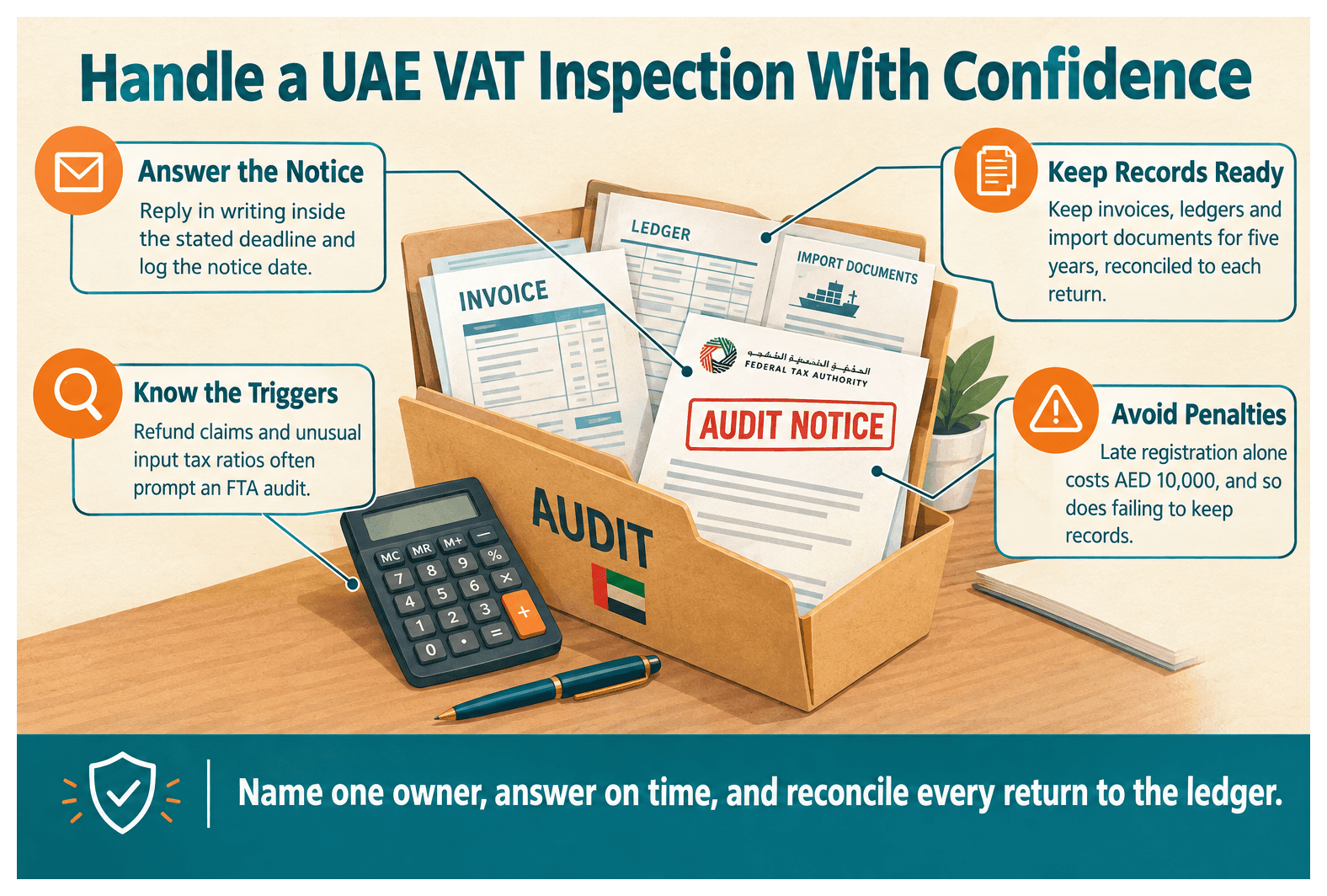
VAT records in the UAE include tax invoices, credit notes, import and export documents, VAT returns, accounting ledgers and bank statements. Businesses must keep them for five years, and real estate records longer. Inspectors expect records to be complete, accurate, accessible in the UAE and reconcilable to each filed return.
Core Documents an Inspector Will Request
Sales and purchase tax invoices.
Credit and debit notes.
Customs and import declarations.
A ledger-to-return reconciliation.
Reconcile Box 1 sales on each return to the general ledger before any visit. See our tax invoice retention period in the UAE guide for timing.
Invoice Quality and Retention Standards
A missing or defective invoice usually means denied input tax. Picture a claim rejected because the supplier invoice lacked a TRN (Tax Registration Number). Failing to keep records starts at AED 10,000 (FTA penalty schedule, as of 2026) [1]. Check every field against the tax invoice requirements in the UAE.
Organising a Digital Audit File
One sub-folder per quarter.
A master index with document owners.
Access controls and daily backups.
What Is the Right Way to Prepare Before the FTA Arrives
Prepare for a UAE VAT inspection by running an internal review of returns, reconciling ledgers, correcting errors through voluntary disclosure, and briefing staff. Name one contact, gather records by period, and confirm TRN details. Early preparation shortens the visit and reduces the penalty exposure from avoidable Mistakes.
Run a Mock Review of Your VAT Returns
Sample 25 invoices per quarter.
Check evidence for zero-rated and exempt supplies.
Confirm reverse charge treatment.
Our reverse charge VAT in the UAE explainer helps with that last check.
Fix Errors With a Voluntary Disclosure
If you find an error, submit a voluntary disclosure through EmaraTax before the audit starts. Disclosing early generally reduces the penalty exposure. Say a company spots an under-declared quarter. Correcting it before the notice arrives is far cheaper than having inspectors find it. Our VAT return filing for Dubai companies guide covers corrections.
Brief Your Team and Appoint a Lead
Appoint a single point of contact, such as the finance manager. Decide who may speak to inspectors, and keep a registered tax agent on call.
Step-by-Step Guide to Handle a UAE VAT Inspection
To handle a UAE VAT inspection, acknowledge the FTA notice, appoint a lead, collect requested records, brief the inspectors, answer queries in writing, review the findings, and challenge errors through reconsideration if needed. Meeting each deadline and keeping a log of every exchange protects your position.
Step 1: Acknowledge the Notice and Log the Deadline
Reply in writing within the stated period.
Record the notice reference and contact officer.
Request an extension if records are extensive.
Step 2: Collect and Submit the Requested Records
Send only what's requested, organised by period.
Keep a copy of everything submitted.
Flag missing items with an explanation.
Step 3: Manage the On-Site Visit or Desk Review
Provide a meeting room and one contact.
Answer factually and confirm complex answers in writing.
Note every request. If an inspector asks for a supplier contract, promise delivery within 48 hours.
Step 4: Review Findings and Respond
Review the audit report line by line.
Settle undisputed amounts.
File a reconsideration request for disputed items within the legal time limit.
Can You Challenge an FTA Audit Finding?
Yes. If you disagree, file a reconsideration request with the FTA within the legal time limit. Attach evidence, such as import documents supporting a disallowed input tax claim. Check the deadline on your decision notice, because missing it can end your right to dispute.
Which Penalties and Costs Apply to a UAE VAT Inspection
Penalties after a UAE VAT inspection depend on the finding: fixed AED fines for record-keeping or filing failures, plus percentage penalties on unpaid tax. Late registration costs AED 10,000, and missing records start at AED 10,000. Always confirm the current FTA penalty schedule and date before quoting figures to management.
Common Administrative Penalties in AED
Late registration: AED 10,000 (as of 2026).
Failure to keep records: from AED 10,000 (as of 2026).
Late filing and late payment: fixed and percentage penalties.
A firm that lost invoices for two quarters faces both fixed and percentage charges.
Prepared Versus Unprepared Business in a UAE VAT Inspection (AED, dated)
Feature | Prepared Business | Unprepared Business |
|---|---|---|
Records readiness | Indexed file per quarter, ledger reconciled to each return | Invoices scattered across inboxes, gaps found during the visit |
Response time to FTA notice | Acknowledged the same day, pack sent within the deadline | Extension requests and missed deadlines |
Penalty exposure in AED | Limited to disclosed errors (as of 2026 FTA schedule) | From AED 10,000 per record failure plus percentage penalties (as of 2026) |
Staff time consumed | One lead, a few focused days | Several staff pulled off work for weeks |
Likely outcome | Closes in weeks with minor adjustments | Disallowed input tax and fines |
Budgeting for Compliance Support
Budget for a tax agent and bookkeeping support. A new Dubai South company can use the cost calculator to estimate setup and annual compliance overhead. Check penalty rules with the Ministry of Finance before presenting figures to management.
How Does a Free Zone Company Prepare for an FTA Audit in the UAE
A free zone company prepares for an FTA audit in the UAE the same way as a mainland one: it must hold a valid TRN, file returns on time, and keep full records. Free zone status doesn't remove VAT duties, and designated zone goods rules need extra customs and stock documents.
VAT Duties for Dubai South Business Hub Companies
Registration is mandatory above AED 375,000 in taxable supplies. A free zone license isn't a VAT exemption. Align your license name, invoices and TRN record, and verify the name with the name check. Our VAT registration in UAE guide has the process.
Evidence for Designated Zone and Cross-Border Supplies
Customs documents and transport proof.
Reverse charge records.
Shipping evidence for every export.
An export can lose zero-rating if shipping evidence is missing.
Should You Do Next to Start Handling a UAE VAT Inspection With Confidence
Next, audit your VAT records, reconcile each return, correct errors by voluntary disclosure, and assign an inspection lead. Consider a registered tax agent and keep an indexed digital file. Doing this before any FTA notice arrives is the cheapest way to manage a UAE VAT inspection.
A 30-Day Readiness Checklist
Week 1: reconcile returns.
Week 2: review invoice quality.
Week 3: file a voluntary disclosure if needed.
Week 4: brief staff.
Get Support From Dubai South Business Hub
Dubai South Business Hub offers free zone company formation, trade licenses and residency visa packages tied to your license. Start your setup with a VAT file from day one. Contact the team for setup and compliance guidance, and read preparing for your first UAE audit.
Conclusion
A UAE VAT inspection is manageable when your records are complete, your returns reconcile, and one lead owns the response. Acknowledge the notice, collect records, manage the review, respond to findings and dispute errors on time. Early preparation costs far less than a AED 10,000 penalty. Review your VAT records now, budget compliance with the cost calculator, and contact Dubai South Business Hub for company setup support.
References
Frequently Asked Questions