Topic Summary
What Is UAE E-Invoicing: Who Is In Scope and Who Is Exempt and Why It Matters
UAE e-invoicing is a mandatory system where taxable invoices and credit notes are issued, exchanged and reported in a structured electronic format through an accredited service provider on the Peppol-based network. It applies in phases to VAT-registered businesses, while specified government and non-business entities are exempt. Scope depends on revenue and transaction type.
Who Is In Scope Under UAE E-Invoicing: Who Is In Scope and Who Is Exempt
Who Is In Scope Under UAE E-Invoicing: Who Is In Scope and Who Is Exempt
Who Is Exempt From UAE E-Invoicing: Who Is In Scope and Who Is Exempt
Exempt categories include government entities acting in a sovereign capacity, diplomatic and international organisations, individuals not carrying on a business, and certain financial services. Exemption covers named categories only. A free zone license alone doesn't qualify.
Practical Actions to Get Your Dubai South Company UAE E-Invoicing Ready
Confirm VAT status and revenue tier, choose an accredited provider, check your accounting system outputs structured data, clean tax details, test during the pilot and train staff. Finish before your appointment deadline.
How Free Zone Companies in Dubai South Fit Into UAE E-Invoicing: Who Is In Scope and Who Is Exempt
Dubai South free zone companies are in scope when VAT-registered and making covered B2B or B2G supplies. Treatment depends on registration, designated zone status for goods and customer type. Check each revenue stream separately.
Risks of Misjudging Your UAE E-Invoicing Scope and How to Avoid Them
Misjudging scope risks penalties, rejected invoices, delayed payments and input tax disputes. Check official decisions, document your reasoning, review scope yearly and confirm doubtful cases with the FTA.
Next Steps for Your Dubai South Company
UAE e-invoicing: who is in scope and who is exempt comes down to VAT registration, revenue tier and customer type. Only named categories are exempt. Review your VAT status now, shortlist an accredited provider, and speak to the Dubai South Business Hub team about setting up or reviewing your free zone company.
UAE e-invoicing: who is in scope and who is exempt is now a live question for Dubai South founders. More than 350,000 businesses are VAT-registered [1]. A pilot starts in July 2026 [2]. Firms with AED 50 million or more in revenue go first [2]. VAT registration becomes mandatory at AED 375,000 [3]. Late registration costs AED 10,000 [3]. This guide shows you where your company sits and what to do next.
What Is UAE E-Invoicing: Who Is In Scope and Who Is Exempt and Why It Matters
UAE e-invoicing is a mandatory system where taxable invoices and credit notes are issued, exchanged and reported in a structured electronic format through an accredited service provider on the Peppol-based network. It applies in phases to VAT-registered businesses, while specified government and non-business entities are exempt. Scope depends on revenue and transaction type.
How the Structured Format Differs From a PDF Invoice
A PDF isn't an e-invoice. The data must be machine-readable. Think of a Dubai South trading company that emails PDFs today: under the new model, the same invoice is generated as structured data and sent through its provider.
The Peppol-based five-corner model links the supplier, the supplier's provider, the buyer's provider, the buyer and the tax authority. Confirm the pilot timing on the Ministry of Finance site.
Why Scope Matters Before You Pick a Provider
Your status sets your appointment and go-live dates.
Wrong exemption assumptions risk penalties and input tax recovery problems.
Existing tax invoice requirements in the UAE still apply.
Picture a startup that assumes its size means no obligation, then loses a large client that demands e-invoices.
Who Is In Scope Under UAE E-Invoicing: Who Is In Scope and Who Is Exempt
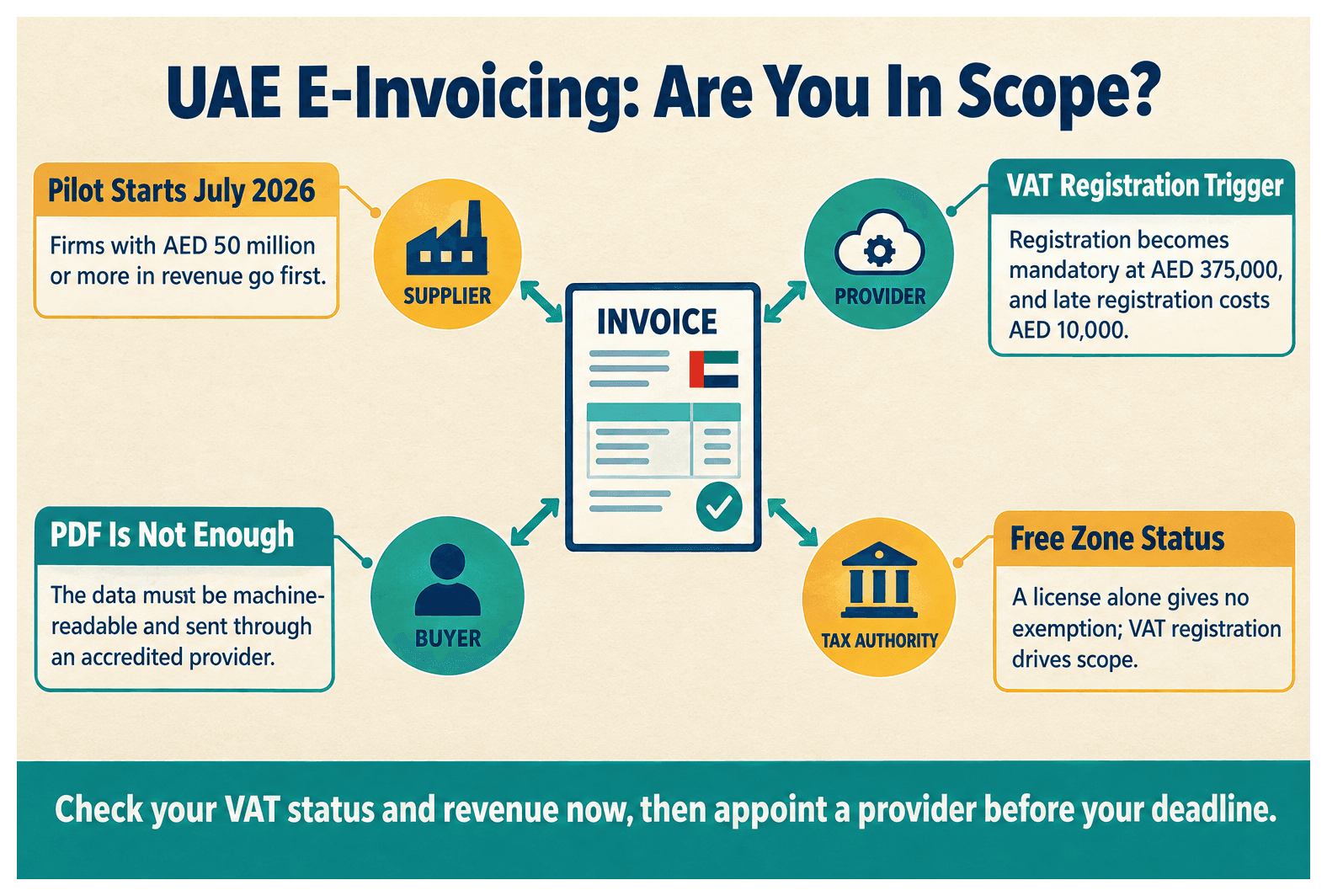
In scope are VAT-registered businesses making taxable B2B and B2G supplies, phased by annual revenue. Larger businesses (AED 50 million or more) go first. Smaller ones follow later. Check your category against the latest Ministry of Finance decisions.
Revenue Thresholds and Phased Deadlines
AED 50 million or more: earlier appointment and go-live window.
Below that: later window, currently mid-2027.
Government entities: separate timeline.
A Dubai South logistics firm with AED 60 million revenue appoints a provider before a smaller consulting firm next door. Dates can change, so recheck the portal.
In Scope Versus Exempt Under UAE E-Invoicing
Feature | In Scope | Exempt |
|---|---|---|
VAT-registered businesses making B2B supplies | Structured invoices through an accredited provider, phased by revenue | No general exemption once VAT-registered |
B2G supplies to government entities | Covered in the first mandate, with credit notes in the same format | Only the government buyer's sovereign activity is carved out |
Free zone companies with VAT registration | In scope for covered B2B and B2G supplies | A license alone gives no exemption |
Government entities in sovereign activities | Commercial activities may fall in scope | Sovereign functions are outside the mandate |
Individuals not carrying on a business | Only if they run a business that makes taxable supplies | Private sales, such as a personal car, are outside scope |
Transaction Types Covered: B2B and B2G
B2B and B2G supplies come first. B2C is handled differently, so confirm its current status. A free zone IT company invoicing a mainland client is covered; a walk-in retail sale isn't treated the same way.
Why Registration Status Is the Trigger
VAT registration drives scope, not license type. Registration is mandatory above AED 375,000 and voluntary from AED 187,500, and late registration costs AED 10,000 (Federal Tax Authority). Once you cross the line, the e-invoicing UAE preparation timeline applies to you.
Who Is Exempt From UAE E-Invoicing: Who Is In Scope and Who Is Exempt
Exempt categories include government entities acting in a sovereign capacity, diplomatic and international organisations, individuals not carrying on a business, and certain financial services. Exemption covers named categories only. A free zone license alone doesn't qualify.
Named Exempt Categories
Sovereign government activity.
Diplomatic missions and international organisations.
Individuals outside business activity.
Certain financial services (check the decision's exact wording).
Common Misreadings of Exemption
Zero-rated supplies aren't automatically outside the system. A free zone company making zero-rated exports still needs a compliant structured invoice where its supplies are covered. Free zone status shapes corporate tax treatment (see corporate tax exemptions in the UAE), not e-invoicing exemption.
Practical Actions to Get Your Dubai South Company UAE E-Invoicing Ready
Confirm VAT status and revenue tier, choose an accredited provider, check your accounting system outputs structured data, clean tax details, test during the pilot and train staff. Finish before your appointment deadline.
Confirm status. Check your TRN on the FTA portal. A founder with AED 8 million revenue confirms the later phase.
Select a provider. Use only Ministry of Finance accredited providers. Compare ERP integration and service levels.
Prepare and test. Standardise customer names and TRNs. One finance manager ran 20 test invoices and fixed missing TRN fields before go-live. Keep records for five years (see tax invoice retention period).
How Free Zone Companies in Dubai South Fit Into UAE E-Invoicing: Who Is In Scope and Who Is Exempt
Dubai South free zone companies are in scope when VAT-registered and making covered B2B or B2G supplies. Treatment depends on registration, designated zone status for goods and customer type. Check each revenue stream separately.
Free Zone License Versus VAT Registration
These are separate questions. Designated zone rules affect VAT on goods, not scope. A Dubai South Business Hub company selling services to a mainland client issues a structured invoice carrying the 5% standard VAT rate once it is in scope.
Mainland Clients and Cross-Border Sales
Mainland buyers will expect compliant invoices. One consultancy lost a procurement tender because it couldn't send them. Read how a free zone company can invoice mainland clients. Corporate tax (9% on non-qualifying income) is a separate matter.
Risks of Misjudging Your UAE E-Invoicing Scope and How to Avoid Them
Misjudging scope risks penalties, rejected invoices, delayed payments and input tax disputes. Check official decisions, document your reasoning, review scope yearly and confirm doubtful cases with the FTA.
A buyer's platform rejects invoices, delaying AED 400,000 in receivables.
Late VAT registration costs AED 10,000.
Revisit your revenue tier each year; crossing AED 50 million moves you to the earlier phase.
Next Steps for Your Dubai South Company
UAE e-invoicing: who is in scope and who is exempt comes down to VAT registration, revenue tier and customer type. Only named categories are exempt. Review your VAT status now, shortlist an accredited provider, and speak to the Dubai South Business Hub team about setting up or reviewing your free zone company.
References
Frequently Asked Questions