Topic Summary
What Is a Good Standing Certificate and When Do You Need One and Why It Matters
A good standing certificate is an official document issued by a company's registering authority confirming the business is validly registered, holds a current license, and has no outstanding compliance breaches. You need one when banks, overseas regulators, tenderers, or partners ask for proof your company is active and lawful.
When Do You Need a Good Standing Certificate: Common Triggers
When Do You Need a Good Standing Certificate: Common Triggers
How a Good Standing Certificate Differs From Other Company Documents
A good standing certificate confirms current compliance, while a certificate of incorporation proves the company was formed, and a certificate of incumbency names current directors. A trade license shows permitted activities. Each answers a different question, so counterparties often request several together.
Steps to Obtain and Use Your Good Standing Certificate
To obtain a good standing certificate, confirm your license is active, clear dues, submit a request to your registering authority, pay the fee, and attest the result if the receiving country requires it. Confirm current fees and timelines with your free zone authority.
What You Need Before Requesting a Good Standing Certificate in Dubai South
Before requesting a good standing certificate in Dubai South, you need a valid trade license, up-to-date company details, cleared fees, and an authorised signatory. Keeping renewal documents to hand avoids rejections from mismatched information.
Common Mistakes That Delay a Good Standing Certificate
The most common delays come from expired licenses, unpaid fees, mismatched details, missing attestation, and ordering too early so the certificate expires before use. Check the recipient's requirements first.
Next Steps on a Good Standing Certificate and When Do You Need One
Understanding a good standing certificate and when do you need one helps you avoid delays with banks, regulators, and partners. Keep your license active, fees cleared, and records consistent.
More than 750,000 commercial licenses were active across the UAE in 2024 (Ministry of Economy, 2024), yet many founders learn only at the last minute that banks and overseas partners want proof of status. This guide explains a good standing certificate and when do you need one, so Dubai South founders can request it before a deal stalls.
What Is a Good Standing Certificate and When Do You Need One and Why It Matters
A good standing certificate is an official document issued by a company's registering authority confirming the business is validly registered, holds a current license, and has no outstanding compliance breaches. You need one when banks, overseas regulators, tenderers, or partners ask for proof your company is active and lawful.
What the Certificate Actually Confirms
It confirms the company exists, the license isn't suspended or expired, and the authority has no unpaid fines on record. But it's a snapshot. Picture a Dubai South trading company whose UK supplier wants proof of activity before approving credit terms. The certificate answers that question on the issue date, and nothing beyond it.
For a wider view, see our guide to a certificate of good standing for a UAE company.
Why Counterparties Ask for It
It reduces fraud and due diligence risk.
It supports KYC (know your customer) onboarding at banks.
It reassures overseas regulators on cross-border dealings.
A foreign bank opening a corresponding account will often ask for it first. The UAE Central Bank's anti-money laundering framework is one reason banks keep tightening onboarding checks.
When Do You Need a Good Standing Certificate: Common Triggers
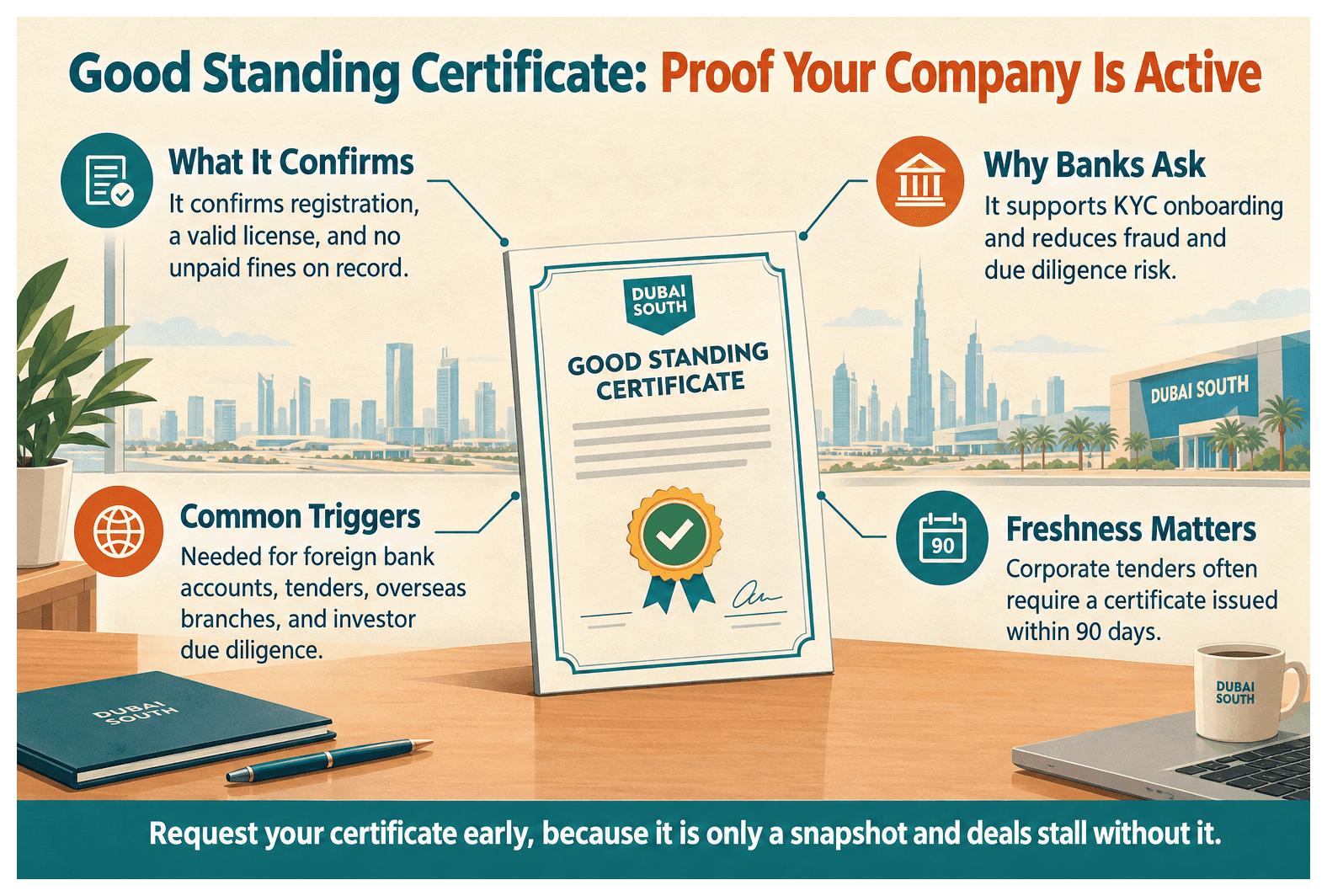
You typically need a good standing certificate when opening foreign bank accounts, entering international contracts, bidding on tenders, registering a branch abroad, applying for overseas licenses, or completing investment due diligence. Any party outside your registering authority may request it.
Banking and Financing Requests
Account opening and KYC refreshes
Credit and trade finance applications
Investor closing checklists
One founder raising seed funding found the investor's lawyers listed it as a closing condition. It delayed signing by a week.
Good Standing Certificate Compared With Other Company Documents
Feature | What It Confirms | Typical Use |
|---|---|---|
Certificate of good standing | Current registration, valid license, no recorded breaches | Bank onboarding, tenders, overseas filings |
Certificate of incorporation | The company was formed on a set date | Proof of formation for banks and partners |
Certificate of incumbency | Current directors and officers | Showing who can sign contracts |
Trade license copy | Permitted activities and license validity | Contracts, visas, supplier onboarding |
Company ownership certificate | Who holds the shares | Share transfers, due diligence |
Cross-Border Contracts and Overseas Registrations
A Dubai South logistics firm registering a branch abroad will usually face a demand for a recent certificate. Joint ventures and distribution agreements trigger the same request.
Tenders, Audits, and Due Diligence
Corporate tenders often require a certificate issued within 90 days. Mergers and share transfers do too. Knowing a good standing certificate and when do you need one keeps these deadlines manageable.
How a Good Standing Certificate Differs From Other Company Documents
A good standing certificate confirms current compliance, while a certificate of incorporation proves the company was formed, and a certificate of incumbency names current directors. A trade license shows permitted activities. Each answers a different question, so counterparties often request several together.
Good Standing vs Certificate of Incorporation
Incorporation is a one-time historical record. Good standing reflects present status. A bank may accept your certificate of incorporation in the UAE as formation proof, then still ask for good standing.
Good Standing vs Incumbency and Trade License
Incumbency shows who can sign.
The license lists activities and validity.
Bundle all three for overseas contracts.
A certificate of incumbency in the UAE pairs naturally with your Dubai South license copy.
Steps to Obtain and Use Your Good Standing Certificate
To obtain a good standing certificate, confirm your license is active, clear dues, submit a request to your registering authority, pay the fee, and attest the result if the receiving country requires it. Confirm current fees and timelines with your free zone authority.
Step 1: Confirm Your License and Dues Are Current
An expired license blocks issuance until renewal is done. Review the Dubai South license renewal process first, and settle any fines.
Step 2: Submit the Request and Pay the Fee
Apply through your account manager with license details, authorised signatory information, and the purpose of the request.
Step 3: Attest and Deliver the Document
Check whether the destination requires attestation. Over 85% of UAE visa, license and court filings need an attested document (u.ae, 2026). Mind the 30 to 90 day validity window, because a certificate that expires mid-attestation forces a second request.
What You Need Before Requesting a Good Standing Certificate in Dubai South
Before requesting a good standing certificate in Dubai South, you need a valid trade license, up-to-date company details, cleared fees, and an authorised signatory. Keeping renewal documents to hand avoids rejections from mismatched information.
Documents and Details to Prepare
Trade license and license number
Signatory's passport and Emirates ID
Receiving party and purpose
Renewal receipts and paid-fee proof
Keeping Your Company Active and Compliant
Renew before expiry and keep establishment card records tidy. A missed Federal Tax Authority deadline carries at least AED 10,000 in penalty exposure (Federal Tax Authority, 2026). Here's my view: treat the certificate as a compliance health check, not a paperwork chore.
Common Mistakes That Delay a Good Standing Certificate
The most common delays come from expired licenses, unpaid fees, mismatched details, missing attestation, and ordering too early so the certificate expires before use. Check the recipient's requirements first.
Timing and Validity Errors
Ordering too early
Ignoring the recipient's age limit
Skipping attestation lead time
Data and Compliance Gaps
One bank rejected a pack because the company name differed slightly across documents. Unpaid renewals and a missing company ownership certificate in the UAE cause similar delays.
Next Steps on a Good Standing Certificate and When Do You Need One
Understanding a good standing certificate and when do you need one helps you avoid delays with banks, regulators, and partners. Keep your license active, fees cleared, and records consistent.
Speak with the Dubai South Business Hub team to confirm your license is current and get your documents ready before your next bank, tender, or cross-border deal.
References
Frequently Asked Questions