Import and Export Between Australia and Dubai: License and Process

Topic Summary
Connect Australia and Dubai Markets
A Dubai trading company can support sales, distribution or re-export coordination when its licensed activities cover the goods. Free zone status does not remove customs obligations.
Match Your License to Goods
List products and sales channels before choosing trade activities. Regulated goods may require additional permissions beyond company formation and license issuance.
Verify HS Codes Before Shipping
Classification depends on factors such as a product’s material, function and composition. Confirm uncertain codes because they can affect duties, restrictions and declarations.
Keep Shipping Documents Consistent
Align the commercial invoice, packing list, origin records and transport documents on goods, quantities, origin and value. Inconsistent figures can delay clearance.
Follow Five Steps to Trade
Confirm the product and route, establish suitable license activities, check codes and permits, prepare documents, and coordinate freight and clearance. Keep Australian export and UAE import records aligned.
Plan Customs and Freight Early
Confirm the importer of record, customs declaration responsibilities and delivery arrangements before dispatch. Al Maktoum International Airport’s planned cargo capacity is up to 12 million tonnes annually at full development.
Check Compliance Before Dispatch
Review applicable Australian export and UAE import requirements, including product approvals and customs registration where required. Registration does not guarantee approval.
Al Maktoum International Airport’s planned cargo capacity is up to 12 million tonnes annually at full development, according to Dubai Airports. For Australian businesses, import export australia dubai planning starts with the correct license activity, goods classification and route. This guide explains how to establish a Dubai South Business Hub Free Zone (DSBH) trading company, prepare customs documents and coordinate freight. You’ll also see which Australian and UAE compliance questions to check before dispatch.
What Is Import and Export Between Australia and Dubai and Why It Matters
Import and export between Australia and Dubai means moving or selling goods across markets under applicable licensing, customs and tax rules. A DSBH company may conduct eligible trade activities, but its free zone status doesn’t remove customs obligations or authorize activities outside its license.
Connect the Two Markets With a Trading Company
Separate the licensed business activity from the shipment route. An Australian exporter of packaged goods, for example, can arrange delivery to a UAE buyer through a Dubai company licensed for the relevant goods. See this Australia-UAE trade and routes guide for route planning.
Decide When a Dubai Entity Fits
A Melbourne homewares seller could hold stock for UAE buyers through an Australian Dubai trading company, subject to license scope and customs arrangements. This model may also suit distribution or re-export coordination. Consider the wider company setup route from Australia.
How to Choose a License and Set Up Your Trading Company
Choose a Dubai trade license with activities matching the goods you plan to import, export or trade. Company formation and license issuance are separate from shipment approvals and product-specific permits.
Match Licensed Activities to Your Goods
List products and sales channels first. A coffee trader should confirm the activity covers coffee, rather than assume a broad description is enough. Regulated goods may need extra permissions. Review the import export license in Dubai guidance before selecting activities.
Prepare Company and Customs Details
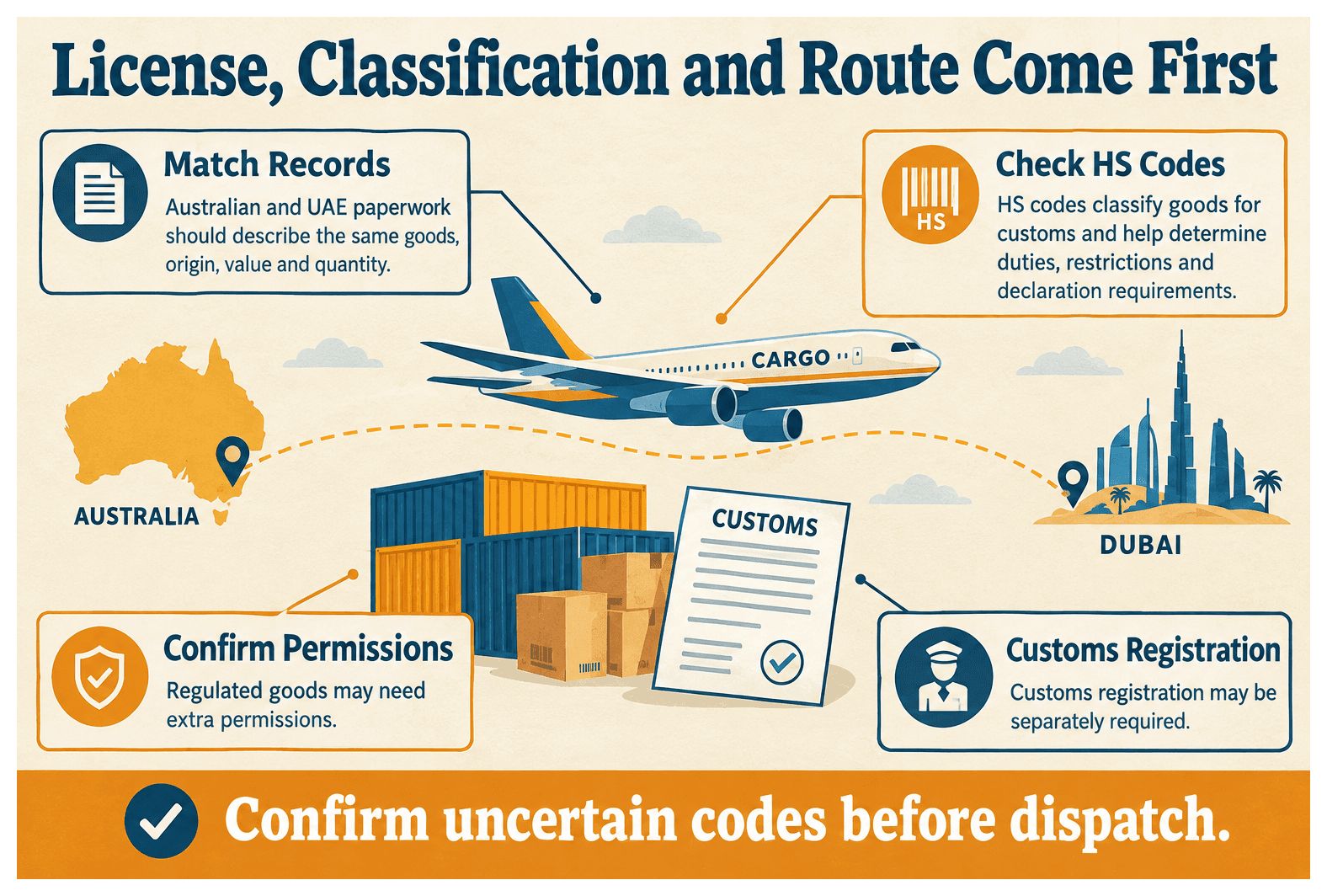
Keep ownership details, license activities and product lists consistent. Customs registration may be separately required. ICP means the Federal Authority for Identity, Citizenship, Customs and Port Security; check its official customs information. Registration doesn’t guarantee approval.
Which HS Codes and Shipping Documents Should You Prepare
HS codes classify goods for customs and help determine duties, restrictions and declaration requirements. Australian and UAE paperwork should describe the same goods, origin, value and quantity.
Check Classification, Origin and Product Rules
Classification depends on material, function and composition. The international HS headings use six digits, with national tariff detail added beyond that level. A stainless-steel drink bottle may classify differently from an insulated, mixed-material bottle. Confirm uncertain codes before dispatch.
Align Commercial and Transport Records
Commercial invoice and packing list.
Bill of lading or air waybill.
Certificate of origin, where applicable.
Product certificates or approvals, if required.
If the invoice lists 500 units but the packing list shows 480, the discrepancy may delay clearance.
How to Complete Import Export Australia Dubai in Five Steps
Complete import export australia dubai operations by confirming the product and route, licensing activities, checking codes and permits, preparing documents, then coordinating freight and clearance. Keep Australian export and UAE import records aligned.
Confirm seller, buyer, origin, destination and whether goods will be re-exported.
Set up the DSBH company and confirm activities before signing contracts.
Verify HS codes, duty treatment and product approvals with a broker or authority.
Match invoice, packing list, origin records and transport documents.
Agree the importer of record, declaration and delivery responsibilities.
A Sydney-to-Dubai delivery requires different planning from a Sydney-to-Dubai-to-third-market re-export. Food products may need extra documentation.
How to Plan Customs and Al Maktoum Logistics
Choose logistics based on cargo, timing, cost and destination, not airport proximity alone. Confirm carrier availability, customs arrangements and onward transport with your freight forwarder. Al Maktoum logistics planning should reflect current services, not only long-term capacity projections.
Air Freight and Sea Freight for Australia–Dubai Trade
Feature | Air Freight | Sea Freight |
|---|---|---|
Typical shipment use | Urgent samples or compact orders | Large, less urgent stock orders |
Transit-time considerations | Usually faster; verify carrier schedules | Allow for sailing and port handling |
Cargo size and handling | Cartons; check size and weight limits | Pallets or containers; plan unloading |
Freight-cost considerations | Compare chargeable weight with urgency | Compare volume, port and handling charges |
Customs and delivery planning | Arrange airport clearance and final-mile delivery | Plan port clearance, storage and truck delivery |
How to Manage Australian and UAE Compliance
A Dubai trading company doesn’t automatically remove Australian tax or reporting duties. Review ATO obligations and ASIC requirements based on your structure, control and income flows.
Check Tax and Treaty Questions
UAE Federal Decree-Law No. 47 of 2022 sets the corporate tax framework. Ask an adviser and the Federal Tax Authority (FTA) how current rules apply. The UAE-Australia Double Tax Treaty doesn’t automatically eliminate tax. An Australian resident founder should get advice on their existing entity and personal circumstances.
What Setup, Customs and Residency Details Should You Confirm
Before launch, confirm license scope, customs registration, route, documents and cross-border tax treatment. Residency packages are linked to a company license and subject to eligibility and processing requirements.
Use a Pre-Launch Checklist for the First Shipment
Confirm license activities and product permissions.
Verify HS codes, importer details and customs documents.
Agree freight, arrival handling and delivery.
Check visa allocation with GDRFA, the General Directorate of Residency and Foreigners Affairs; verify identity and Emirates ID steps with ICP.
Don’t book until classification and buyer details are settled. Australian founders can review setting up a Dubai company from Australia, then use the Business Activities and Cost Calculator to compare setup options.
Import export australia dubai planning works best when license activities, classification, customs paperwork, freight and tax review align before shipment. Confirm shipment-specific requirements with the relevant authorities and advisers, then prepare your first consignment.
References
import-and-export-between-australia-and-dubai-license-and-process