
Topic Summary
What Is UAE VAT for Food Business and Why It Matters
UAE VAT for food business is a 5% consumption tax charged on most food and beverage supplies. You collect it from customers and remit it to the Federal Tax Authority (FTA). Registration is mandatory above AED 375,000 and voluntary from AED 187,500 [1].
Zero Rated VAT UAE for Staples Versus Standard-Rated Catering
Zero Rated VAT UAE for Staples Versus Standard-Rated Catering
Step-by-Step VAT Registration Food Business Process
VAT registration food business applications are filed on the FTA EmaraTax portal. You create an account, declare taxable supplies, upload your documents, submit, and receive a Tax Registration Number (TRN) once approved. Timelines vary, so check the FTA for current processing times.
Input VAT Recovery and Tax Invoice Regulations in the UAE
Food businesses recover input VAT on ingredients, equipment, rent and services used for taxable or zero-rated sales, provided they hold valid tax invoices. Missing details, entertainment spend and blocked items can sink a claim. Documentation discipline protects cash flow.
Cost Comparison for UAE VAT Compliance in a Food Business
VAT compliance costs depend on registration support, accounting software and filing frequency. Government penalties are fixed, while advisory and bookkeeping fees vary by volume. Verify dated figures on the FTA site before budgeting [1].
Common Mistakes and What Should You Do Next to Start Compliant VAT Reporting
Common errors include charging 5% on zero-rated exports, treating all food as zero-rated, missing AED 375,000 and issuing incomplete invoices. Next, classify every product line, register on EmaraTax if required, configure your POS and set a filing calendar.
Bringing It Together
UAE VAT for food business comes down to correct classification: 5% on most food service and catering, 0% on qualifying supplies like exports, and registration above AED 375,000. Accurate invoices and timely returns protect margins. Estimate your costs with the cost calculator, check your company name, and speak to Dubai South Business Hub about a VAT-ready free zone structure.
In 2026, UAE VAT for food business means 5% on most supplies, with registration mandatory above AED 375,000 in taxable supplies over 12 months [1]. Restaurant and catering services are generally standard-rated, while qualifying exports are taxed at 0% [2]. More than 350,000 businesses are VAT-registered in the UAE [1], and food operators are exposed because one menu can mix several tax treatments.
This guide is for finance and operations staff. You'll learn how to classify supplies, register, file, budget and avoid penalties.
What Is UAE VAT for Food Business and Why It Matters
UAE VAT for food business is a 5% consumption tax charged on most food and beverage supplies. You collect it from customers and remit it to the Federal Tax Authority (FTA). Registration is mandatory above AED 375,000 and voluntary from AED 187,500 [1].
How the 5% Standard Rate Applies to Food Supplies
VAT is charged at each supply stage, and you recover it as input tax. Restaurants, cafes, cloud kitchens and caterers all charge 5% on sales. Prices shown to consumers must be VAT-inclusive.
Take a Dubai cafe selling AED 105 of coffee and pastries. It collects AED 5 VAT, then remits that to the FTA after deducting its own input VAT.
Zero-Rated, Standard-Rated and Exempt Food Supplies Compared
Feature | Zero-Rated Supplies (0%) | Standard-Rated Supplies (5%) |
|---|---|---|
VAT rate charged | 0% on the invoice, still reported on the return | 5% added to the taxable value |
Typical food examples | Packaged goods exported outside the GCC implementing states | Dine-in meals, takeaway, delivery, event catering |
Input VAT recovery | Fully recoverable | Fully recoverable, subject to valid invoices |
Invoice treatment | Tax invoice showing 0% and export evidence on file | Tax invoice showing the VAT amount in AED |
Registration threshold impact (AED 375,000) | Counts toward the threshold, so exporters still register | Counts toward the threshold |
Registration Thresholds for Food Operators
Mandatory at AED 375,000 over the past 12 months or expected within 30 days.
Voluntary at AED 187,500 in supplies or expenses.
Late registration costs AED 10,000 (FTA, 2026).
A catering startup forecasting AED 400,000 from one corporate contract must register within 30 days. For process detail, see the UAE VAT registration guide.
Why Food Businesses Face Higher Classification Risk
Mixed menus, heavy input VAT on rent and equipment, and thin margins make errors costly. A grocery-restaurant hybrid, for instance, must split retail sales from dine-in sales on one till system. Penalties are assessed per filing cycle, so one bad setting repeats every quarter.
Zero Rated VAT UAE for Staples Versus Standard-Rated Catering
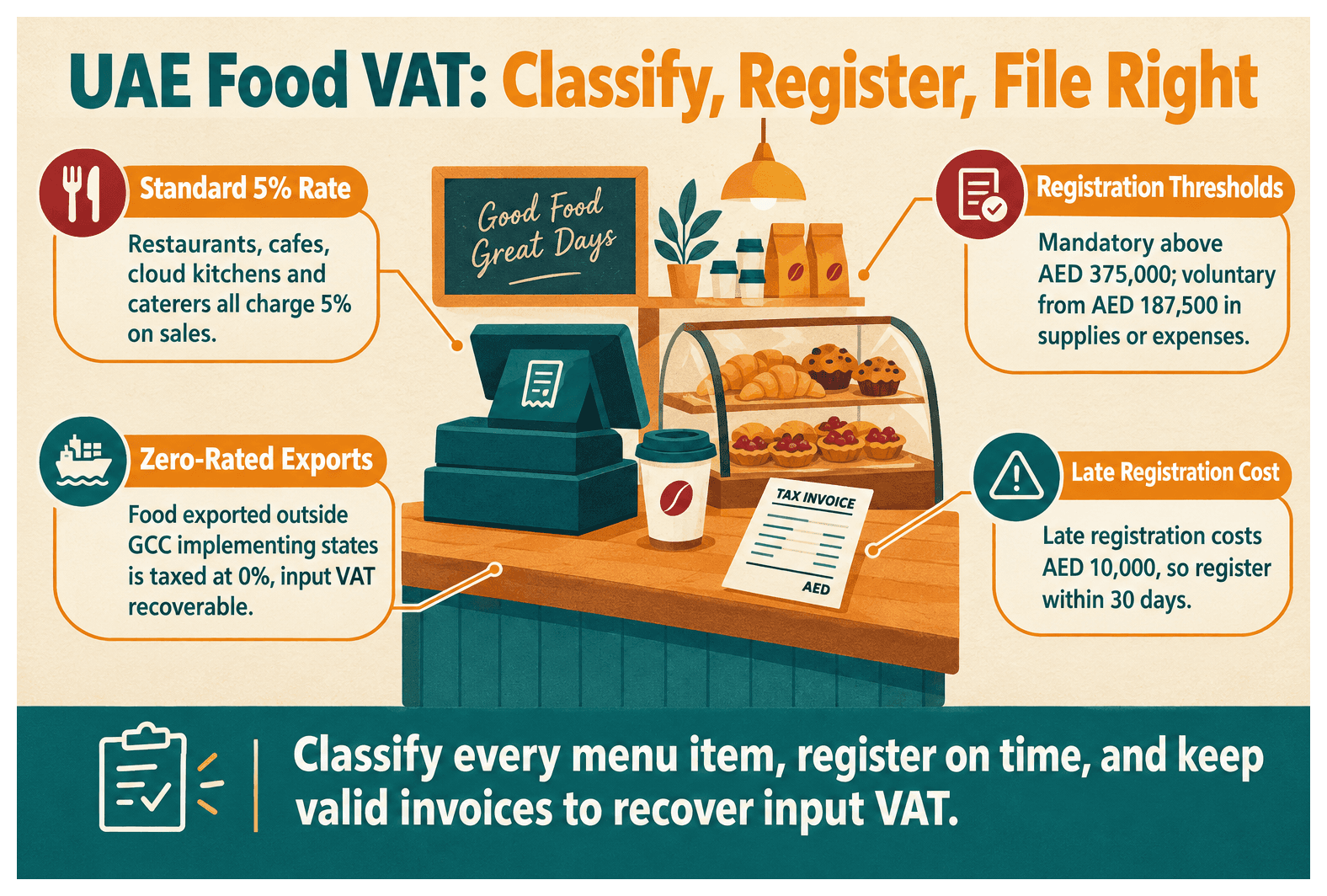
Zero rated VAT UAE treatment applies to specific supplies such as exports, taxed at 0% with input VAT still recoverable [2]. Restaurant meals, catering and takeaway are generally standard-rated at 5%. Confirm each product line against current FTA guidance before setting prices.
Which Food Supplies Qualify for Zero Rating
Exports of food outside the GCC implementing states.
International transport of goods.
Zero-rated is not exempt: input VAT stays recoverable.
Keep export evidence for 5 years.
Here's my contrarian view: don't assume basic staples are zero-rated domestically. Under Federal Decree-Law No. 8 of 2017, most local food sales carry 5%. A Dubai South trader exporting packaged goods to a buyer outside the GCC charges 0% and reclaims input VAT. Importers should also review food import registration and labelling rules.
Why Restaurants and Catering Are Standard-Rated
Dine-in, takeaway, delivery and event catering all carry 5%. Service charges and delivery fees form part of the taxable value. Bundled meal deals take the standard rate on the whole bundle unless you split it fairly. A wedding caterer invoicing AED 20,000 adds AED 1,000 VAT.
Step-by-Step VAT Registration Food Business Process
VAT registration food business applications are filed on the FTA EmaraTax portal. You create an account, declare taxable supplies, upload your documents, submit, and receive a Tax Registration Number (TRN) once approved. Timelines vary, so check the FTA for current processing times.
Step 1: Prepare Your Documents
Trade license, passport and Emirates ID of owners.
Turnover evidence for the last 12 months.
Bank details and contact information.
A cloud kitchen would compile 12 months of delivery platform statements.
Step 2: Submit on EmaraTax
Create the taxable person account.
Declare expected supplies by category.
Review everything before submitting.
A restaurant group should declare dine-in, delivery and catering revenue separately.
Step 3: Set Up Invoicing and Filing Calendar
Configure POS and accounting software for 5%.
Diarise quarterly or monthly returns.
File and pay within 28 days of period end.
One bakery chain sets a reminder 7 days before each deadline. Our guide on VAT return filing for Dubai companies covers the rest.
Input VAT Recovery and Tax Invoice Regulations in the UAE
Food businesses recover input VAT on ingredients, equipment, rent and services used for taxable or zero-rated sales, provided they hold valid tax invoices. Missing details, entertainment spend and blocked items can sink a claim. Documentation discipline protects cash flow.
What Input VAT Food Businesses Can Claim
Ingredients, packaging, kitchen equipment and utilities.
Fit-out costs: AED 200,000 at 5% gives AED 10,000 recoverable.
Apportioned amounts when some supplies are exempt.
Read how to claim input VAT back before your first return.
Tax Invoice Details You Must Show
The words "Tax Invoice", supplier TRN and date.
Description, and VAT amount in AED.
Simplified invoices for small retail sales.
Records kept for 5 years.
A supplier invoice missing a TRN can be rejected in an audit. Learn to issue a correct tax invoice first time.
Cost Comparison for UAE VAT Compliance in a Food Business
VAT compliance costs depend on registration support, accounting software and filing frequency. Government penalties are fixed, while advisory and bookkeeping fees vary by volume. Verify dated figures on the FTA site before budgeting [1].
Penalties and Fixed Government Charges
Item | Amount (as of 2026) |
|---|---|
Late registration | AED 10,000 |
Late return filing (first offence) | AED 1,000 |
Late return filing (repeat within 24 months) | AED 2,000 |
A cafe registering 60 days late pays AED 10,000 before any return penalties. Confirm figures with the FTA, as the Ministry of Finance publishes updates [3].
Budgeting for Setup Alongside VAT
Combine license, visa and tax budgets from day one. Run numbers through the cost calculator and check availability with the company name check before applying.
Common Mistakes and What Should You Do Next to Start Compliant VAT Reporting
Common errors include charging 5% on zero-rated exports, treating all food as zero-rated, missing AED 375,000 and issuing incomplete invoices. Next, classify every product line, register on EmaraTax if required, configure your POS and set a filing calendar.
Mistakes That Trigger FTA Penalties
Wrong rate on mixed menus.
Late registration or filing.
Claiming blocked input VAT.
Poor record keeping.
Picture a caterer who ignores a large contract and crosses AED 375,000 unregistered. That's an AED 10,000 penalty waiting to happen.
Next Steps With a Dubai South Business Hub License
Form a free zone company, then register for VAT once thresholds are met. Free zone status doesn't remove VAT obligations. A food trader could obtain a Dubai South license, with residency visa packages tied to it, then register before its first large sale. Start with the food and beverages wholesale trading license.
Bringing It Together
UAE VAT for food business comes down to correct classification: 5% on most food service and catering, 0% on qualifying supplies like exports, and registration above AED 375,000. Accurate invoices and timely returns protect margins. Estimate your costs with the cost calculator, check your company name, and speak to Dubai South Business Hub about a VAT-ready free zone structure.
References
Federal Tax Authority, VAT registration and penalties, 2026.
Federal Tax Authority, Federal Decree-Law No. 8 of 2017 guidance, 2025.
UAE Ministry of Finance, tax legislation updates, 2026.
Frequently Asked Questions


