
Topic Summary
What Is AML Screening at UAE Banks and Why It Matters
AML screening is the process UAE banks use to check a company, its owners, directors and signatories against sanctions lists, PEP databases and adverse media before opening an account. It flags money-laundering and terrorist-financing risk early and sets the risk rating that governs future monitoring.
Which Regulators and Regulations in the UAE Drive AML Screening
Which Regulators and Regulations in the UAE Drive AML Screening
How PEP Screening in the UAE Works for New Company Accounts
PEP screening in the UAE checks whether a shareholder, director or signatory holds or recently held a prominent public role, or is a close relative or associate of someone who does. A match doesn't block an account, but it triggers enhanced due diligence and senior approval.
Step-by-Step Guide to How Banks Screen a New Account
Banks collect documents, verify identity and ownership, run a sanctions check on the bank account parties plus PEP and media checks, review alerts, assign a risk rating, then approve, escalate or decline. Screening continues after opening.
What a Sanctions Check on a Bank Account Covers
A sanctions check on a bank account screens the company, owners, directors, signatories, and often counterparties and jurisdictions, against UAE and international lists. It covers individuals, entities and vessels, and repeats whenever lists or transactions change.
How Much Does AML Screening Cost and How Long Does It Take
Banks rarely charge a separate fee for aml screening uae banks run, but account opening and minimum balance costs vary. Clean files typically clear within days, while PEP matches or complex structures can stretch to several weeks. Confirm current fees with the bank and note the date quoted.
Which Mistakes Should You Avoid With AML Screening at UAE Banks
The most common mistakes are inconsistent spellings, undisclosed PEP links, vague activity descriptions, missing source-of-funds evidence and unclear ownership. Each creates an alert the bank must resolve. Hiding a PEP connection is the worst: it can end the application.
AML screening is the check a bank runs on a company, its shareholders, directors and signatories against sanctions lists, PEP databases and adverse media. In the UAE, banks apply it at onboarding and re-screen continuously, so a clean file on day one matters.
More than 40 licensed banks operate in the UAE, and the country remains on the FATF regular follow-up list in 2026 [1]. Roughly 40% of first-time founders report a delayed or declined corporate account [2]. This guide shows compliance officers and company managers how aml screening uae banks perform works, and how to prepare a file that clears review.
What Is AML Screening at UAE Banks and Why It Matters
AML screening is the process UAE banks use to check a company, its owners, directors and signatories against sanctions lists, PEP databases and adverse media before opening an account. It flags money-laundering and terrorist-financing risk early and sets the risk rating that governs future monitoring.
Definition of AML Screening in Plain Terms
Screening compares names, dates of birth, nationalities and passport numbers against watchlists. Picture a new Dubai South Business Hub company with two shareholders: the bank screens both individuals, the director, the signatory, then the company name and trading counterparties. A match is an alert for review, not an automatic rejection.
Why Screening Decides Whether Your Account Opens
Many free zone registrations stall at the bank, not at licensing. The screening outcome feeds the risk rating, which drives the documents requested and how often the file is reviewed. A founder with an unexplained news-database name match can wait weeks. See why UAE banks reject corporate account applications for the usual triggers.
How Screening Differs From KYC
KYC collects and verifies identity and business data.
Screening tests that data against risk lists.
Example: passport verified under KYC, then run against the UN Consolidated List.
Both run at onboarding; screening continues afterwards.
Which Regulators and Regulations in the UAE Drive AML Screening
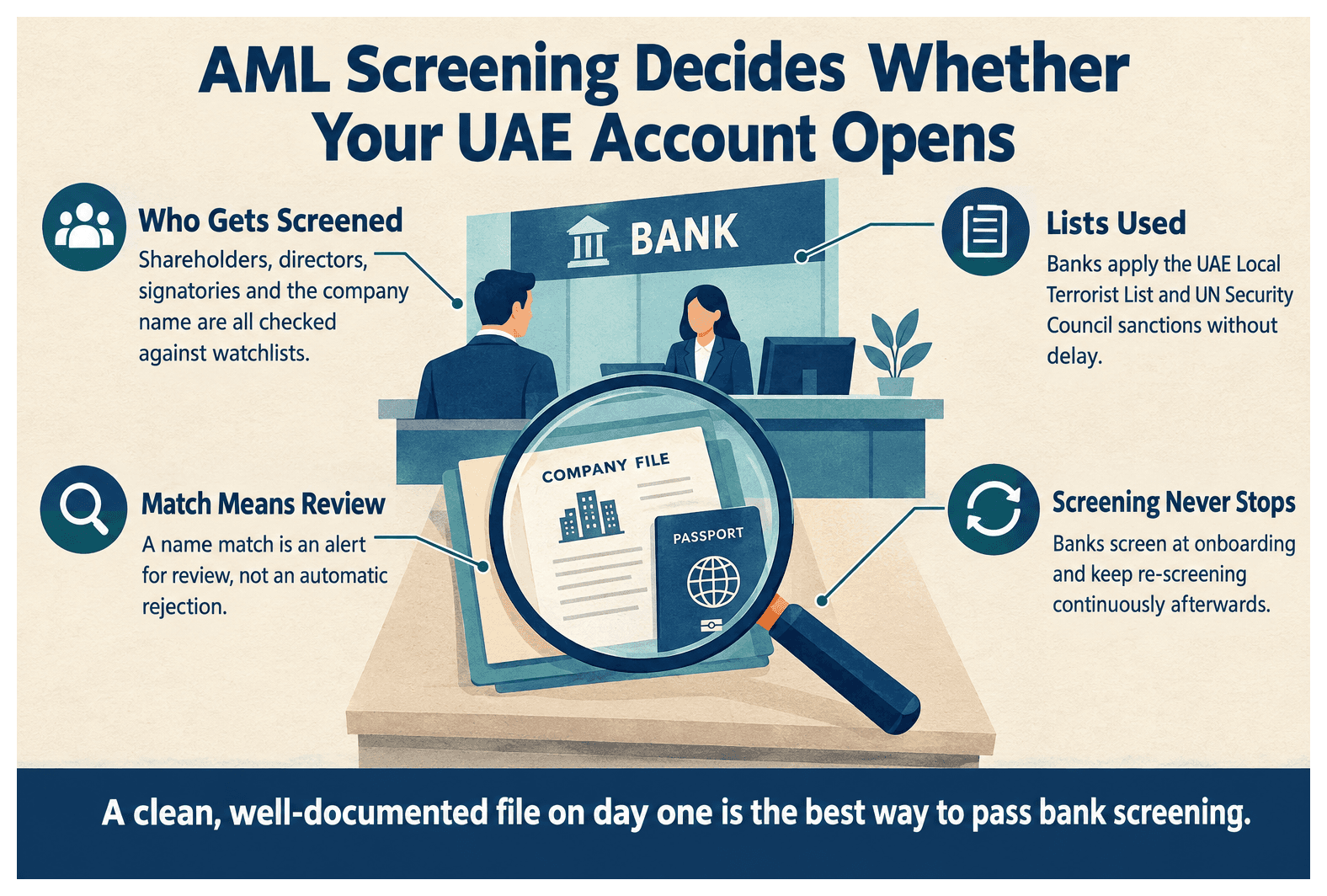
The Central Bank of the UAE supervises bank AML controls, the UAE Financial Intelligence Unit receives suspicious transaction reports through goAML, and the Ministry of Finance oversees designated non-financial businesses. Banks must apply UAE Local Terrorist List and UN Security Council sanctions without delay.
Central Bank and Financial Intelligence Unit Roles
The Central Bank sets and inspects due diligence standards. The FIU has received more than 100,000 suspicious transaction reports through goAML [3]. If a bank finds a sanctions-adjacent counterparty during onboarding review, it files a report.
Lists Banks Screen Against
UAE Local Terrorist List.
UN Security Council Consolidated List.
OFAC, EU and UK lists, applied by bank policy.
Policy can be stricter than law. A bank with USD correspondent relationships screens against OFAC even where UAE law doesn't require it.
What Free Zone Companies Must Understand
Free zones aren't exempt. The framework covers over 40 DNFBP categories, so your own duties may apply. Read AML compliance for a UAE free zone company. A trading company may get a bank questionnaire on its controls.
How PEP Screening in the UAE Works for New Company Accounts
PEP screening in the UAE checks whether a shareholder, director or signatory holds or recently held a prominent public role, or is a close relative or associate of someone who does. A match doesn't block an account, but it triggers enhanced due diligence and senior approval.
Who Counts as a Politically Exposed Person
Senior government, judicial and military officials.
State-owned enterprise executives, domestic or foreign.
Family members and close associates.
A founder whose uncle is a senior official abroad can be flagged as an associate. Details sit in PEP obligations in the UAE.
Enhanced Due Diligence After a PEP Match
Expect source-of-wealth evidence, senior sign-off and tighter reviews, commonly every 12 to 18 months for higher-risk files. One PEP-linked founder explained wealth with audited statements, a sale agreement and tax records.
Handling False Positives Without Delay
Common names and transliteration create false hits. Mohammed versus Muhammad between passport and license is enough to trigger manual review. Supply date of birth, passport and a clarifying letter up front, and keep spelling identical everywhere.
Step-by-Step Guide to How Banks Screen a New Account
Banks collect documents, verify identity and ownership, run a sanctions check on the bank account parties plus PEP and media checks, review alerts, assign a risk rating, then approve, escalate or decline. Screening continues after opening.
Step 1: Submit the Corporate Document Pack
Trade license, articles, share certificate.
Passports, Emirates ID, proof of address.
Submit everything in one batch.
More than 60% of applications stall at document review [2]. See corporate documents for a UAE bank account review.
Step 2: Identify Ultimate Beneficial Owners
Banks look through holdings to individuals. If a holding company owns 100%, they trace the two people behind it. Every UBO and signatory is screened.
Step 3: Run Sanctions, PEP and Adverse Media Checks
Systems screen names, aliases and birth dates automatically. A partial name match generates an alert. The company name and key counterparties may be checked too.
Step 4: Review Alerts and Assign a Risk Rating
An analyst clears or escalates each alert. Nationality, sector, geography, structure and expected turnover set the rating. A cash-intensive or high-risk-jurisdiction trader rates higher.
What a Sanctions Check on a Bank Account Covers
A sanctions check on a bank account screens the company, owners, directors, signatories, and often counterparties and jurisdictions, against UAE and international lists. It covers individuals, entities and vessels, and repeats whenever lists or transactions change.
Parties and Activities Screened
Owners, directors, signatories, UBOs.
Business activity and trade geography.
Supplier and customer names from questionnaires.
A commodities trader's supplier jurisdiction, for instance, prompts extra questions.
AML Screening Outcomes by Risk Level at UAE Banks (Indicative)
Feature | Standard-Risk File | Higher-Risk or PEP-Linked File |
|---|---|---|
Typical onboarding timeline | Several days once the pack is complete | Several weeks, longer with layered structures |
Documents requested | Standard corporate pack, passports, proof of address | Standard pack plus source-of-wealth evidence, audited statements, contracts |
Level of approval needed | Compliance analyst | Senior management sign-off |
Review frequency | Longer cycle set by bank policy | Commonly every 12 to 18 months |
Indicative extra cost in AED (state date quoted) | AED 0 separate screening fee (as of June 2026, confirm with bank) | Document attestation, translation and audit costs vary (as of June 2026, confirm with bank) |
Ongoing Screening After Account Opening
Banks re-screen daily or periodically against updated lists, monitor transactions and screen payments. If a name is added to a sanctions list months later, activity freezes and reporting follows.
Adverse Media and Reputation Checks
Analysts search news and litigation on principals. An old regulatory dispute in a founder's home country usually needs a written explanation. Unresolved allegations can lead to enhanced review [4].
How Much Does AML Screening Cost and How Long Does It Take
Banks rarely charge a separate fee for aml screening uae banks run, but account opening and minimum balance costs vary. Clean files typically clear within days, while PEP matches or complex structures can stretch to several weeks. Confirm current fees with the bank and note the date quoted.
Budgeting for the Full Banking Journey
License and visa costs come before onboarding, plus attestation, translation and notarisation. Map them with the cost calculator before you apply.
Ways to Shorten the Process
Submit a complete pack.
Match names across all documents.
Pre-draft a source-of-wealth letter.
Describe your activity precisely.
Which Mistakes Should You Avoid With AML Screening at UAE Banks
The most common mistakes are inconsistent spellings, undisclosed PEP links, vague activity descriptions, missing source-of-funds evidence and unclear ownership. Each creates an alert the bank must resolve. Hiding a PEP connection is the worst: it can end the application.
Disclosure and Documentation Errors
Omitting a PEP link.
Passport, license and form details that differ.
Listing "general trading" while contracts show a high-risk commodity.
More examples appear in why UAE banks reject new company applications.
Structure and Naming Problems
Opaque offshore layers raise flags. So does a trade name resembling a listed entity, which can trigger repeated alerts. Run the name check before registering.
Treating Screening as a One-Time Event
Share transfers or activity changes must be reported. An unnotified transfer can leave you with a restricted account at review. Answer periodic review requests promptly.
What Should You Do Next to Pass AML Screening at UAE Banks
Prepare a consistent pack, map every beneficial owner, disclose any PEP link and document source of funds before applying. Set up a clean-named Dubai South Business Hub company, then approach the bank with complete evidence and a clear model.
Build a Screening-Ready File Before You Apply
Passports and a UBO chart.
Source-of-funds evidence.
Contracts and a business plan.
Review what UAE banks look for in a startup application.
Set Up the Company With Banking in Mind
Choose a precise activity, verify the name, then register your free zone license and residency package with Dubai South Business Hub.
AML screening at UAE banks is a continuing check on your company and its people. Consistent documents, honest disclosure and clear funds evidence separate fast approvals from stalled files. Plan your spend with the cost calculator, run the name check, and talk to Dubai South Business Hub about a license built for banking.
References
Frequently Asked Questions