
Topic Summary
What Is Emiratisation and Does It Apply to Free Zones in 2026 and Why It Matters
Emiratisation is the UAE policy of raising Emirati participation in private sector skilled roles. In 2026, mandatory quotas hit mainland companies with 50 or more employees. Free zone companies are generally exempt, though authority-specific expectations may apply.
How Emiratisation Targets and Fines Work for Private Employers
How Emiratisation Targets and Fines Work for Private Employers
Where Free Zones Stand on Emiratisation Rules
Free zone companies are generally outside mainland MOHRE quotas because their authority regulates them. Mainland branches and contracts fall under mainland rules, so confirm before hiring.
Steps to Meet Emiratisation Requirements as a New Employer
Confirm your license type, count skilled staff, compare against 10%, register on Nafis, recruit, and keep records current. Free zone firms should confirm authority rules first.
Planning Your Hiring Strategy as a Dubai South Entrepreneur
Forecast headcount, budget for Emirati salaries, and decide early whether you'll stay free zone only. Build compliance into growth plans so emiratisation and does it apply to free zones in 2026 never surprises you at 50 staff.
Common Emiratisation Mistakes Free Zone Founders Make
Founders assume blanket exemption, ignore mainland branches, hire Emiratis on paper, or miss updates. Each leads to fines or audits.
Planning Ahead With Dubai South
Emiratisation and does it apply to free zones in 2026 comes down to jurisdiction. Mainland employers with 50 or more staff face a 10% target and monthly fines. Free zone entities are generally outside those quotas, but verify authority rules and watch mainland exposure.
In 2026, private firms with 50 or more skilled employees must reach a 10% Emirati share, up from 6% in 2024 (MOHRE, 2026). This guide is for Dubai South founders who want to know where they stand and what to do next. Here's the straight answer on emiratisation and does it apply to free zones in 2026.
What Is Emiratisation and Does It Apply to Free Zones in 2026 and Why It Matters
Emiratisation is the UAE policy of raising Emirati participation in private sector skilled roles. In 2026, mandatory quotas hit mainland companies with 50 or more employees. Free zone companies are generally exempt, though authority-specific expectations may apply.
What Emiratisation Means in Plain Terms
It's a national workforce policy driven by MOHRE and Cabinet resolutions, supported by the Nafis programme UAE. It targets skilled roles only. A 60-person mainland consultancy, for instance, must add Emirati hires on a set schedule.
Why Free Zone Founders Should Care Now
Many founders assume free zones sit outside labour policy entirely. A Dubai South trading startup that opens a mainland branch finds that branch is assessed separately, with its own quota.
Who Sets and Enforces the Rules
MOHRE enforces quotas on mainland employers.
Free zone authorities regulate their own licensees.
Compliance checkpoints run quarterly and annually.
Nafis offers incentives and talent pipelines.
How Emiratisation Targets and Fines Work for Private Employers
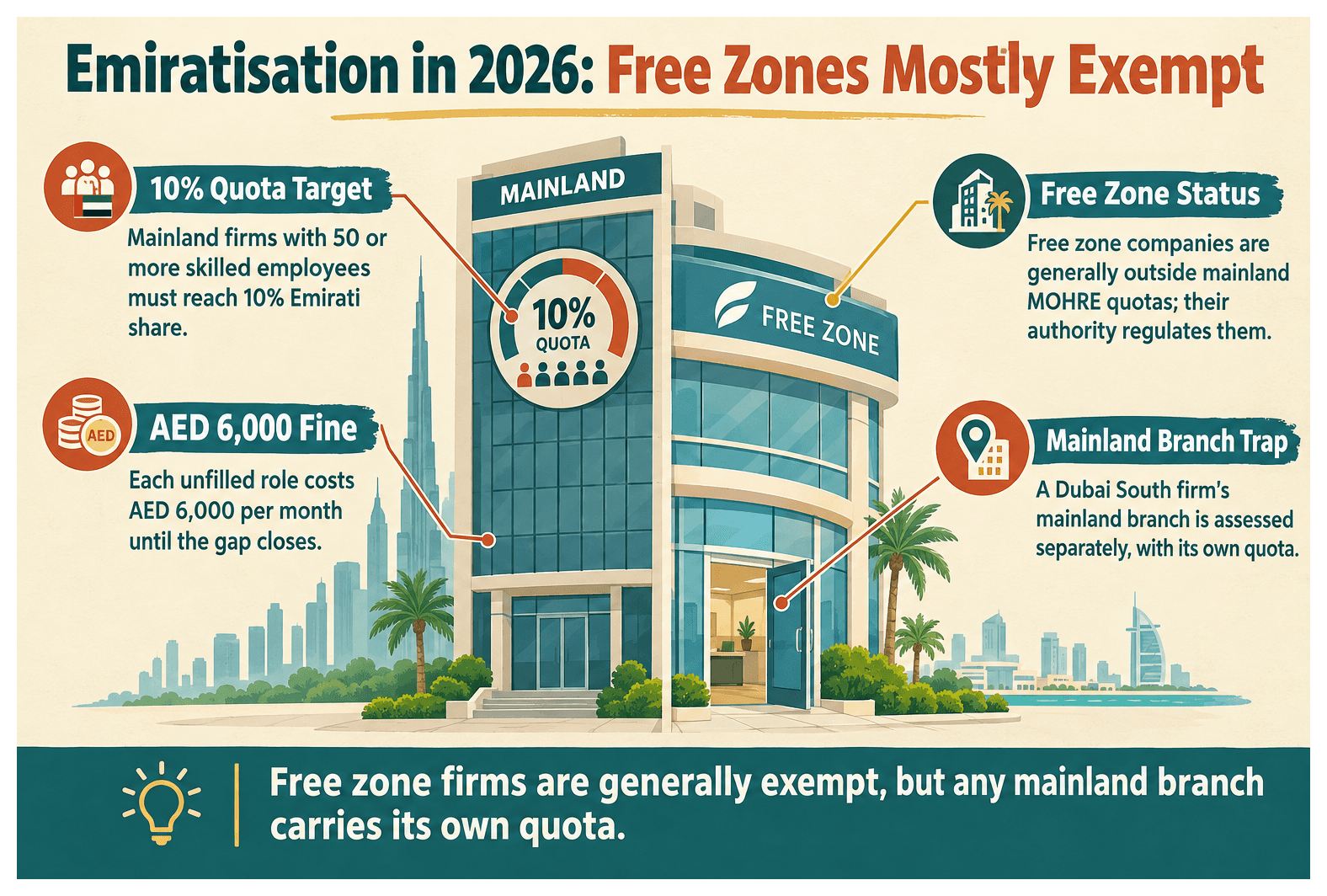
Emiratisation targets require eligible employers to raise Emirati skilled headcount yearly, reaching 10% by 2026. Missing a target costs AED 6,000 per month per unfilled role (UAE Cabinet, 2022).
Annual Targets and the 50-Employee Threshold
Targets rise in half-year steps. A 100-person logistics firm first counts its skilled roles, then applies the percentage. Read the detail in Emiratisation targets in the UAE.
Emiratisation Rules: Free Zone vs Mainland
Feature | Free Zone Company | Mainland Company |
|---|---|---|
Regulating authority | The free zone authority sets its own framework | MOHRE |
Mandatory Emiratisation quota | Generally none | 10% of skilled staff in 2026 |
Fines for unfilled positions | None under the mainland quota | AED 6,000 per role per month |
Nafis programme access | Voluntary hiring support; confirm eligibility | Incentives and talent pipeline for employers |
Impact of crossing 50 employees | No automatic quota, but a mainland branch is assessed separately | Quota applies to skilled headcount |
Fines for Missing Quotas
Fines accrue monthly per unfilled role.
They continue until the gap closes.
Three gaps over 12 months cost AED 216,000.
Fake hiring triggers further penalties.
Verification and Reporting
Employers register Emirati staff in MOHRE systems. Wage Protection System (WPS) files confirm timely pay at contract rates, and mismatched records can trigger audits.
Where Free Zones Stand on Emiratisation Rules
Free zone companies are generally outside mainland MOHRE quotas because their authority regulates them. Mainland branches and contracts fall under mainland rules, so confirm before hiring.
Free Zone Entities Versus Mainland Entities
Over 40 free zones operate across the UAE (u.ae, 2026); see the free zone vs mainland for companies hiring employees comparison. A Dubai South firm with a mainland branch applies quotas only to that branch's headcount.
Voluntary Hiring and Incentives
Nafis offers salary support and training.
Voluntary hiring builds government relationships.
Some tenders favour suppliers with Emirati staff.
Changes That Could Alter Your Position
Targets rose from 6% to 10% between 2024 and 2026, so obligations can shift. Check MOHRE circulars quarterly, especially before passing 50 staff.
Steps to Meet Emiratisation Requirements as a New Employer
Confirm your license type, count skilled staff, compare against 10%, register on Nafis, recruit, and keep records current. Free zone firms should confirm authority rules first.
Step 1: Confirm Your License Jurisdiction
Check free zone or mainland status.
Identify any mainland branches.
Ask your authority about hiring expectations.
Step 2: Count Skilled Roles and Set Your Target
Separate skilled from non-skilled roles.
Apply 10%: 80 skilled roles need eight Emiratis.
Split hires across two half-year windows.
Step 3: Register With Nafis and Source Talent
Create an employer account on Nafis.
Post vacancies and shortlist candidates.
Use training and wage support.
Step 4: Issue Compliant Contracts and Maintain Records
Use written contracts under UAE labour law.
Pay through WPS.
Keep contracts and payslips in one folder.
The Tawteen and Emiratisation portals for employers guide covers the paperwork.
Planning Your Hiring Strategy as a Dubai South Entrepreneur
Forecast headcount, budget for Emirati salaries, and decide early whether you'll stay free zone only. Build compliance into growth plans so emiratisation and does it apply to free zones in 2026 never surprises you at 50 staff.
Budgeting for Emirati Talent
One unfilled role costs AED 72,000 a year in contributions. Model that against an Emirati coordinator's salary, training and benefits.
Choosing Between Free Zone and Mainland Growth Paths
Free zones suit trade and regional services. Open a mainland entity only when local demand justifies it, since quotas follow at 50 employees.
Tax and Compliance Links to Consider
Mainland revenue can affect tax status. The 9% rate applies where Qualifying Free Zone Person conditions aren't met (Federal Tax Authority, 2026). Review labour and tax together once a year.
Common Emiratisation Mistakes Free Zone Founders Make
Founders assume blanket exemption, ignore mainland branches, hire Emiratis on paper, or miss updates. Each leads to fines or audits.
Assuming Blanket Exemption
Exemption follows jurisdiction, not size.
Mainland branches fall under MOHRE.
Get your status confirmed in writing.
Fake Emiratisation Practices
Registering Emiratis without genuine work breaches the rules. MOHRE audits salary and attendance patterns, and flagged employers face penalties.
Missing Policy Updates
Targets doubled in effect from 6% to 10% in two years. Set a quarterly reminder to review circulars.
Planning Ahead With Dubai South
Emiratisation and does it apply to free zones in 2026 comes down to jurisdiction. Mainland employers with 50 or more staff face a 10% target and monthly fines. Free zone entities are generally outside those quotas, but verify authority rules and watch mainland exposure.
Contact Dubai South Business Hub to set up a free zone company with a trade license and residency visa package, and plan your hiring before you grow.
References
Frequently Asked Questions