How to Get a Dry Ice Trading License in Dubai

Topic Summary
Choose the Right Free Zone Location
Dubai South Business Hub Free Zone is the issuing authority for the dry ice trading license under activity code 4690.95. Its proximity to Al Maktoum International Airport and Jebel Ali Port makes it an ideal base for regional distribution.
Understand What the License Permits
The trading license covers import, export, re-export, and local distribution of dry ice across permitted channels. It suits a wide range of business models, from supplying UAE end users to acting as a GCC distribution intermediary.
Budget for Annual License Fees
License fees at Dubai South range from AED 12,000 to AED 20,000 per year depending on the package selected. Processing typically takes just 5 to 10 working days, making setup relatively fast.
Account for Hazardous Material Regulations
Dry ice is classified as a hazardous material under UAE federal law, requiring compliance with rules on handling, storage, and transport. Approvals from UAE transport authorities and civil defence bodies may also be necessary depending on operational scale.
Take Advantage of Free Zone Ownership Benefits
Businesses registered at Dubai South can enjoy 100% foreign ownership and full repatriation of profits. Zero corporate tax on qualifying income adds further commercial appeal for international traders.
Identify the Right Business Profile for This License
The license is well-suited to pharmaceutical and food logistics operators, international traders building a GCC hub, and entrepreneurs entering the cold chain market. Manufacturers' agents formalising UAE operations are also a strong fit.
Leverage Dubai's Cold Chain Infrastructure
The UAE's cold chain logistics sector is growing rapidly, driven by pharmaceutical exports, food trade, and e-commerce demand. Dubai South's location within this ecosystem gives dry ice traders direct access to one of the region's most active supply chain networks.
Dubai's cold chain and logistics boom is creating strong demand for dry ice, making a dry ice trading license one of the more commercially compelling opportunities available at Dubai South Business Hub Free Zone. This guide explains exactly how to obtain a dry ice trading license under activity code 4690.95 at Dubai South, covering costs, compliance steps, and why the UAE is an ideal base for this trade.
Key Stats at a Glance
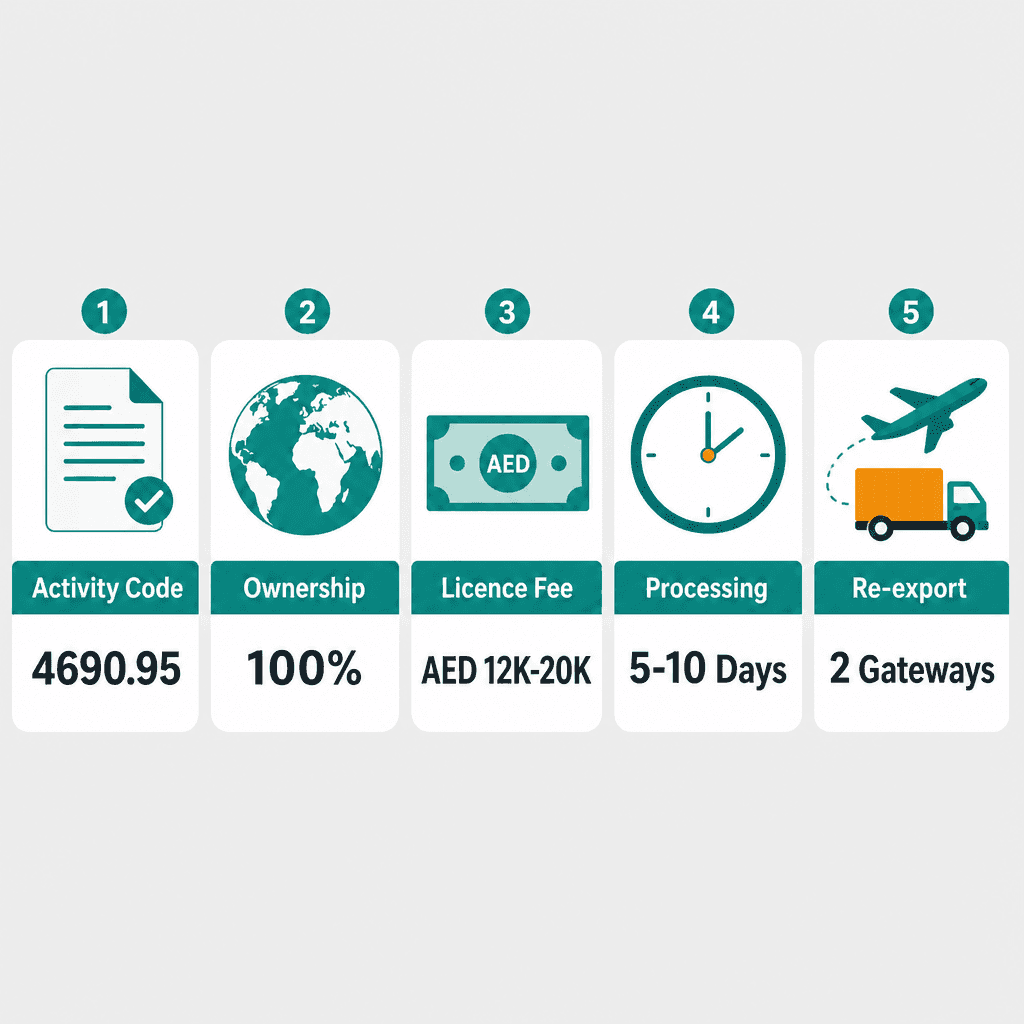
Activity Code: 4690.95
License Type:Trading License
Category: Trading
Issuing Authority: Dubai South Business Hub Free Zone
Foreign Ownership: 100% permitted
License Fee Range:AED 12,000 to AED 20,000 per year (package dependent)
Typical Processing Time: 5 to 10 working days
Re-export: Permitted via Jebel Ali Port and Al Maktoum International Airport
Why Dubai Is Well-Positioned for Dry Ice Trading
The UAE's cold chain logistics sector is expanding at a significant pace, driven by growth in pharmaceutical exports, food trade, and e-commerce fulfilment. Dry ice, as solid carbon dioxide, is a critical component in temperature-sensitive supply chains, and demand from healthcare, catering, and industrial sectors across the GCC continues to rise.
Dubai South's strategic location places it directly adjacent to Al Maktoum International Airport and within close reach of Jebel Ali Port, two of the most important logistics gateways in the Middle East. This infrastructure enables businesses to import dry ice or its raw materials, store them in compliant facilities, and distribute or re-export across the GCC and beyond with minimal friction.
Operating from a free zone also delivers meaningful commercial advantages. Businesses established at Dubai South Business Hub Free Zone benefit from 100% foreign ownership, zero corporate tax on qualifying income under the UAE's current tax framework, and full repatriation of profits. For traders looking to build a regional distribution hub, these conditions are difficult to match elsewhere in the region.
What the Dry Ice Trading License Covers
The dry ice trading license at Dubai South falls under activity code 4690.95, categorised within the Trading license type. It permits the wholesale trading of dry ice, encompassing import, export, re-export, and local distribution through permitted channels. The license is issued directly by the Dubai South Business Hub Free Zone authority, meaning no separate registration with the Department of Economy and Tourism is required for free zone operations.
The scope of the license makes it suitable for a broad range of commercial models, from sourcing dry ice internationally and supplying it to UAE-based end users, to acting as a regional distribution intermediary for GCC markets.
Who This License Is Suited To
This license is particularly well-suited to the following business profiles:
International traders seeking to establish a GCC distribution hub for dry ice or related cold chain consumables
Pharmaceutical and food logistics operators requiring a compliant, locally licensed dry ice supply entity
Entrepreneurs entering the industrial gases or cold chain market for the first time
Manufacturers' agents and cold chain suppliers looking to formalise their UAE operations
Licensing and Compliance Requirements
The trading license is issued by Dubai South Business Hub Free Zone, and businesses operating within the free zone do not require a separate DED license for their free zone activities. However, dry ice presents specific regulatory considerations that applicants must account for from the outset.
Dry ice, as solid CO2, is classified as a hazardous material under UAE regulations. This classification means that traders must adhere to UAE federal laws governing the handling, storage, and transport of hazardous goods. Depending on the volumes handled and the nature of operations, approvals from relevant UAE transport authorities and civil defence bodies may be required.
For re-export shipments, compliance with internationally recognised codes is essential. IATA regulations govern air freight of dry ice, while IMDG codes apply to sea freight via Jebel Ali. Facility requirements are equally important: storage areas must include adequate ventilation systems to prevent dangerous CO2 accumulation, and warehouse specifications must satisfy UAE hazardous material storage standards.
Businesses are strongly advised to confirm specific facility and compliance requirements with the free zone authority and relevant UAE regulatory bodies before committing to a lease or operational plan.
Setup Costs and Steps to Get Licensed
The process of obtaining a dry ice trading license at Dubai South is structured and relatively straightforward when documentation is prepared in advance.
License fees for a trading license at Dubai South Business Hub Free Zone typically start from approximately AED 12,000 to AED 20,000 per year. The final figure depends on the office package selected, whether a flexi-desk, serviced office, or warehouse unit, as well as the number of visas required under the license.
The step-by-step process is as follows:
Select the business activity (4690.95, dry ice trading) and confirm it aligns with your intended operations
Choose an appropriate legal structure for your free zone entity
Reserve a trade name with the free zone authority
Submit your application with the required supporting documents
Pay the applicable license and registration fees
Receive your trading license and proceed to facility and visa arrangements
Required documents typically include passport copies for all shareholders and directors, a business plan, a no-objection certificate where applicable, and a signed lease agreement for your chosen facility. For straightforward applications with complete documentation, the process generally takes between 5 and 10 working days.
Operating and Growing Your Dry Ice Trading Business
Once licensed, businesses can begin trading immediately within the scope of activity code 4690.95. Re-export is fully permitted, and Dubai South's connectivity to both Jebel Ali Port and Al Maktoum International Airport provides an efficient platform for serving GCC markets including Saudi Arabia, Kuwait, Bahrain, Qatar, and Oman.
Profit margins in dry ice trading vary considerably by segment. Pharma-grade and food-safe dry ice supply typically commands premium pricing compared with standard industrial supply, reflecting the stricter quality and documentation requirements of those end-user sectors. Volumes, contract terms, and the consistency of supply relationships are key factors in determining overall profitability.
Under free zone rules, businesses benefit from 100% repatriation of profits and capital, meaning there are no restrictions on moving earnings out of the UAE. Licenses must be renewed annually, and maintaining compliance with hazardous goods storage regulations throughout the year is essential to avoid penalties or operational disruption.
Related Activities
General Non-Specialised Wholesale Trade Trading License
General Trading Wholesalers Trading License
Caps & Lids Trading Trading License
Frequently Asked Questions