Starting an E-Commerce Business in Dubai Targeting India Customers

Topic Summary
Set Up a Dubai Free Zone Company
Hold your license, bank account and warehouse in Dubai, then sell online to Indian buyers. Free zones offer full foreign ownership and profit repatriation.
Match License Activities to Products
Choose online retail, general trading or platform operation based on what you sell. Add trading or warehousing if you hold stock, and note that restricted goods need extra approvals.
Pick a Gateway Supporting Indian Payments
Look for UPI, RuPay, Visa, Mastercard and net banking support, with settlement into a UAE corporate account. Confirm fees, conversion costs and payout timelines before committing.
Follow the Six-Stage Setup Roadmap
Register the company, receive the license, then complete visas, Emirates ID and banking. Most of the process can be done remotely and approvals take days to a few weeks.
Plan Cross-Border Shipping to India
Choose between express courier, air freight consolidators or a bonded warehouse. HS codes, duties and declared value determine landed cost, and the India-UAE CEPA may lower duties on eligible goods.
Choose the Right Fulfilment Model
Direct courier from Dubai is simple to run, while bulk shipping into an Indian hub can speed up local delivery. Pick the model that suits your order volume and margins.
Budget for Tax, Compliance and Costs
Review tax, compliance and remittance rules for both the UAE and India before launching. Factor license, visa, banking, payment and logistics costs into your launch plan.
UAE e-commerce revenue is projected to pass USD 8 billion in 2026 (Statista, 2026). This guide helps Indian founders launch an e-commerce business in Dubai targeting India customers, from license to logistics to tax.
What Is Starting an E-Commerce Business in Dubai Targeting India Customers and Why It Matters
An e-commerce business in Dubai targeting India customers is a UAE free zone company that sells online to Indian buyers. You hold the license, bank and warehouse in Dubai, then ship across the border. Read the e-commerce company setup in Dubai from India guide for the wider picture.
How the Dubai-to-India Model Works
A Bengaluru home decor brand forms a Dubai South Business Hub Free Zone company, stores stock locally and ships orders through an express carrier. That's a Dubai company serving the Indian market from one base.
Why Indian Founders Choose Dubai
Full foreign ownership and profit repatriation.
Multi-currency banking and short freight routes to India.
Residency visas tied to the license.
A Pune electronics reseller serves Indian and Gulf buyers from one company.
Choosing the License and Activities for an E-Commerce Business Dubai India Customers
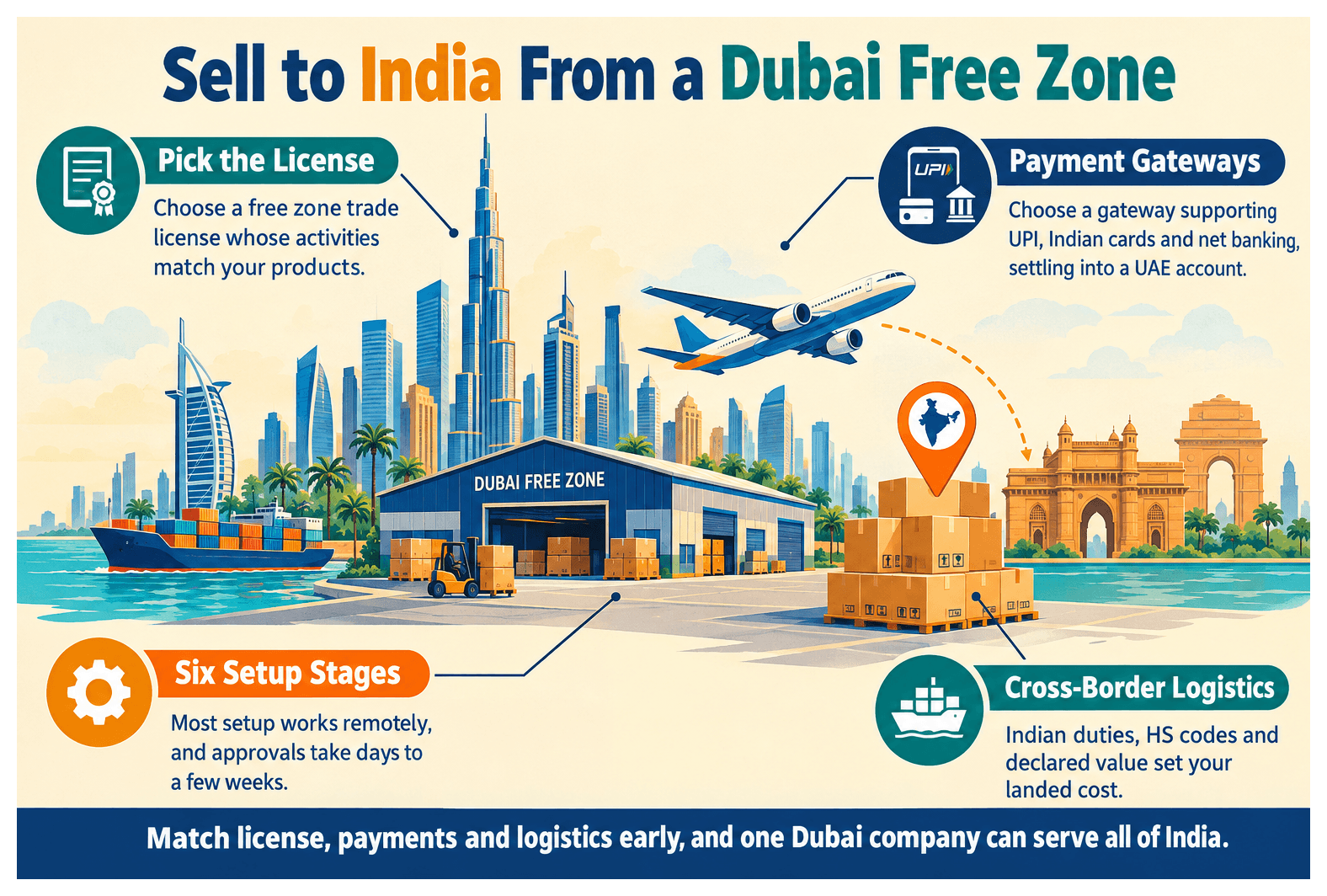
Pick a free zone trade license whose activities match your products. Banks, gateways and customs all check it. For an e-commerce business Dubai India customers rely on, add trading or warehousing if you hold stock. See the online internet retail trading license in Dubai.
Match Activities to Your Product Range
Online retail, general trading or platform operation.
Restricted goods need extra approvals.
A Delhi apparel seller combines online retail and general trading to sell on its own site and marketplaces.
Why a Free Zone Fits Online Sellers
You get full ownership and no local sponsor. A Mumbai founder registered remotely and travelled only for visa stamping. Mainland suits UAE retail; a free zone suits selling abroad.
Payment Gateways That Accept India Payments
Choose a gateway supporting UPI, Indian cards and net banking that settles into a UAE corporate account. UPI often needs a licensed local partner. Confirm fees and payout timelines first. For Indian ecommerce Dubai sellers, payment setup matters early.
Payment Methods Indian Buyers Expect
UPI, RuPay, Visa and Mastercard.
Cash on delivery needs a courier that remits.
Conversion fees cut margin.
A Jaipur jewellery seller pushes prepaid orders to cut return risk.
Settlement Into a UAE Account
Expect corporate KYC and a choice of AED, USD or INR payouts. A Chennai founder compared settlement timelines across two processors first. The Central Bank of the UAE sets payment services rules.
Setup Roadmap for Your Dubai E-Commerce Company
Setup runs in six stages, and most of it works remotely for a free zone Indian online business. Approvals take days to a few weeks.
Step 1: Register the Company and Receive the License
Choose activities.
Reserve the trade name.
Submit passports and visa documents.
Sign the flexi-desk agreement.
Receive the license.
An Ahmedabad founder got licensed from scanned passports without visiting.
Step 2: Complete Visas, Emirates ID and Banking
The GDRFA processes Dubai residency. The ICP handles identity services. Emirates ID follows the medical test and biometrics, and banks require it. A Hyderabad founder booked both in one trip.
Cross-Border Logistics From Dubai to India
Ship by express courier, air freight consolidator or bonded warehouse. Indian duties, HS codes and declared value set landed cost. The India-UAE CEPA can lower duties on eligible goods. Read about an e-commerce fulfilment business in Dubai.
Fulfilment Models and Delivery Times
Direct courier from Dubai is simple. Bulk shipping into an Indian hub is faster locally. A Kochi spice brand does the latter.
Key Facts for Selling From Dubai to India
Area | What to Check |
|---|---|
License and activities | Activities match products; restricted goods approvals |
Payment gateways | UPI support, settlement currency, payout days |
Logistics and customs | HS codes, declared value, CEPA origin proof |
UAE tax and VAT | VAT threshold of AED 375,000, corporate tax status |
Indian reporting and remittance | Foreign asset disclosure, LRS documentation |
Customs, Duties and the CEPA Advantage
The CEPA gives preferential duties on listed goods.
Keep a certificate of origin.
Indian authorities set import rules, so verify first.
A Surat textile seller checked eligibility before pricing a new line.
Tax, Compliance and Remittance Rules Indian Founders Must Know
Your Dubai company faces UAE corporate tax and VAT, while you handle personal tax and remittances at home. Keep clean records and take advice, especially when targeting the Dubai company Indian market.
UAE Corporate Tax and VAT Basics
Federal Decree-Law No. 47 of 2022 introduced corporate tax.
The FTA runs registration and filing.
Qualifying free zone income may get a different rate. It isn't automatically tax free.
Indian Reporting and Sending Money Abroad
The Income Tax Department sets rules on foreign assets and global income. RBI LRS governs individual outward remittances, currently USD 250,000 yearly (verify with RBI). Document the purpose and consult a chartered accountant.
Costs and Smart Launch Planning for Your E-Commerce Business Dubai India Customers
First-year costs cover the license, visas, Emirates ID, flexi-desk, bank and gateway fees, stock and shipping. Visa count and activities drive price. See business setup cost in Dubai for e-commerce.
Launch Checklist and Next Move
Validate Indian demand first.
Pilot 20 SKUs, then expand.
Budget two visas and a flexi-desk to keep fixed costs low.
Your Next Move
An e-commerce business in Dubai targeting India customers works when license, payments, logistics and tax align from day one. Use the Business Activities and Cost Calculator to set up or buy a license, then explore the business setup in Dubai from India guide.
References
Frequently Asked Questions