
Topic Summary
What Is UAE VAT for Energy Business and Why It Matters
UAE VAT for energy business is a 5% consumption tax on taxable supplies of oil products, gas, electricity and renewable energy goods and services. You register once taxable supplies and imports exceed AED 375,000 in 12 months, charge VAT on invoices, recover input VAT and file returns with the Federal Tax Authority (FTA). The legal base is Federal Decree-Law No. 8 of 2017.
Oil, Gas and Renewables Supply Treatment Under UAE VAT for Energy Business
Oil, Gas and Renewables Supply Treatment Under UAE VAT for Energy Business
Zero Rated VAT UAE for Energy Exports and International Supplies
Zero rated VAT UAE treatment means 0% VAT on a supply while you still recover input VAT in full. For energy businesses it applies mainly to qualifying exports and international transport-related supplies. You need customs declarations, commercial invoices and shipping documents, kept for five years.
Step-by-Step VAT Registration for an Energy Business
For VAT registration energy business owners follow six steps: confirm taxable supplies, gather documents, create an EmaraTax account, submit the application, receive the Tax Registration Number (TRN), and issue compliant tax invoices. File within 30 days of crossing AED 375,000 to avoid the AED 10,000 penalty. Our UAE VAT registration guide covers each screen.
Input VAT Recovery and Return Filing for Energy Operators
Energy operators recover input VAT on equipment, fuel, freight and services used for taxable or zero-rated supplies by deducting it from output VAT. Returns are filed quarterly or monthly through EmaraTax, due 28 days after the period ends. Every claim needs a valid tax invoice. See how to claim input VAT back .
Cost Comparison for UAE VAT Compliance in an Energy Business
VAT compliance costs for an energy business include the AED 10,000 late registration penalty if missed, accounting support and system setup. Registering on time costs far less than penalties. Confirm current fees with the FTA, and use the cost calculator to budget license and setup alongside VAT.
Common Mistakes and What to Do Next for UAE VAT for Energy Business
Common errors include zero-rating without export evidence, missing the 30-day registration window, claiming blocked input VAT and issuing non-compliant invoices. Avoid them by classifying each supply stream, keeping records for five years, checking invoices against FTA rules and filing before the 28-day deadline.
UAE VAT for energy business is charged at a 5% standard rate, and registration is mandatory once taxable supplies and imports pass AED 375,000 over 12 months [1]. More than 350,000 businesses were VAT-registered in the UAE in 2025 [2], and a late registration costs a fixed AED 10,000 [1]. Energy traders, fuel distributors and solar developers carry high invoice values, so one wrong tax code can distort a whole return. This guide helps finance and operations staff classify supplies, register, recover input VAT and file on time.
What Is UAE VAT for Energy Business and Why It Matters
UAE VAT for energy business is a 5% consumption tax on taxable supplies of oil products, gas, electricity and renewable energy goods and services. You register once taxable supplies and imports exceed AED 375,000 in 12 months, charge VAT on invoices, recover input VAT and file returns with the Federal Tax Authority (FTA). The legal base is Federal Decree-Law No. 8 of 2017.
The 5% Standard Rate and the AED 375,000 Threshold
Mandatory registration starts at AED 375,000. Voluntary registration is open from AED 187,500 in supplies or expenses. Picture a fuel-additive distributor invoicing AED 420,000 in 12 months: it must register, even if most customers sit in one free zone.
You generally have 30 days to apply after crossing the threshold. Miss it and the FTA charges AED 10,000 (FTA, 2026). For a deeper walkthrough, read the VAT in the UAE business guide.
Why Energy Firms Face Higher Classification Risk
High-value invoices magnify small errors.
Local, export and free zone supplies get mixed.
One license often covers several supply types.
A firm selling local diesel and exported lubricants needs two tax treatments.
Oil, Gas and Renewables Supply Treatment Under UAE VAT for Energy Business
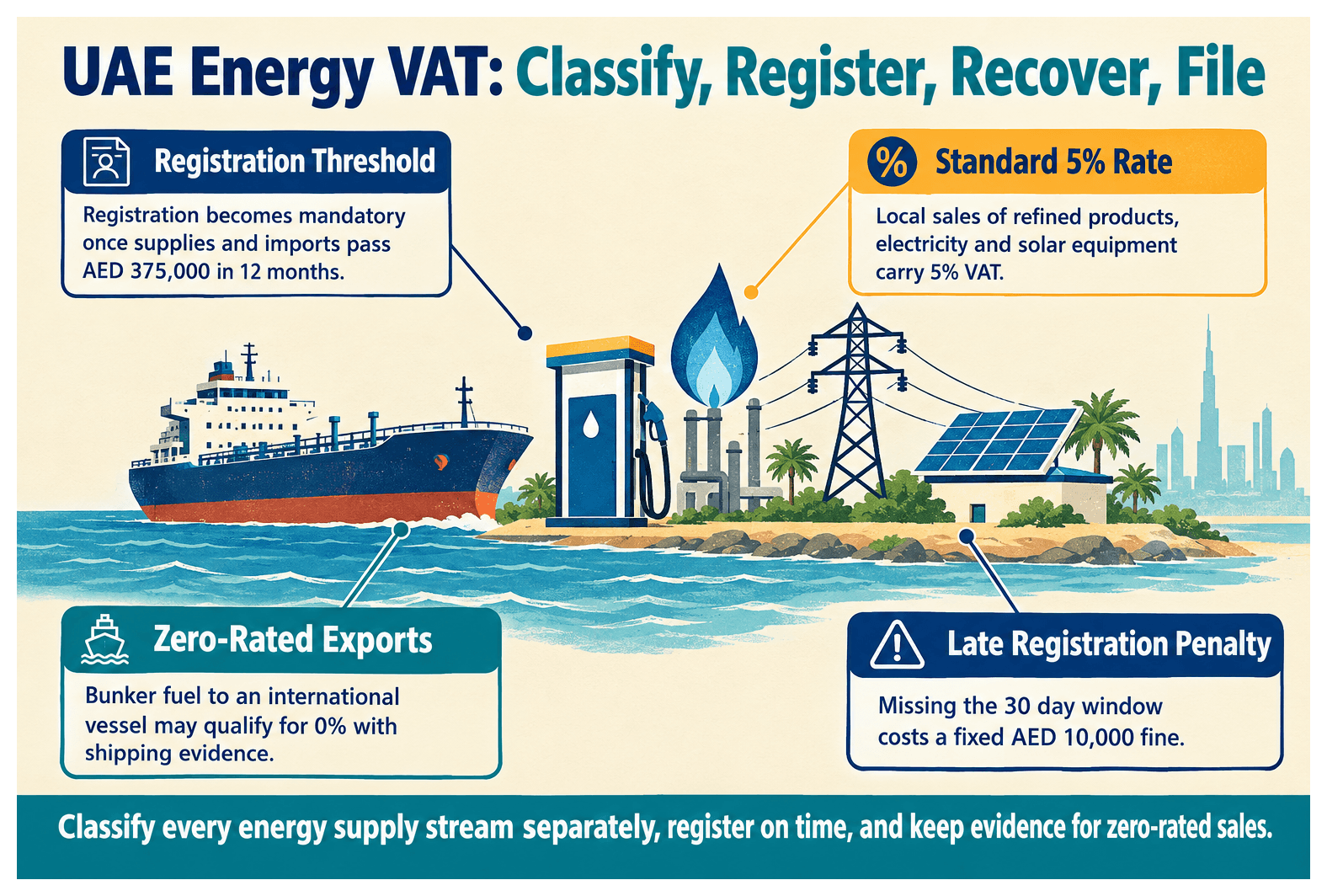
Most domestic supplies of refined products, electricity and solar equipment are standard-rated at 5%. Exports outside the GCC and certain international supplies can be zero-rated. Treatment depends on place of supply, customer location and the nature of the goods or service, so classify each stream separately.
Oil and Refined Product Supplies
Local sales of refined products carry 5%. Crude oil and natural gas have their own treatment under the Decree-Law (Article 45 covers zero-rating), so confirm the current position with the FTA before invoicing. Reverse charge can apply to specified oil-derivative purchases. Take a distributor selling bunker fuel to an international vessel: the supply may qualify for 0%, but only with shipping evidence on file.
Natural Gas and Electricity Supplies
Domestic electricity and gas billed to commercial customers are generally standard-rated at 5%. An independent power producer invoicing a commercial offtaker should show VAT separately on the tax invoice. Cross-border pipeline and grid supplies need individual review.
Solar and Renewable Energy Supplies
Equipment sales and installation are 5% locally.
A Dubai South installer fitting rooftop systems charges 5%.
Zero-rating is limited to qualifying exports.
Check Cabinet Decision conditions first.
Setting up a renewables firm? See the solar and renewable energy business setup guide.
Zero Rated VAT UAE for Energy Exports and International Supplies
Zero rated VAT UAE treatment means 0% VAT on a supply while you still recover input VAT in full. For energy businesses it applies mainly to qualifying exports and international transport-related supplies. You need customs declarations, commercial invoices and shipping documents, kept for five years.
Zero-Rated Versus Exempt Supplies
Zero-rated: 0% charged, input VAT recoverable.
Exempt: no VAT charged, input VAT lost.
Mixing them up distorts your return.
Energy is rarely exempt; most supplies are 5% or 0%.
Exported lubricants can be zero-rated. The same product sold locally is 5%.
Evidence Needed to Support Zero-Rating
Customs export declaration.
Commercial and tax invoices.
Bills of lading or delivery documents.
Proof of export within 90 days of the supply.
Services Exported Outside the UAE
An energy consultancy advising a client in Europe may zero-rate the service if the recipient is outside the UAE and conditions are met. Read the guide to UAE VAT on services exported outside the UAE before you drop the rate.
Step-by-Step VAT Registration for an Energy Business
For VAT registration energy business owners follow six steps: confirm taxable supplies, gather documents, create an EmaraTax account, submit the application, receive the Tax Registration Number (TRN), and issue compliant tax invoices. File within 30 days of crossing AED 375,000 to avoid the AED 10,000 penalty. Our UAE VAT registration guide covers each screen.
Step 1: Calculate Taxable Supplies and Imports
Run a rolling 12-month test, not a calendar-year one.
Include zero-rated supplies and imports.
A gas equipment importer should review turnover monthly.
Step 2: Gather License, Passport and Financial Documents
Trade license and Emirates ID.
Contracts and bank details.
Turnover evidence, in English or Arabic.
Not yet incorporated? Check your company name first.
Step 3: Apply Through EmaraTax and Issue Correct Invoices
Submit through EmaraTax at tax.gov.ae, track approval and note your TRN. Then update templates so every invoice meets tax invoice requirements in the UAE.
Input VAT Recovery and Return Filing for Energy Operators
Energy operators recover input VAT on equipment, fuel, freight and services used for taxable or zero-rated supplies by deducting it from output VAT. Returns are filed quarterly or monthly through EmaraTax, due 28 days after the period ends. Every claim needs a valid tax invoice. See how to claim input VAT back.
Recoverable Capital and Operating Costs
Plant, storage tanks and solar panels at 5% on purchase.
A solar developer can reclaim VAT on imported panels.
Blocked categories, such as certain entertainment costs, stay non-recoverable.
VAT Treatment by Energy Supply Type (rates as of May 2026)
Feature | Domestic Supply (5%) | Qualifying Export (0%) |
|---|---|---|
Crude oil and refined products | Refined products local sale: 5% on invoice | Bunker or export sale: 0% with shipping proof |
Natural gas and electricity | Commercial offtaker billed 5% | Cross-border grid or pipeline: individual review |
Solar equipment and installation | Rooftop systems in Dubai: 5% | Panels shipped abroad: 0% with customs declaration |
Engineering and consultancy services | UAE client: 5% | Overseas recipient: 0% if conditions are met |
Input VAT recovery and evidence needed | Full recovery with valid tax invoices | Full recovery; keep export documents for 5 years |
Filing Deadlines and Refund Claims
Your return is due 28 days after each period closes. An exporter that sits in a refund position every quarter, because zero-rated sales generate no output VAT, can claim the credit. Expect the FTA to review such claims closely. Our VAT refund guide for UAE companies explains the process.
Cost Comparison for UAE VAT Compliance in an Energy Business
VAT compliance costs for an energy business include the AED 10,000 late registration penalty if missed, accounting support and system setup. Registering on time costs far less than penalties. Confirm current fees with the FTA, and use the cost calculator to budget license and setup alongside VAT.
Penalties Versus Proactive Compliance
Item | Amount (AED, May 2026) |
|---|---|
Late registration penalty | 10,000 |
Mandatory threshold | 375,000 |
Voluntary threshold | 187,500 |
A trader who files within 30 days avoids the AED 10,000 charge entirely.
Budgeting With a Dubai South Business Hub License
A free zone license doesn't remove VAT duties. Dubai South Business Hub companies must register when thresholds are met. A startup energy consultancy should budget license, visa and VAT setup together.
Common Mistakes and What to Do Next for UAE VAT for Energy Business
Common errors include zero-rating without export evidence, missing the 30-day registration window, claiming blocked input VAT and issuing non-compliant invoices. Avoid them by classifying each supply stream, keeping records for five years, checking invoices against FTA rules and filing before the 28-day deadline.
Five Errors That Trigger FTA Penalties
Unsupported zero-rating.
Late registration (AED 10,000).
Defective tax invoices.
Blocked input VAT claims.
Late returns.
A distributor with no export documents on file will see zero-rated sales reassessed at 5%.
Next Steps for Finance and Operations Teams
Audit every supply stream.
Set a filing calendar.
Run a quarterly VAT review.
Talk to a specialist about VAT return filing for Dubai companies.
Wrapping Up UAE VAT for Energy Business
UAE VAT for energy business rests on a 5% standard rate, an AED 375,000 registration threshold and careful classification of oil, gas and renewables supplies. Zero-rate only where your evidence supports it. Estimate setup costs with the cost calculator, check your company name, and speak with Dubai South Business Hub about a license and VAT-ready structure.
References
Federal Tax Authority, VAT registration and penalties, 2026.
Federal Tax Authority, registered taxpayer figures, 2025.
UAE Ministry of Finance, Federal Decree-Law No. 8 of 2017 on VAT.
Frequently Asked Questions


