
Topic Summary
What Is UAE VAT for Real Estate Business and Why It Matters
UAE VAT for real estate business is the 5% tax on taxable property supplies, mainly commercial sales and leases. Registration becomes mandatory above AED 375,000 in taxable supplies over 12 months. Residential leases are exempt, while qualifying first sales of new residential property are zero rated.
Commercial Versus Residential Supply Regulations in the UAE for Property Businesses
Commercial Versus Residential Supply Regulations in the UAE for Property Businesses
Step-by-Step VAT Registration for a Real Estate Business
VAT registration for a real estate business follows six steps: calculate taxable supplies, gather your trade license and financial documents, create an EmaraTax account, submit the application, receive the Tax Registration Number (TRN), and begin invoicing and filing. Missing the mandatory deadline triggers an AED 10,000 penalty. Our UAE VAT registration guide goes deeper.
Input VAT Recovery and Tax Invoice Regulations in the UAE
Real estate businesses recover input VAT on costs tied to taxable and zero rated supplies, but not on exempt residential leases. Claims need valid tax invoices showing the supplier TRN, date, amounts and VAT. Partial exemption calculations apply when you make both taxable and exempt supplies.
Cost Comparison for UAE VAT Compliance in a Real Estate Business
VAT compliance costs include the risk of misclassification on large deals, FTA penalties such as AED 10,000 for late registration and AED 1,000 for a first late return, plus accountant fees. Verify all figures against current FTA and Ministry of Finance publications.
Common Mistakes and Final Takeaways for UAE VAT for Real Estate Business
Common errors in UAE VAT for real estate business include treating all leases as standard rated, missing the three-year zero rating window, registering late, ignoring partial exemption and issuing non-compliant invoices. Regular reviews and correct classification prevent most penalties.
UAE VAT for real estate business means 5% on standard-rated supplies such as commercial leases and sales, with mandatory registration above AED 375,000 in taxable supplies over 12 months. Residential leases are exempt, and first sales of new residential property within three years of completion are zero rated.
More than 350,000 businesses are VAT-registered in the UAE (Federal Tax Authority, 2025) [1]. Property firms are where one misclassified lease can distort a whole return. This guide is for finance and operations staff who need to classify supplies, register, recover input VAT and avoid penalties such as the AED 10,000 late registration fine [1].
What Is UAE VAT for Real Estate Business and Why It Matters
UAE VAT for real estate business is the 5% tax on taxable property supplies, mainly commercial sales and leases. Registration becomes mandatory above AED 375,000 in taxable supplies over 12 months. Residential leases are exempt, while qualifying first sales of new residential property are zero rated.
The 5% Standard Rate and the AED 375,000 Threshold
The standard rate is 5%, and the mandatory threshold is AED 375,000. Voluntary registration is possible from AED 187,500. The Federal Tax Authority (FTA) runs everything through its EmaraTax portal.
Take a Dubai leasing company collecting AED 450,000 a year in commercial rent. It's over the line and must register. For a wider primer, see this VAT in the UAE business guide.
Why Property Businesses Face Higher VAT Risk
Mixed supplies: exempt and taxable income often sit in one entity.
Large values: one wrong rate on a sale magnifies the error.
Partial exemption: it limits how much input VAT you recover.
Penalty: late registration costs AED 10,000 (FTA) [1].
Picture a developer selling commercial units and residential units in one project. Each unit type needs its own treatment.
Commercial Versus Residential Supply Regulations in the UAE for Property Businesses
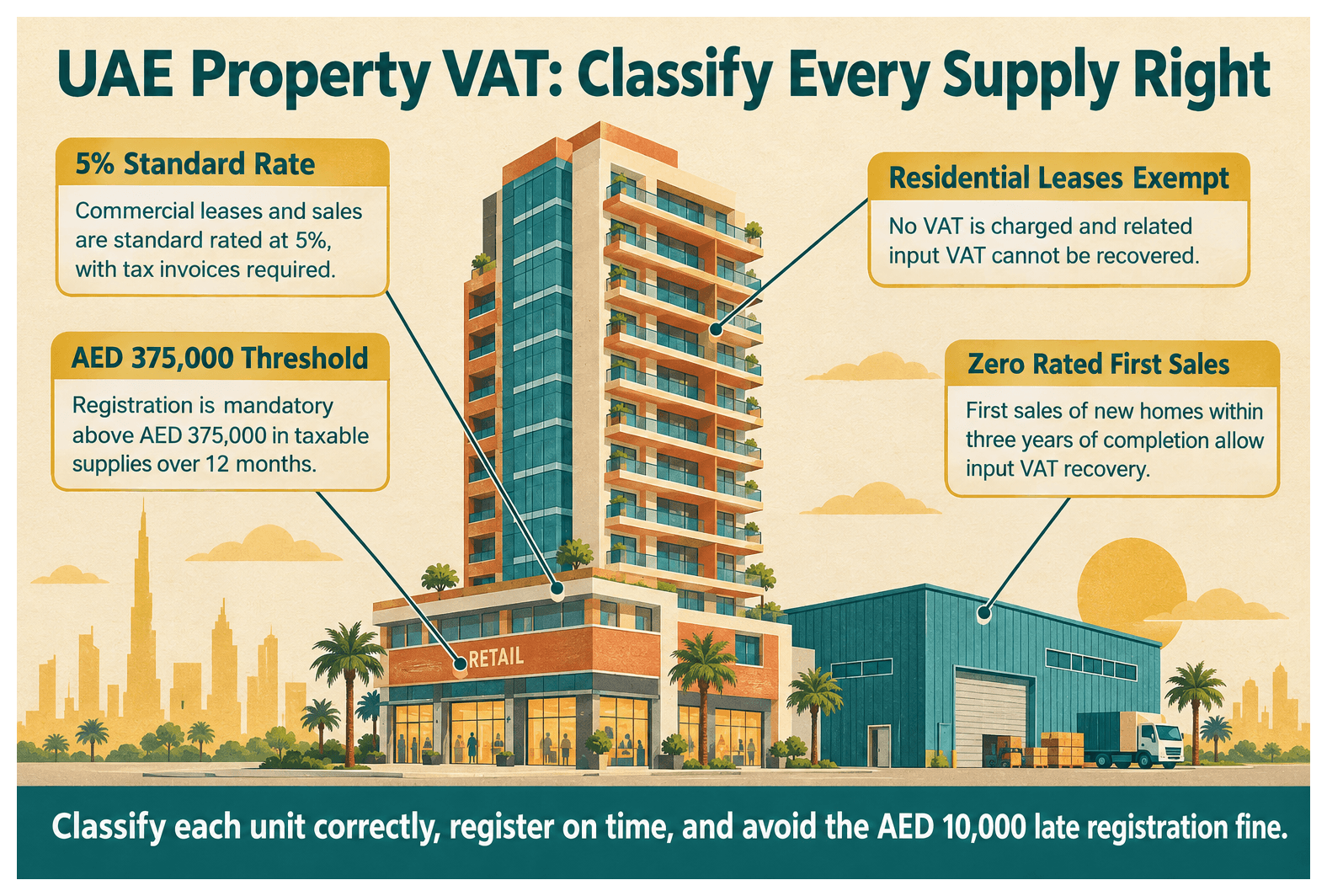
Commercial property sales and leases are standard rated at 5%. Residential leases are exempt, and the first supply of a new residential building within three years of completion is zero rated. Later residential sales are exempt. Classification decides whether you charge VAT and recover input VAT.
Commercial Sales and Leases at 5%
Offices, retail units and warehouses are standard rated. You must issue a tax invoice, and service charges generally follow the treatment of the main supply. A Dubai South warehouse let at AED 200,000 a year carries AED 10,000 of VAT.
Residential Leases and Zero Rated VAT UAE Rules
Residential lease: exempt. You charge no VAT and can't recover related input VAT.
First sale within three years of completion: zero rated.
Zero rated supplies allow input VAT recovery.
Exempt supplies don't.
A developer's first sale of new apartments is zero rated, so it can reclaim construction VAT. Zero rated vat uae treatment (0%) and exemption sound similar, but the recovery outcome is opposite.
Mixed-Use Buildings and Apportionment
A tower with a retail podium and residential floors must split input VAT between taxable and exempt use. Follow FTA guidance on the method, keep records that support it, and expect an annual adjustment. Check property registration details with Dubai Land Department (2025).
Step-by-Step VAT Registration for a Real Estate Business
VAT registration for a real estate business follows six steps: calculate taxable supplies, gather your trade license and financial documents, create an EmaraTax account, submit the application, receive the Tax Registration Number (TRN), and begin invoicing and filing. Missing the mandatory deadline triggers an AED 10,000 penalty. Our UAE VAT registration guide goes deeper.
Step 1: Confirm Your Registration Obligation
Test your taxable supplies on a rolling 12-month basis.
Register within 30 days once you pass AED 375,000.
Consider voluntary registration from AED 187,500.
A property manager crossing AED 375,000 in month 10 has 30 days to act.
Step 2: Prepare Documents and Company Setup
Gather the trade license, owner passport and Emirates ID, financial statements and lease contracts.
Setting up a new entity? Confirm the company name with the name check tool.
A Dubai South Business Hub free zone license supports property activities.
Step 3: Apply Through EmaraTax and Start Filing
Create your account and submit the application.
Receive your TRN.
File quarterly or monthly returns by the 28th day after period end.
A first late return costs AED 1,000. Our guide to filing a UAE VAT return walks through the portal.
Input VAT Recovery and Tax Invoice Regulations in the UAE
Real estate businesses recover input VAT on costs tied to taxable and zero rated supplies, but not on exempt residential leases. Claims need valid tax invoices showing the supplier TRN, date, amounts and VAT. Partial exemption calculations apply when you make both taxable and exempt supplies.
Which Costs Qualify for Recovery
Construction, brokerage, legal and maintenance costs can qualify.
Direct input tax is allocated to specific supplies; residual input tax is apportioned.
Blocked items, such as certain entertainment costs, stay unrecoverable.
A developer with AED 2 million of construction costs for zero rated sales reclaims AED 100,000 (5%). Read more on claiming input VAT back.
VAT Treatment of Real Estate Supplies in the UAE
Feature | Commercial Supply | Residential Supply |
|---|---|---|
Lease treatment (5% vs exempt) | Standard rated at 5%; AED 200,000 rent adds AED 10,000 VAT | Exempt; no VAT charged |
Sale treatment (5% vs 0% first sale or exempt) | Standard rated at 5% | 0% on first sale within three years of completion; later sales exempt |
Input VAT recovery | Recoverable with valid tax invoices | Recoverable on zero rated first sales; not on exempt leases or later sales |
Registration threshold AED 375,000 | Counts toward the threshold | Zero rated sales count; exempt leases don't |
Late registration penalty AED 10,000 | Applies once you miss the 30-day deadline | Applies if zero rated sales push you over the limit |
Tax Invoice Requirements
Show the supplier TRN, date, description, amounts and VAT.
Issue within 14 days of the supply.
Use simplified invoices only where rules allow.
Correct errors with credit notes.
See how to issue a correct tax invoice.
Refund Claims and Timing
Excess input VAT can be refunded through EmaraTax, which suits a developer in a heavy build phase. Refund UAE rules may require supporting documents, so keep them organised. Generally keep records for five years, and longer for real estate, where the FTA requires 15 years for certain property records. Our VAT refund guide covers the process.
Cost Comparison for UAE VAT Compliance in a Real Estate Business
VAT compliance costs include the risk of misclassification on large deals, FTA penalties such as AED 10,000 for late registration and AED 1,000 for a first late return, plus accountant fees. Verify all figures against current FTA and Ministry of Finance publications.
Penalties and Fees at a Glance
Commercial lease: 5%.
Residential lease: exempt.
First residential sale: 0%.
Later residential sale: exempt.
Late registration: AED 10,000 (FTA, 2025).
First late return: AED 1,000 (FTA, 2025).
Budgeting for Compliance
Budget for accounting software, an accountant and an annual classification review. A small leasing firm filing quarterly should treat those as fixed costs. Registering early avoids penalties. Use the cost calculator to estimate company setup and license costs.
Common Mistakes and Final Takeaways for UAE VAT for Real Estate Business
Common errors in UAE VAT for real estate business include treating all leases as standard rated, missing the three-year zero rating window, registering late, ignoring partial exemption and issuing non-compliant invoices. Regular reviews and correct classification prevent most penalties.
Mistakes That Trigger FTA Penalties
Misclassifying residential and commercial supplies.
Registering late (AED 10,000) or filing late (AED 1,000).
Keeping poor records.
One landlord charged VAT on a residential lease and had to issue credit notes to every tenant. That's avoidable admin.
What Should You Do Next to Start Compliant VAT Reporting
Review your supply classification, register once you near AED 375,000, and set up compliant invoicing. An operations lead can run this as a pre-registration checklist. If you're forming a new entity, check availability with the name check and estimate costs in the cost calculator. Then speak with the Dubai South Business Hub team about a free zone license and residency visa package.
The takeaway: UAE VAT for real estate business hinges on classifying each supply correctly. That means 5% on commercial, exempt for residential leases, zero rated for qualifying first residential sales, and registration above AED 375,000.
References
Frequently Asked Questions


